
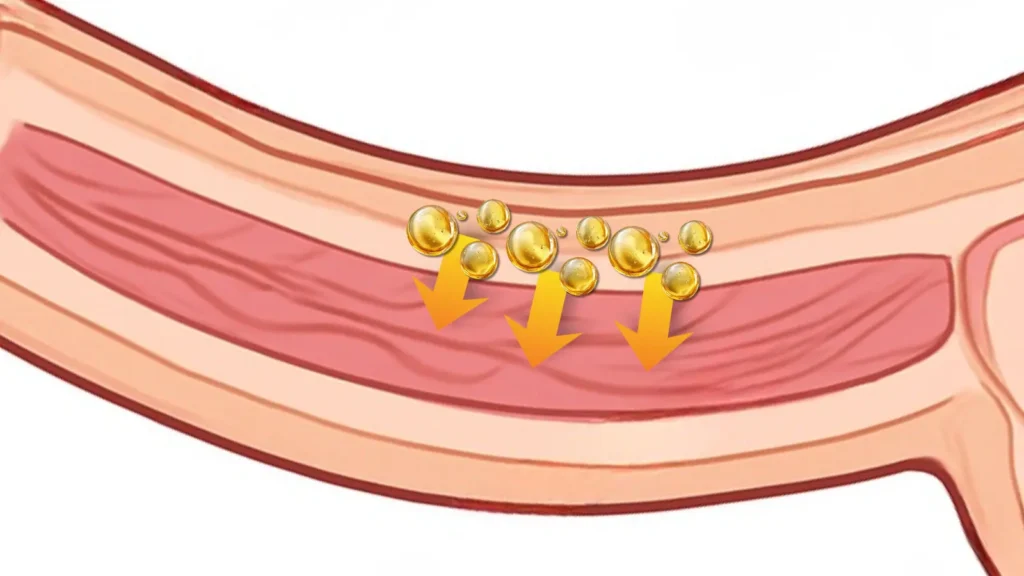
Illustration showing how deep PMMA penile filler placement can compress important penile structures

PMMA Penile Girth Enhancement Gone Wrong: Dr. Carney’s Case Study of Glans Necrosis

What men need to know about PMMA penis filler, Bellafill® penile enhancement, deep injection, and glans necrosis.

Quick Answer: Yes, PMMA penile filler can cause devastating injury. When permanent filler is injected too deep, in too much bulk, or by someone without true urologic expertise, the result can include urethral bleeding, urinary obstruction, reduced blood flow, glans necrosis, erectile problems, loss of sensation, and permanent tissue loss. This case is based on a real patient Dr. Kenneth Jeff Carney, MD, PharmD, FACS has personally evaluated and is now helping manage.

Graphic Medical Image Warning

This page discusses severe penile filler complications and may include graphic clinical photographs for medical education and patient safety awareness.

Why This Matters

If you have been researching permanent non-surgical penile enhancement, you have probably come across Bellafill® PMMA being used off-label to make the penis thicker.

What many men are not being shown clearly enough is that permanent filler in the penis is very different from a routine cosmetic injection.

The penis is a delicate organ with a urethra, arteries, nerves, erectile tissue, muscles, and thin skin that all have to work together. When filler is placed too deep or in too much volume, the consequences can go far beyond appearance.

At Morganstern-Rejuvall, we are seeing more and more repair cases after penile filler performed elsewhere. In the past, repair work made up a small part of our cosmetic urology practice. Today, it accounts for a much larger share (about 40%) of what we do, and much of that growth has come from non-surgical injectable filler complications.

PMMA cases are especially concerning because the material is permanent and much harder to correct than with hyaluronic acid girth enhancement when something goes wrong.

We are not publishing this case for shock value, and we are not saying this just because we are urologists. We are publishing it because Dr. Carney has seen this complication firsthand. He has examined this patient himself, reviewed the history, and is involved in the patient’s ongoing care.

Once you have seen a case of real penile tissue death after filler performed elsewhere, it becomes impossible to pretend this is just another cosmetic service.

Clinical Authority

Why Morganstern-Rejuvall Is Speaking on This

Morganstern-Rejuvall did not set out to become a penile filler repair center. But over time, more men began coming to us after failed cosmetic urology procedures performed elsewhere. Dr. Kenneth J. Carney, MD, PharmD, FACS' extensive background in urologic surgery, trauma, and repair made him uniquely prepared to evaluate and manage difficult penile complications, and that expertise has become increasingly important as off-label injectable filler use in the penis has grown.

The most common PMMA problems we see are nodules, granuloma, and poor shaft shape. But some cases are far more serious. In the most severe situations, large amounts of PMMA placed too deeply and/or in too much volume can create arterial pressure-related injury, irreversible loss of sensation during an erection, severe inflammation, reduced blood flow, chronic erectile dysfunction, urethral problems including stricture, and tissue necrosis. That is the level of complication discussed in this article.

Why We Are Publishing This

A lot of men who research penis filler online see before-and-after photos, marketing promises, and talk about “permanent” results. What they often do not see is what happens when the procedure goes wrong.

Men usually seek filler like PMMA because results are permanent. Unfortunately, if things go wrong, the problems that occur can also be everlasting.

Case Study: What Happened to This Patient

This patient first began sharing his experience publicly on PhalloBoards after developing serious symptoms following PMMA penile filler performed elsewhere. What started as warning signs quickly turned into something much more severe.

According to the history later given to Morganstern-Rejuvall, he had undergone multiple large-volume PMMA sessions into the penile shaft. After the final treatment, he developed pain, fever, and scab-like lesions.

He also began having bleeding from the urethra and increasing trouble with urination. The physician who injected him with PMMA assured him it was only inflammation and prescribed an antibiotic as a solution.

As the injury progressed, the tissue around the glans worsened instead of healing. The urethral opening became obstructed by the necrotic process, and he became unable to urinate normally.

At that point, he had to see another urologist, who catheterized him so he could urinate and told him that what looked like “scabbing” was actually necrosis. He then reached out to Morganstern-Rejuvall for further evaluation and care.

By the time Dr. Carney examined him, this was no longer a question of whether something had gone wrong.

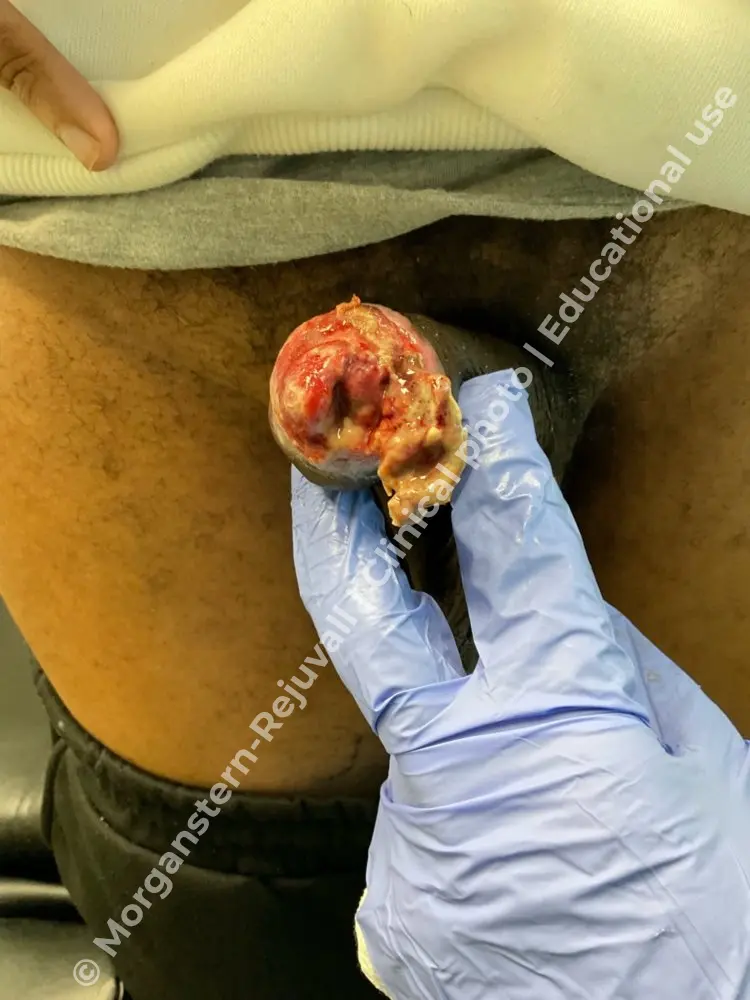
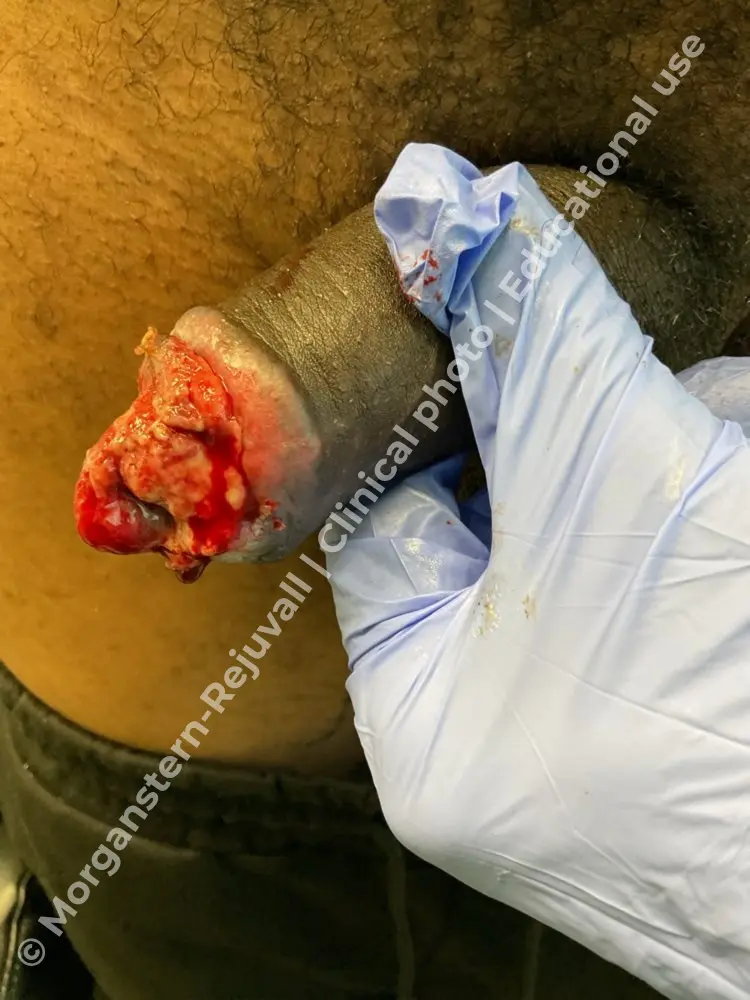
The patient presented with large amounts of encrusted tissue around the base and top of the glans that appeared necrotic. The clinical photographs taken during his care (shown below) showed progressive destruction of the glans, including yellow-gray slough, blackened devitalized tissue, exposed wound surface, and later partial loss of glans contour.

WARNING: Graphic Medical Images Below

This is exactly why we believe patients need to understand that permanent penile filler is not a casual cosmetic upgrade.

In mild cases, PMMA complications may involve nodules, granuloma, or misshapen contour. But in more severe cases, when large amounts of PMMA are placed too deep and in too much bulk, the result can be pressure-related injury, urethral problems, reduced blood flow, and tissue death.

That is the level of complication this patient experienced.

What makes this case especially important is that it shows how quickly a filler complication can escalate. It did not start with obvious massive tissue loss. It started with bleeding, pain, swelling, and urinary symptoms.
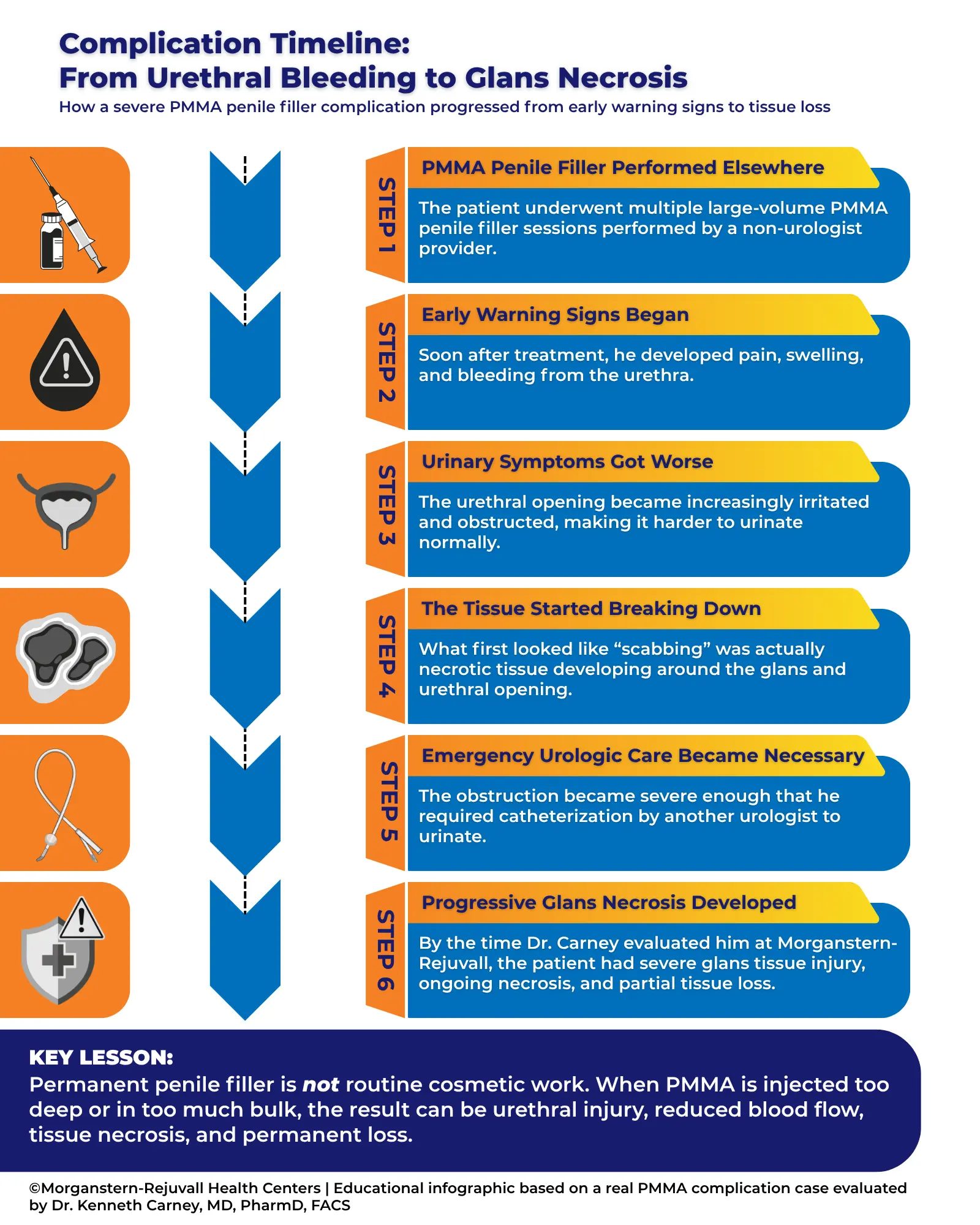
Those early warning signs were followed by obstruction, catheterization, and progressive necrosis. That is why men should never dismiss urethral bleeding, worsening swelling, pain with erection, darkening tissue, or trouble urinating after penile filler as “just part of healing.”

Why This Matters So Much

One of the biggest problems in this space is that many men assume the worst possible outcome from penile filler is a nodule, unevenness, or a cosmetic result they do not like.

That is not true.

A bad penile filler complication can affect:

  • urination
  • blood flow
  • sensation
  • erectile function
  • tissue survival
  • future enhancement options
  • future reconstructive options
  • mental health
  • sexual confidence
  • quality of life

That is what makes the penis different from a routine cosmetic injection site.

The penis is not just skin. It is not just something to make bigger. It is a vascular organ with complexity similar to that of the human heart. And when you injure an organ, the consequences are very different from a poor cosmetic result.

Why PMMA in the Penis Is Especially Dangerous

PMMA is not like hyaluronic acid.

That difference matters.

PMMA is not just a permanent filler. It’s inflammatory by design, which is how it stimulates collagen production associated with its longevity. When this inflammatory action occurs deep within fragile tissue, nerve endings, and penile arteries, complications can occur.

If a large amount of PMMA (>10mL) is injected at once, the risk of such complications increases significantly. Once PMMA is within the tissue, it is not something that can simply be dissolved away.

That means if the product is improperly placed, planted too deeply, or in too much volume, fixing the problem can be extremely difficult.

This is one of the reasons we take such a strong stance about the amount and timing of PMMA injection into the penis.

Permanent filler in a small, delicate, highly specialized organ leaves very little room for error.
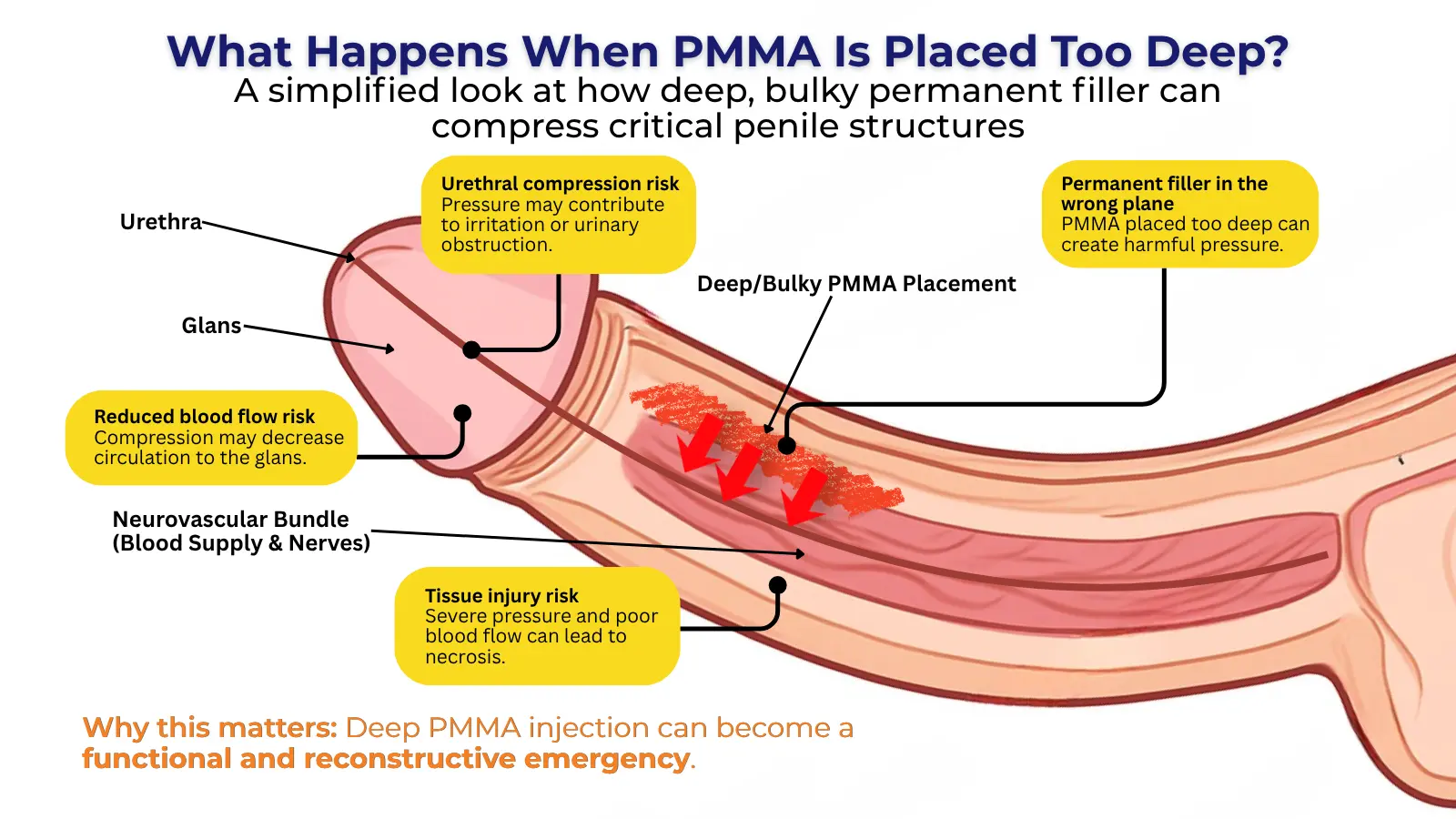
If too much permanent product is placed in the wrong plane, you may not just get an uneven result. You will likely get:

  • pressure on arteries
  • reduced blood flow
  • pressure on the urethra
  • obstructive swelling
  • severe inflammation
  • pain with erection
  • foreign-body reaction
  • tissue breakdown
  • necrosis
  • difficult revision or reconstruction later

Men need to stop thinking about penile PMMA as “just filler.”

Men need to stop thinking of PMMA injections as “just filler” when it is going into the penis.

Think of it this way: if someone injected permanent filler inside your nose and it compressed your airway, you would understand immediately that this is not routine cosmetic work. You would want a pulmonologist or ENT with real expertise in the anatomy and function of breathing, not just someone who happens to inject filler.

The same logic applies to the penis. If permanent filler is placed too deep or in too much bulk, the compression may affect urination, blood flow, sensation, and tissue survival. That is exactly why penile enlargement should be handled by a urologist.

Hyaluronic Acid Penile Girth Enhancement at Rejuvall→

In the United States, drugs and injectable fillers must undergo FDA review for safety and effectiveness in their intended use before they can be marketed. After approval, licensed medical providers may use these products “off label,” meaning for an indication, technique, or anatomical site that was not specifically studied or approved by the FDA.

Although off-label use is legally permitted, it places greater responsibility on the provider to exercise sound clinical judgment, obtain proper informed consent, clearly disclose the known and unknown risks, and ensure that the procedure is performed within the limits of their training and expertise.

When an off-label use results in patient harm, particularly in a setting that falls outside accepted standards of care, the provider may face malpractice liability if the treatment was not adequately disclosed, appropriately indicated, or safely performed.

Kenneth J. Carney, MD, PharmD, FACS Clinical Observations in This Case

Based on Dr. Carney’s direct examination and clinical assessment, the complication pattern in this case is most consistent with PMMA being implanted too deeply and in too much bulk, resulting in pressure-related injury to the internal pudendal artery, which compromised tissue health and blood supply to the glans.

In plain English, this means the product appears to have been placed in a way that the penis could not safely tolerate, resulting in death of penile tissue (necrosis) and loss of sensation to the area of the glans where necrosis occurred because of the ill-placed PMMA.

The pattern that drove this outcome was as follows:

  1. First, the patient developed bleeding from the urethra.
  2. Then he developed worsening swelling and obstruction at the opening.
  3. Then he could not urinate and needed catheterization.
  4. Then the glans darkened and became necrotic.

That is not the pattern of healing following inflammation. That is the pattern of a serious stricture complication.

Could inflammation and infection also have played a small role? Yes, very possibly. But the core lesson remains the same:

Depth matters. Volume matters. Anatomy matters.

Why Large Volume Makes Everything Worse

One of the most alarming features of this case is the large volume of PMMA reportedly used over multiple sessions. According to the patient, he received a total of 70mL of PMMA filler over 3 sessions (20-20-30).

Even without getting hung up on the exact number, the key point is obvious: this was large-volume, multi-session PMMA penile injection.

That should concern any patient.

A lot of men think bigger volume simply means bigger results. But bigger volume can also mean:

  • more pressure in the tissue
  • more inflammation
  • more risk to circulation
  • more distortion of normal anatomy
  • more danger to the urethra
  • less room for error
  • less ability to reverse the damage later

The penis is not an unlimited container.

There is a point where “more” stops equating to “better” and starts meaning “more dangerous.”

That is especially true with permanent filler.

Non-Urologists Are Not Suited for Most Cosmetic Urology Procedures

Morganstern-Rejuvall’s position is simple and firm:

Non-urologists are not well-suited for performing most penis enlargement procedures.

To become a board-certified urologist requires 5-6 years of specialized training after graduation from medical school.

Most urologists agree it takes another decade of practice to be regarded as “competent” as a urologist.

Further training in cosmetic urology adds time and expertise to this essential standard of qualification.

Increasingly, we’re treating problem cases performed by physicians whose specialty medical training is primary care, osteopathic medicine (D.O. instead of M.D.), and emergency room healthcare, who took a few classes in cosmetic urology procedures and subsequently declared themselves “penis enlargement experts” because they began performing so many penis enlargement procedures.

Some of these same physicians have performed thousands of procedures, yet are still not be qualified to inject the penis.

Why?

Because when a complication happens here, it is no longer just cosmetic. It becomes a urologic problem.

If there is urethral bleeding, urinary obstruction, tissue ischemia, necrosis, loss of sensation, erectile dysfunction, erectile pain, or future reconstructive problems, the patient does not need someone who will prescribe them an antibiotic and suggest bedrest.

He needs someone who understands the penis as an organ.

He needs someone who understands penile anatomy, penile blood supply, the urethra, wound healing, complication rescue, and reconstruction.

He needs a skilled urologist.
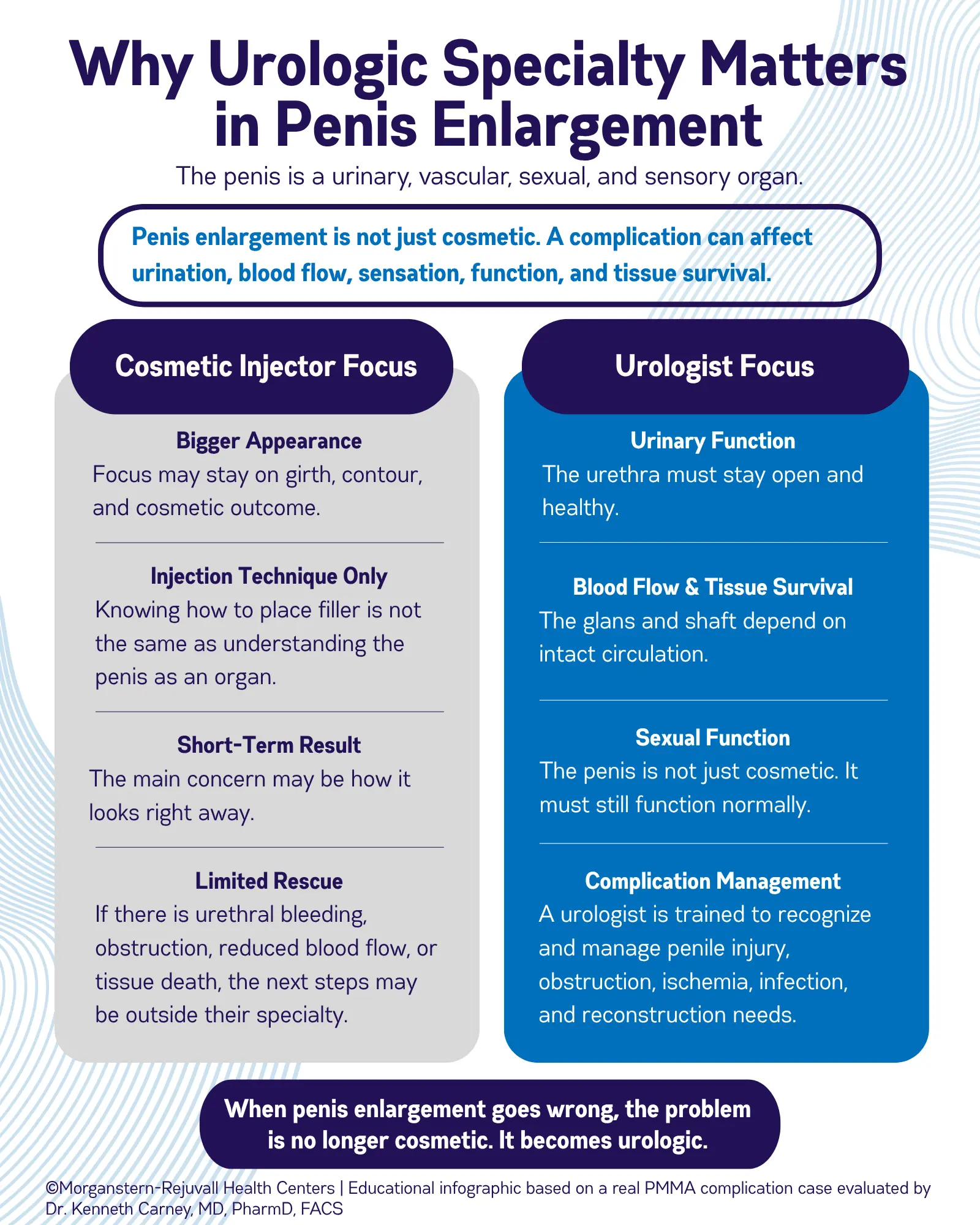
That is why Dr. Carney’s expertise matters so much here. He is not just commenting from the sidelines. He personally examined this patient, identified the severity, and is helping manage the aftermath.

That is what real authority looks like in this field.

About Dr. Kenneth J. Carney, MD, PharmD, FACS→

Penile Filler Revision & Repair at Rejuvall→

Warning Signs Men Should Never Ignore After Penile Filler

If you have had penile filler and you develop any of the following, do not assume it is normal healing:

  • blood from the urethra
  • worsening trouble urinating
  • scabbing, narrowing, or closure at the urethral opening
  • darkening, graying, or blackening of the glans
  • severe swelling
  • pain during erection
  • escalating pain
  • fever
  • drainage, pus, or foul odor
  • numbness, coldness, or sudden color change

These are red flags.
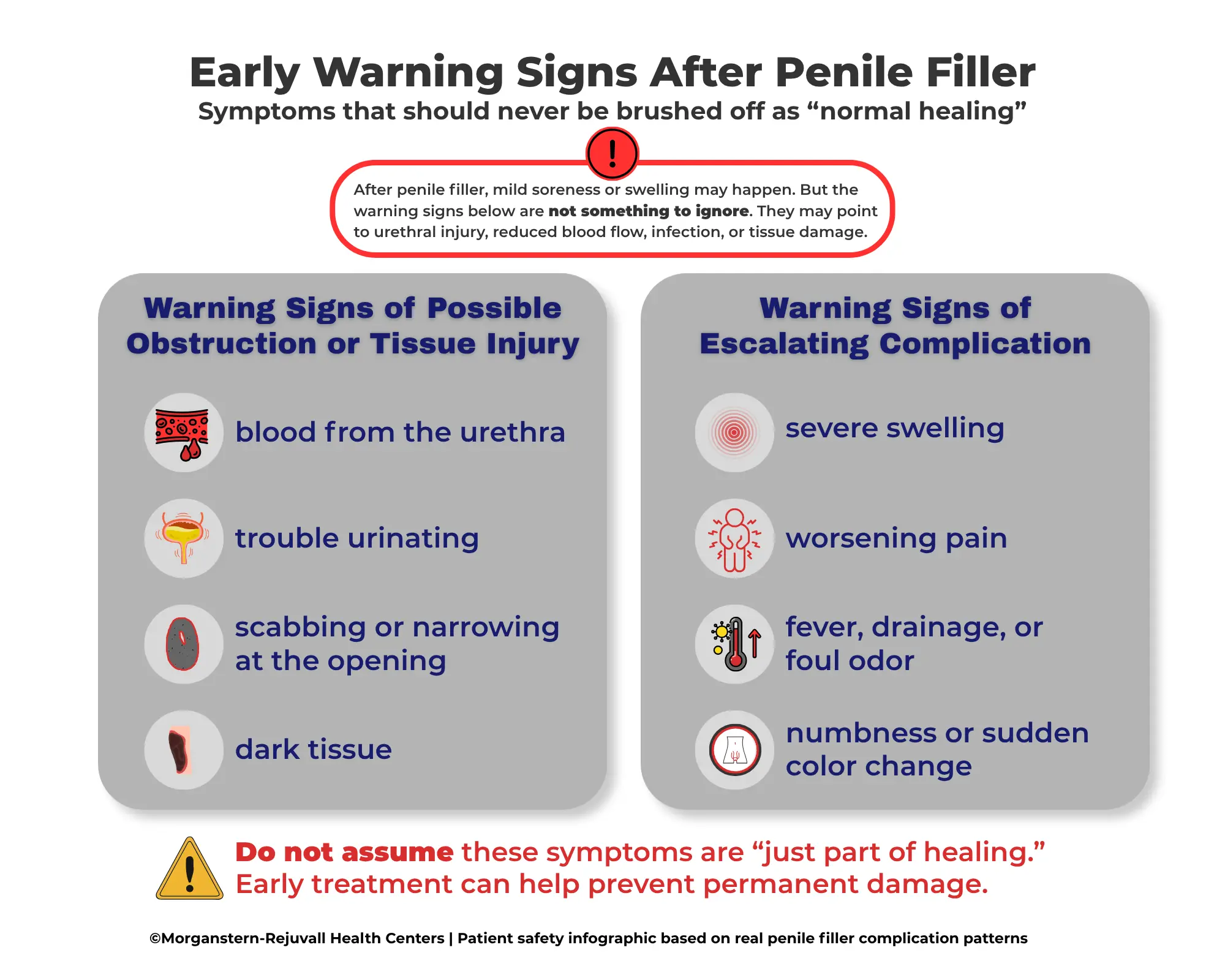
This case shows how early warning signs can escalate quickly. What starts as “a little blood” or “a little swelling” can turn into urinary obstruction and tissue loss.

If something looks wrong, feels wrong, or seems to be getting worse, do not wait and hope for the best.

What We Want Patients to Understand

The main message of this article is not just that this one case was bad. Rather, this case study is a culmination from over 20 cases we’ve seen over the last 12 months with increasingly severe issues from injection of PMMA into the penile shaft.

The main message is that this case was predictably possible in the wrong hands.

When permanent filler is injected into the penis by someone who is not a skilled urologist, the patient is taking a risk many people do not fully understand until it is too late.

We want men to understand that penis enlargement is not a routine cosmetic service.

It is a serious medical decision involving a highly specialized organ. And if a provider does not have deep training in that organ, the patient should think very carefully before moving forward.

This is especially true for men drawn in by heavy marketing, online popularity, or promises of permanent size.

Permanent sounds appealing until the complication is permanent too.

Final Takeaway

If you are researching PMMA penile enhancement, Bellafill penis filler, or a popular provider for non-surgical girth enlargement, here is our blunt advice:

Do not choose based on hype.
Do not choose based on popularity.
Do not choose based on marketing alone.

Choose based on anatomy, specialty, and who you would trust to manage a disaster.

Dr. Carney has often seen what that disaster can look like firsthand.

This case shows that PMMA injected too deep and in too much bulk can lead to urethral bleeding, urinary obstruction, catheterization, glans necrosis, and permanent tissue loss.

It also shows why penis enlargement should stay in the hands of specialists who truly understand the organ they are treating.

At Morganstern-Rejuvall, we believe that specialist should be a highly skilled urologist with experience in cosmetic enhancement.

Concerned About a Penile Filler Complication?

If you had penile filler elsewhere and are now dealing with pain, nodules, abnormal swelling, urethral symptoms, discoloration, drainage, skin breakdown, or a result that does not look right, do not assume it is part of normal healing.

Start with the Cosmetic Urology Assessment below and request a discreet consultation with Morganstern-Rejuvall.

Picture of Medically Reviewed by Dr. Kenneth J. Carney, MD, PharmD, FACS

Medically Reviewed by Dr. Kenneth J. Carney, MD, PharmD, FACS

Dr. Carney has personally evaluated the patient discussed in this case study and is involved in his ongoing care. This page is published for medical education and patient safety awareness.

Leave a Comment

Your email address will not be published. Required fields are marked *

Scroll to Top