
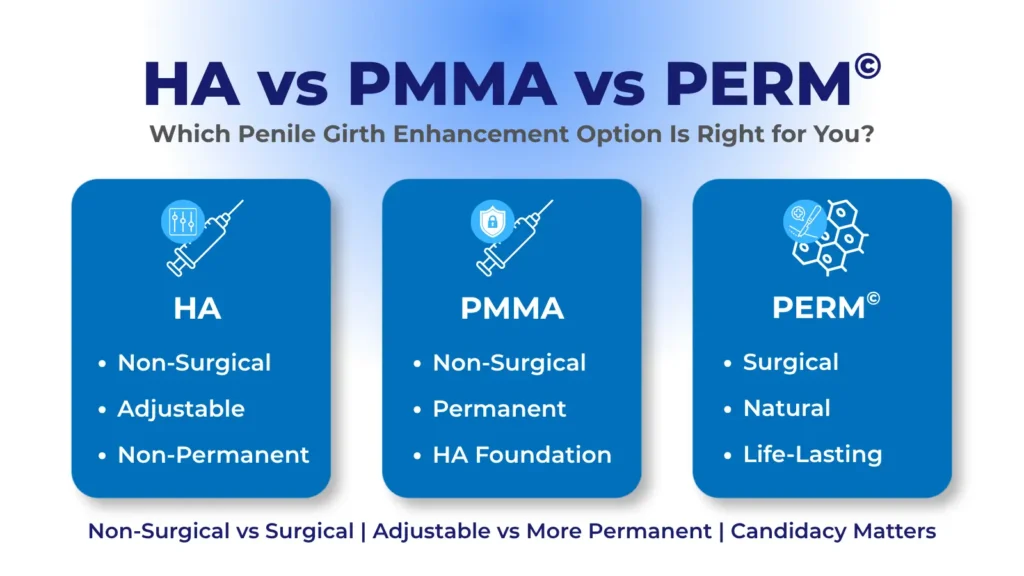
What Is PMMA for Penile Girth Enhancement?
PMMA refers to polymethyl methacrylate, the microsphere component in Bellafill®. Bellafill® is used off-label for penile girth enhancement as a long-term or permanent treatment pathway.
The key distinction is this: PMMA should never be treated as the first move.
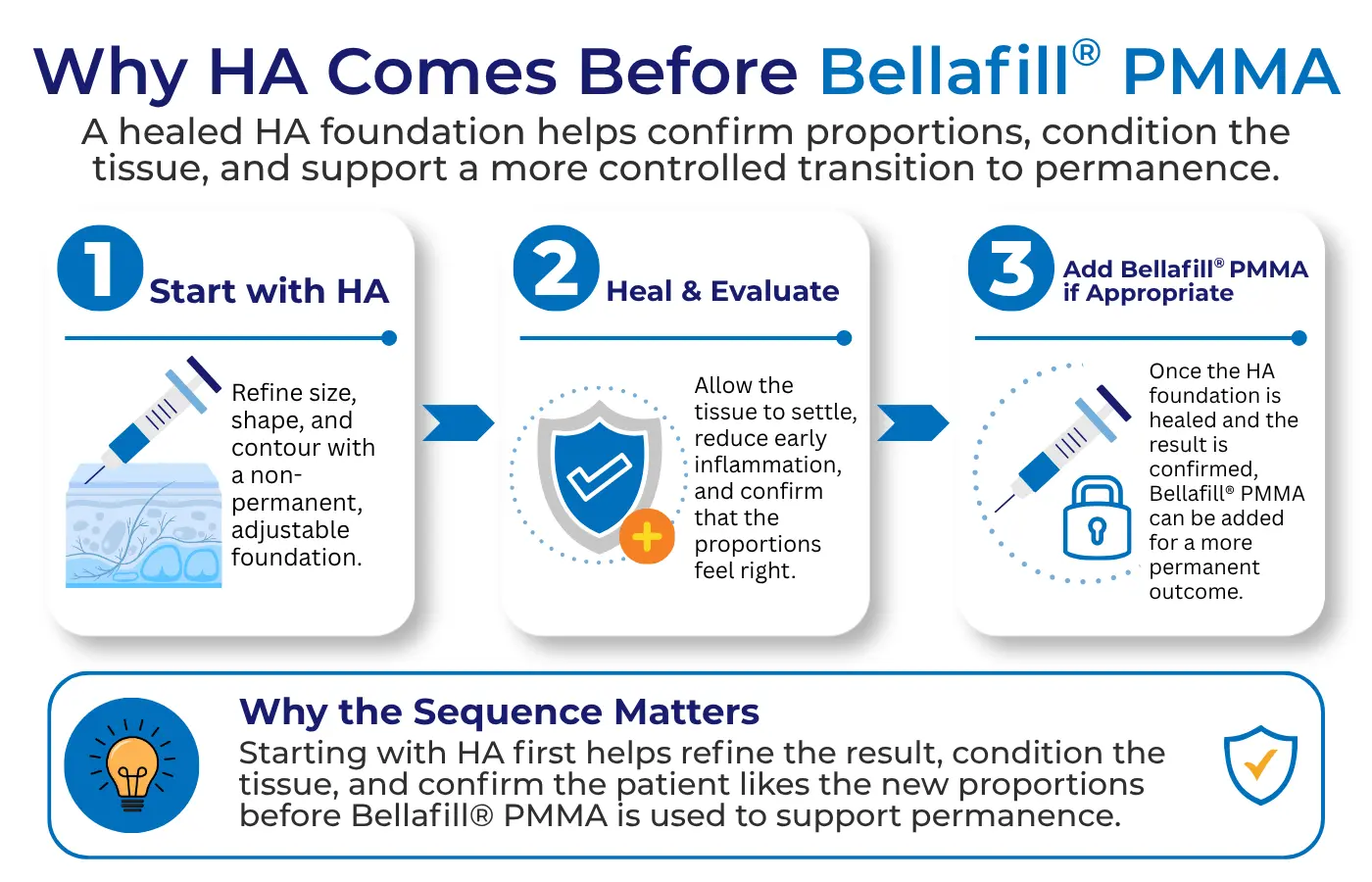
At Rejuvall, the process begins with HA to refine size, shape, and tissue structure before Bellafill® is added for permanence.
It also helps prime the tissue, since first-time injection of a man-made filler into the penile shaft can trigger a variable inflammatory response from one patient to the next.
FusionThick™ is built around that same principle for patients who already have an HA result and want to transition to permanence more conservatively.
That distinction matters. A lot of patient education online makes PMMA sound like just another filler choice. It is not.
Bellafill® is a more serious long-term decision because it is intended to remain in place and cannot simply be dissolved like HA.
That is why size, feel, contour, proportions, and inflammatory immune responses should be evaluated with HA first, then the foundation should be allowed to heal before moving forward with a permanent underlayer.
Why a Healed HA Foundation Comes Before Bellafill PMMA
This is one of the most important differences in the entire decision-making process.
Bellafill® PMMA should be layered onto a stable, established HA foundation rather than injected into a first-time, untested baseline. HA helps confirm preferred size and proportions, supports a smoother and more uniform starting contour, and allows refinement before permanence is added.
It also serves another purpose: it helps condition the tissue before a permanent underlayer is introduced.
When filler is placed for the first time, the body may respond with a stronger early inflammatory reaction and more swelling during the initial healing phase. Starting with HA first helps create a more stable baseline, which can make later PMMA placement more controlled, more even, and more predictable.
In other words, HA helps answer the question, “Do I actually like this new normal?” before Bellafill® is used to help lock in a lasting result.
That is why this should not be approached as “pick HA, or pick PMMA, or pick fat transfer” in a simplistic way.
The PMMA path is really a sequenced permanence plan that follows HA, not a totally separate day-one alternative to HA.
Who PMMA Is Often Best For
PMMA is usually best for men who want permanence but prefer a non-surgical path.
It makes the most sense for men who already have a stable HA foundation, know they like their proportions, and understand that permanent enhancement should be approached conservatively.
So, if a patient wants a lasting non-surgical endpoint, Bellafill® may be the right eventual direction, but that direction is safely reached by first building and healing an HA foundation.
What Is Fat Transfer for Penile Girth Enhancement?
Fat transfer is the surgical option in this comparison. Rather than using a dermal filler, it uses the patient’s own harvested tissue to create increased girth.
At Rejuvall, this surgical pathway is called a PERM®, and it is a life-lasting enlargement option that uses the patient’s own adipose tissue as the primary bulking material.
PERM® goes beyond standard fat transfer. Traditional fat grafting can be limited by reabsorption, clumping, nodules, and inconsistent long-term retention.
PERM® is scientifically designed to improve on those issues with a more advanced approach to how tissue is harvested, structured, and supported during healing, helping create a smoother, more natural, more durable enlargement.
For many men, that is highly appealing. They do not want a temporary filler. They do not want a synthetic filler. They want a surgical approach that uses their own tissue and fits with a more definitive treatment mindset.
If you are interested in a surgical “it’s all me” natural tissue option, it is worth understanding why Rejuvall’s PERM® should not be lumped in with ordinary fat transfer techniques.
The Biggest Obstacle With a Fat Transfer
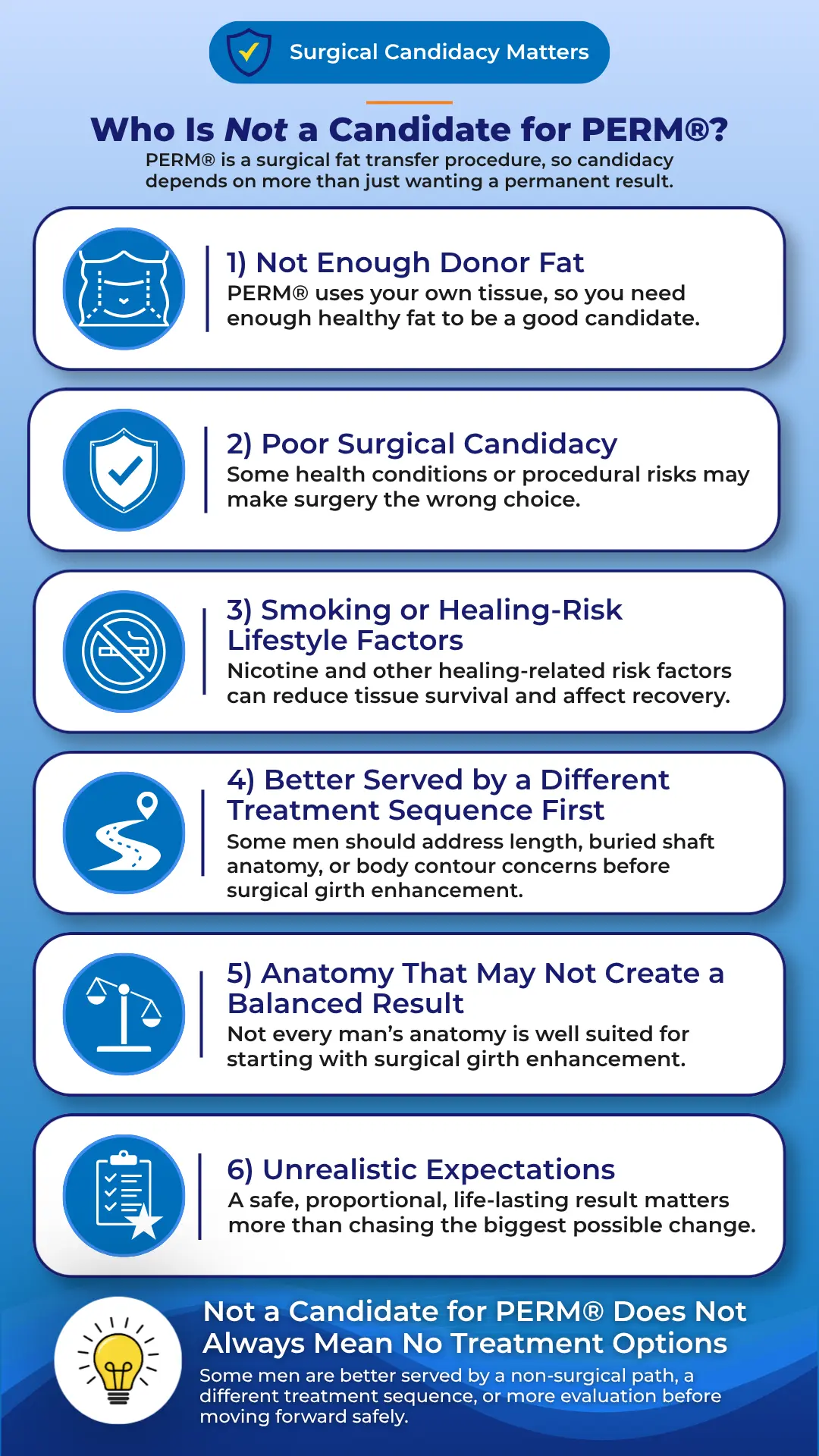
The biggest obstacle with a fat transfer is most men are not suitable candidates for a successful surgical girth procedure.
Obstacles to fat transfer candidacy include:
- Age: Men over the age of 62 will not succeed with a fat transfer, regardless of physical fitness
- Adequate adipose cells: The PERM procedure requires harvesting over 100mL’s of healthy body fat. Lots of men don’t meet that requirement
- High quality adipose cells: Obese men or men who’ve recently lost a lot of weight usually don’t have the quality of adipose cells needed for a successful cellular transplant
- Tobacco, marijuana, vaping, and alcohol: All of these lifestyle choices disrupt successful fat tissue transplants
Along with these obstacles, there’s also the surgery itself to consider.
Undergoing a surgical procedure means time-off-work availability, anesthesia, swelling, pain, recovery, and post-operative care regimens. Surgical planning requires a different level of evaluation, and not every patient is a good candidate.
Who Fat Transfer / PERM® Is Often Best For
PERM is often best for men who are comfortable with surgery, want an own-tissue solution, and meet candidate requirements for a surgical procedure.
It may be especially appealing to men who want a life-lasting, all-natural enhancement and more size “all at once,” versus the slower process for increased size from injections.
In addition, assuming you’re wanting to increase girth by at least one inch, it’s a more affordable pathway than injections.
HA vs PMMA vs Fat Transfer: Which Option Is Right for You?
If you want the most flexible and least committal starting point, HA is usually the easiest option to justify. It is non-surgical, adjustable, and often reversible when clinically appropriate. It is a strong fit for men who want physician-guided girth enhancement without committing to permanence from the start.
If you want a permanent non-surgical endpoint, PMMA may be the right long-term direction. But that does not usually mean skipping straight to Bellafill®. It means first establishing and healing an HA foundation, then considering Bellafill® once size, contour, and proportion have been confirmed.
If you are a candidate for PERM and you’re comfortable with the surgical aspects of enhancement, a large, all-natural girth enlargement using your own tissue may be the better fit.
So in practical terms, the decision often comes down to this:
- Do you want a flexible non-surgical starting point?
- Do you want a more permanent non-surgical plan after first confirming your result with HA?
- Or do you want a surgical, permanent, natural approach?
That is the real comparison.
Other Important Factors to Evaluate
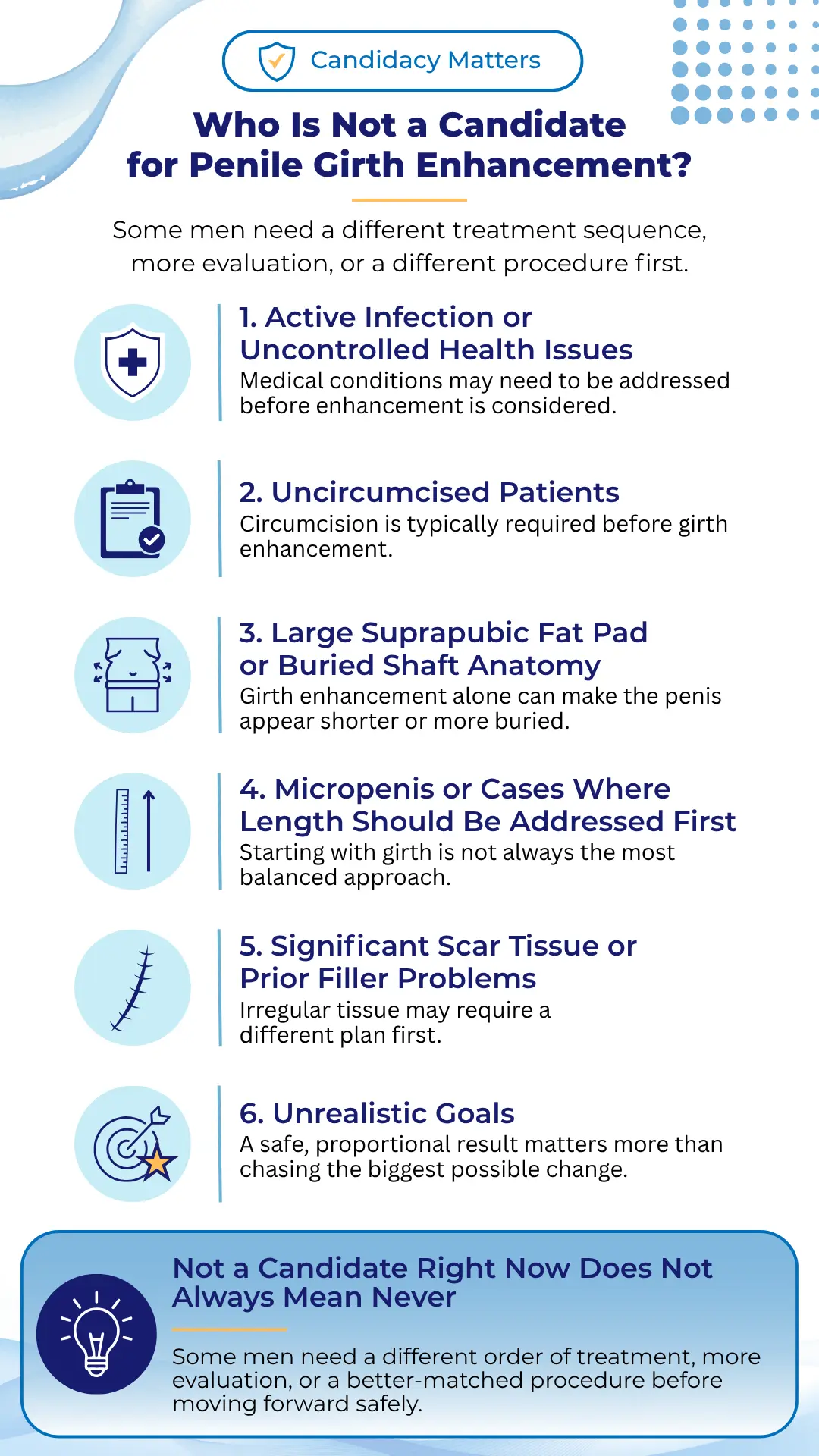
Choosing the right girth enhancement option is not just about preference. It is also about candidacy.
Anatomy, tissue quality, contour, proportion, healing behavior, and circumcision status all matter.
Circumcision is required before girth enhancement at Rejuvall to help reduce the risk of uneven contour, migration, and foreskin-related health issues once girth is added.
That means a good recommendation should account for much more than the patient’s wish list and budget.
A medically responsible plan should also consider whether the chosen option is likely to heal well, look balanced, and make sense for the patient’s anatomy and lifestyle over time.
Final Takeaway
There is no single penile girth enhancement option that is right for everyone.
HA is often the best place to start for men who want a non-surgical, adjustable option with more flexibility.
Bellafill® PMMA is best understood as a permanence pathway, and at Rejuvall, that path is typically built on top of a healed HA foundation rather than used as a true first step.
PERM® is usually the best fit for men who are good surgical candidates and want a surgical, permanent, natural solution that’s large from the beginning.
The right choice is not the one that sounds (or looks) the most dramatic online. It is the one that best fits your body, your goals, your lifestyle, and the level of permanence, recovery, and commitment that makes sense for you.
How to Choose the Right Penile Girth Enhancement Option
If you are considering penile girth enhancement and want help understanding whether HA, Bellafill® PMMA, or PERM® is the most appropriate fit, the next step is a private consultation with a urology-based team that can answer your questions, evaluate your anatomy, and help you understand your options.
Most patients begin with a free phone consultation with our Patient Education Manager, John, and then move forward to a medical consultation if appropriate.
Start the confidential assessment process by submitting the form below to schedule your call with John and learn which penile girth enhancement path may be right for you.
