
Proprietary Penile Filler Repair: Complications From Custom-Compounded Injectables
Can Complications From Proprietary or Compounded Penile Fillers Be Repaired?
Quick Answer: Complications from proprietary or custom-compounded penile fillers can often be treated or significantly improved. However, these repairs frequently require surgery and can become particularly complex when the exact ingredients, concentrations, or permanent components of the injected material are unknown.
At Rejuvall, we often see men who were told they received products described as “proprietary filler,” “custom-compounded PMMA,” “collagen-inducing injections,” or “minimally invasive permanent filler.”
The marketing name alone does not tell a reconstructive surgeon exactly what is present inside the tissue.
That matters because successful repair begins by determining:
- What material was injected
- Whether any component is permanent
- How long it has been present
- Where it was placed
- Whether it has migrated
- How the surrounding tissue has reacted
- Whether the penile skin and deeper structures remain healthy
Our main penis enlargement repair experience has shown that identifying the original material is one of the most important parts of choosing the correct repair pathway.
Why Can Custom-Compounded Penile Filler Repair Be So Difficult?
Repair becomes more complicated when permanent or unidentified injected material has remained in the penile shaft for an extended period.
Based on Dr. Carney’s surgical findings in these repair patients, some compounded permanent materials may become incorporated into surrounding tissue, produce chronic inflammatory changes, or adhere to deeper layers beneath the penile skin.
That can make removal more difficult and may prolong postoperative healing.
Four factors can make recovery particularly challenging:
1. The Filler That Was Injected
Certain injected agents are easier to resolve than others. Some agents are more likely to permanently adhere to complex inner tissue.
Other fillers contribute to the deterioration of internal tissues, according to our surgical repair experience, hence jeopardizing patient recovery and increasing the risk of postoperative infections.
2. The Material Has Been Present for a Long Time
The longer permanent foreign material remains within tissue, the greater the opportunity for fibrosis, inflammatory response, tissue adherence, or other changes to develop.
When material becomes attached to the underside of the penile shaft skin or incorporated into surrounding tissue, repair may require careful surgical separation rather than simple removal.
3. Patient Age and Healing Ability
Healing capacity varies considerably from patient to patient and generally changes with age.
Older repair patients experience more prolonged swelling and recovery than younger patients, particularly when surgery involves tissue that has already been affected by foreign material or previous procedures.
4. Existing Wound-Healing Risk Factors of Patient
Recovery can also be more difficult in patients with factors that interfere with healthy wound healing, including:
- Diabetes
- Certain autoimmune conditions
- Tobacco use
- Significant prior obesity
- Substance or heavy alcohol-use history
- Other medical conditions affecting circulation or tissue repair
These factors are evaluated before Rejuvall recommends a surgical repair pathway.
Can HA Filler Be Added Over a Problematic Compounded Filler?
Sometimes expertly placed additional filler can improve a surface irregularity, but covering an existing problem with HA penile filler is not the same as repairing it.
If an unidentified or permanent compounded injectable has already caused inflammation, fibrosis, nodules, migration, or deeper tissue changes, placing more filler over it does not remove the underlying problem.
Adding filler also introduces another material into tissue that may already be reacting abnormally.
Inflamed internal tissue may respond strongly even to mild injectable agents, such as HA filler, potentially making the outward appearance worse.
Rejuvall therefore does not consider simply adding filler over a problematic compounded injectable to be an appropriate substitute for determining what is actually happening beneath the skin.
Filler has legitimate uses in penile girth enhancement when appropriately selected and placed.
But when a patient already has an unknown foreign material and an inflammatory or structural complication, the priority should be diagnosing the problem rather than disguising its appearance.
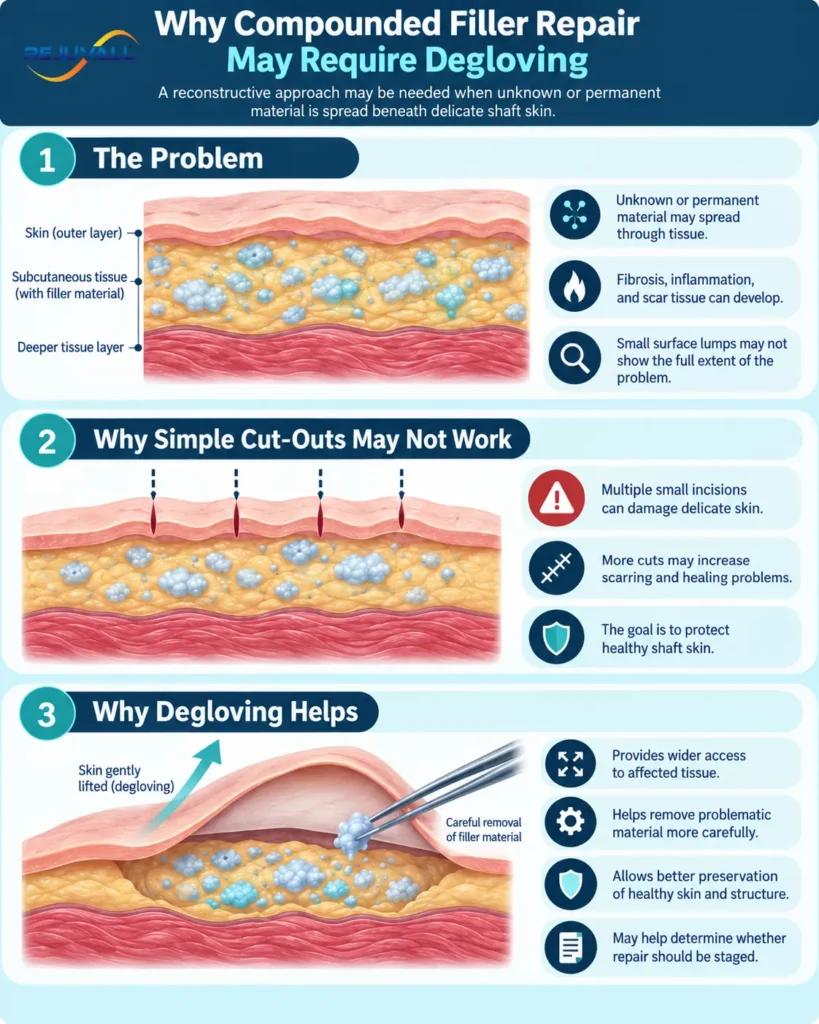
Why Can’t a Compounded Penile Filler Nodule Simply Be Cut Out?
Patients frequently ask whether an unattractive or painful lump can simply be removed through a small incision.
For a very small, isolated nodule, that is often possible.
For larger nodularity and extensive permanent material, it usually is not.
Why is that?
The skin of the penile shaft is thin, mobile, highly elastic, vascular, and sensitive. It must move freely as the penis changes between flaccid and erect states.
Protecting that specialized skin is one of the most important objectives of reconstructive penile surgery.
Multiple incisions to remove larger nodules through compromised shaft skin can:
- Produce additional scar tissue
- Make wound closure more difficult
- Affect skin mobility
- Affect sensation
- Increase healing complications
- Further damage tissue already altered by the injected material
In a severe case, loss of viable penile shaft skin can ultimately require skin-graft reconstruction, which is a far more extensive procedure and cannot completely reproduce the texture or sensation of healthy original shaft skin.
Removal From the Inside: Why Compounded Penile Filler Repair May Require Degloving
When foreign material is spread throughout a larger area of the penile shaft, repair often has to be performed from the inside out.
This may require complete penile degloving.
Degloving allows Dr. Kenneth J. Carney, MD, PharmD, FACS to expose the affected tissue while minimizing multiple separate incisions through the outer shaft skin.
The compounded material, fibrosis, scar tissue, and surrounding structures can then be evaluated directly.
This approach allows Dr. Carney to:
- Locate migrated or incorporated material
- Carefully separate foreign material from surrounding tissue
- Remove damaged or inflamed tissue where appropriate
- Assess the underside of the penile skin
- Preserve as much healthy shaft skin as possible
- Determine whether reconstruction should be completed in one operation or staged
When permanent injected material has been present for a long period, portions may very well be firmly incorporated into surrounding tissue.
In those cases, the training and experience of the reconstructive urologist become especially important.
Are Custom-Compounded Penile Fillers FDA-Approved?
No, they are not.
Compounded drugs are not FDA-approved. FDA states that it does not verify the safety, effectiveness, or quality of compounded drugs before they are marketed.
Lawful drug compounding can serve legitimate medical needs under federal frameworks including Sections 503A and 503B, but that does not turn an individual compounded formulation into an FDA-approved product.
Compounded dermal fillers are considered illegal by the FDA.
Certain pharmaceuticals are formulated and authorized for human administration by compounding laboratories, whereas dermal fillers are explicitly governed by the FDA as medical devices.
The FDA mandates that all medical devices involving the injection of an agent into the human body get approval prior to utilization, and that manufacturing processes are sanctioned and overseen by the FDA.
In addition, the FDA has not approved injectable fillers for penile enlargement or other body-contouring enhancement.
FDA-approved dermal fillers have specific approved indications, primarily involving areas of the face and hands.
Therefore, statements such as:
- “FDA registered”
- “Made at an FDA-registered facility”
- “503B compounded”
- “Uses an FDA-approved ingredient”
should not be interpreted to mean:
“This finished proprietary penile filler is FDA-approved.”
Why Manufacturing Quality Matters
FDA’s standard pharmaceutical manufacturing system uses Current Good Manufacturing Practice (CGMP) requirements to establish controls for drug identity, strength, quality, purity, facilities, production methods, and testing.
The rules differ depending on the type of compounder. For example, qualifying 503B outsourcing facilities are subject to CGMP requirements and FDA inspections, but their compounded drugs themselves are still not FDA-approved.
FDA has documented quality risks associated with poorly compounded products, including problems involving contamination, potency, sterility, and manufacturing quality.
For a material that may be injected into penile tissue and remain there for years or permanently, patients should know:
- Exactly what the product contains
- Who manufactured or compounded it
- Whether the ingredients and concentrations are documented
- Whether it is temporary or permanent
- What quality controls apply
- Whether the finished product itself has FDA approval
- What treatment is available if a complication develops
A proprietary name should never replace informed consent about the actual material entering the body.
What Should You Ask Before Receiving a Proprietary Penile Filler?
Before agreeing to any product described as a “proprietary filler,” “collagen-inducing injection,” “custom-compounded PMMA,” or “permanent compounded filler,” ask the provider:
- What are the exact ingredients?
- What percentage or concentration of each ingredient is present?
- Is any component permanent?
- Who manufactures or compounds the product?
- Is the finished product itself FDA-approved?
- Is penile injection an FDA-approved indication for this product?
- Can I see the manufacturer’s labeling and product information?
- What happens if the material causes inflammation, migration, nodules, fibrosis, or tissue damage?
- Can the physician performing the injection surgically repair the complication if something goes wrong?
Patients deserve clear answers before an elective material is injected into penile tissue.
Concerned About a Filler’s FDA Status?
If you are unsure whether a clinic’s claims about a filler are accurate, you can contact the FDA directly.
The FDA’s Division of Industry and Consumer Education (DICE) provides information about medical devices and can be reached at 800-638-2041.
Patients can also report problems involving FDA-regulated products through MedWatch at 1-800-FDA-1088 or through FDA’s online reporting system.
If a clinic says its proprietary penile filler is “FDA-approved,” ask whether that statement refers to:
the actual finished product and its intended use — or merely an ingredient, manufacturer, pharmacy, or facility associated with it.
Again, dermal fillers are classified by the FDA as medical devices and it is illegal to privately create medical devices without FDA approval and safety management.
How Rejuvall Evaluates Compounded Penile Filler Complications
Repair begins by determining what is present and what it has done to the tissue.
During an in-person evaluation, Dr. Kenneth J. Carney, MD, PharmD, FACS assesses:
- What the patient was told was injected
- What material was used (as best can be determined)
- When the injections occurred
- How much material was used
- Product or pharmacy records, when available
- Where the material appears to be located
- Migration
- Nodules or granulomas
- Fibrosis and scar tissue
- Penile skin quality and mobility
- Pain, sensation, appearance, and function
- Whether surgery should be performed in one stage or multiple stages
Patients should bring any available product labels, invoices, lot numbers, pharmacy information, ingredient lists, medical records, or treatment notes from the original procedure.
The ultimate goal is not simply to remove foreign material.
It is to correct the underlying complication while preserving as much healthy penile skin, structure, sensation, and function as possible.
Consultation & Pricing for Compounded Penile Filler Repair
A definitive repair plan cannot be established from photographs alone.
Compounded penile filler complications require a hands-on examination at Rejuvall’s Atlanta clinic so Dr. Carney can assess the material, fibrosis, skin condition, migration, tissue damage, and complexity of reconstruction.
Pricing depends on:
- The material involved
- How much material is present
- How long it has been present
- How extensively it has spread
- Scar tissue and tissue damage
- Surgical complexity
- Whether reconstruction is necessary
- Whether more than one procedure will be required
Start With a Private Phone Consultation
The first step is a complimentary phone consultation with Rejuvall’s Patient Education Manager.
You can discuss what procedure you received, what the clinic told you was injected, when it was performed, and what problems you are currently experiencing.
If your case appears appropriate for evaluation, the next step is an in-person examination at our Atlanta cosmetic urology clinic.
Call Rejuvall at 445-220-0765 or complete the form below to begin your compounded penile filler repair consultation.
If the Cosmetic Urology Assessment form doesn’t appear above, click here to open it in a new window.