
The second most common penis enlargement repair at Rejuvall is lost length following a penis enlargement surgery. Sounds like an oxymoron, doesn’t it? Sadly, it’s not uncommon.
The good news is that it’s not hazardous to your health like injected silicone oil. The bad news is that it almost always requires surgery to resolve, and final outcomes vary.
Unlike silicone injections, which can cause systemic inflammation and lymphatic damage, lost penile length after surgery is usually the result of scarring or healing mechanics. While still serious, these cases are localized surgical problems and are treated differently than filler-related injuries and silicone injection complications.
Why do men sometimes lose penile length following a ligament ligation?
Penile length loss after ligament ligation is usually caused by excessive internal scar formation or failure to follow a structured traction protocol during healing. True ligament reattachment is uncommon and accounts for only a small fraction of lost-length repair cases.
Losing length following a penile lengthening procedure is most often due to a tandem of issues, including:
1. Excessive scar tissue from the ligation procedure
Internal scarring after ligament ligation can tether the penis internally, reducing visible length. This is most often seen when ligaments are incompletely released or when aggressive cutting leads to abnormal healing.
This is the most common reason men lose length following a ligament ligation. Penile ligaments vary in size, number and nature from one man to the next. Ligaments are never uniform.
Successful and comprehensive removal requires extensive ligation experience. Less skilled surgeons or overly aggressive cutting usually results in significant residual scar tissue.
2. Not being prescribed traction or failing to follow it
Post-operative penile traction is essential after penile lengthening surgery. Without consistent stretching during healing, scar contraction can shorten the penis even after technically successful surgery.

Every surgical incision triggers scar tissue, regardless of where those cuts are made. It’s simply an aspect of part of the human body healing process. Thus, every patient will need to stretch the penis as the healing is occurring to counteract lost penis size as the body heals.
We’ve encountered a lot of patients who claim they were never told to stretch following surgery. Others admitted they failed to follow such protocols or didn’t understand why it was important.
3. Compromised surgical healing
Poor healing—often related to smoking, metabolic factors, or abnormal scar formation—can lead to contracture scars that pull penile tissue inward and reduce length after surgery.
Some men are not aware that surgical procedures involving so-called “keloids” might result in hampered recovery and aberrant scarring. Keloids are lumpy scars that may grow beyond initial incision site and cause penile retraction.
Loss of penile length can also be explained by contracture scars, which pull the skin’s surface tighter than it was before to the surgery.
More frequently, smoking at any point in the 90 days prior to surgery impairs the healing process and can inhibit results.
4. Ligament reattachment
True ligament reattachment is rare. In most cases of post-surgical length loss, scar tissue—not ligament regrowth—is responsible for the reduced visible length.
Although it is the least frequent cause of lost length that we have found during surgical repairs after lost length, patients who experienced length loss most frequently cited ligament reattachment as their surgeon’s explanation.
Why does everyone use this explanation? Ligament ligation is a risk, and a patient can’t prove differently.
The term “ligament reattachment” is a bit misleading. In reality, the incised ligaments do not “reattach” as they did prior to the surgery. Instead, a detached ligament strand may later adhere to another site, most frequently the pelvic bone, if it is not entirely cut.

The size, quantity, and thickness of each man’s suspensory and deep ligaments differ, as we previously discussed. They run the risk of reattaching if they are not completely cut during ligation.
Only 2 out of the 23 lost length repair procedures we’ve done at Rejuvall recently had ligament reattachment as the actual cause.
The most frequent causes of decreased length are either too much internal scar tissue after the treatment or not adhering to an appropriate post-operative penile stretch regimen.
Lost penile length after implant-based enlargement is most commonly caused by internal scarring, infection, or secondary Peyronie’s disease. These cases often require surgical repair and should be evaluated by a reconstructive urologist.
Based upon our repair experience, there are three different levels of post-Penuma® trauma that a patient might face.
The first is the buildup of scar tissue, most commonly at or near the base of the penis. The most common side effect of residual scar tissue is lost penile length. Surgery is required to remove scar tissue.
The second is Peyronie’s disease which is manifested by fibrous plaques in the soft tissue of the penis.
Fibrotic plaque formation following implant removal can lead to curvature and length loss consistent with Peyronie’s disease. Treating these plaques is essential for restoring both length and function.
Peyronie’s disease treatment and removing fibrous plaques in the penis is the primary specialty of our clinic and was the underlying basis that got us into cosmetic urology, as lost penis size is one of the many negative symptoms of Peyronie’s disease.
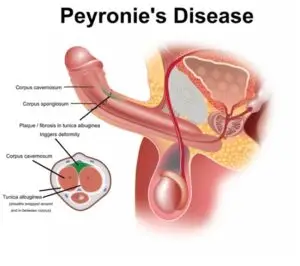
One of the most emotionally devastating Peyronie’s cases we encountered following removal of a problematic Penuma® implant was a young and healthy man who we discovered from duplex Doppler ultrasonic testing had acquired a large number of fibrous plaques.
According to the patient, when he complained about the problem after the implant was removed, his surgeon handed him a penis pump and stretching device and told him that would resolve the problem.
Not hardly.
Infection and Catastrophic Cases
Infections following penile implants can cause progressive tissue damage, severe scarring, and in rare cases, complete loss of the penile shaft—requiring complex reconstructive surgery.
Infection is another factor from which we heal penile implant enlargements. Most often, infection happens shortly after the implant is put in place. The worst situations are when an infection occurs and the practitioner proceeds to place another implant.
In the worst situations, these men have repeated damage that causes them to lose their entire penile shaft. They then need a penile shaft transplant using donor tissue, usually from the inner thigh region.
Shaft transplants need extensive surgery. We strongly advise you to seek a second opinion from a qualified urologist before moving further if you experience an infection after having an insert implanted.
The worst repair case we’ve encountered related to a Penuma® implant was a case where the patient had three implants installed following constant infections.

In the end? His penile shaft had become completely necrotic after this process and a penile shaft transplant had to be performed.