
Complications of Silicone Penile Injections
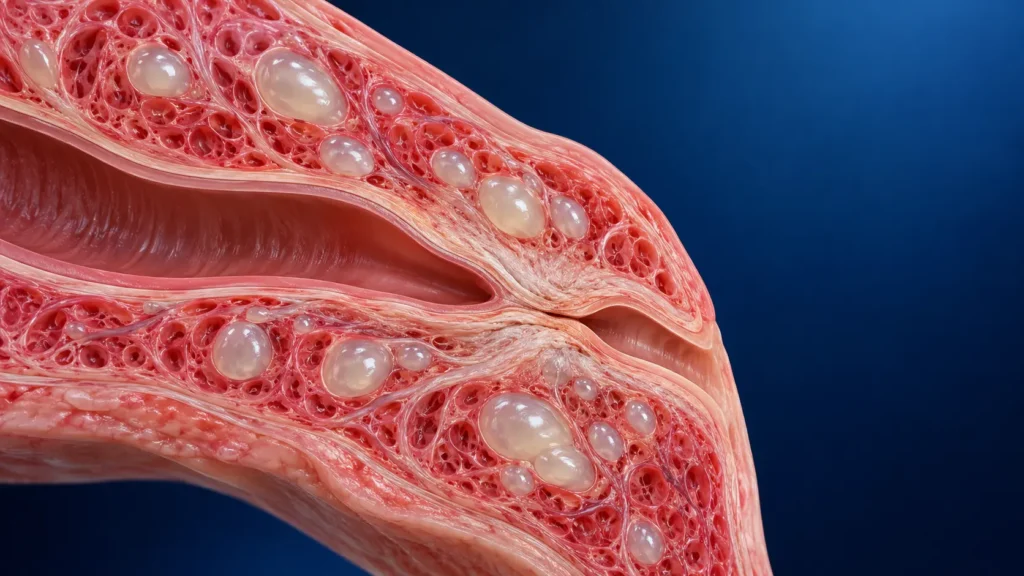
Liquid silicone injected into penile tissue does not behave like a temporary dermal filler and does not remain reliably confined to the original injection site.
Over time, silicone tends to spread through surrounding tissue and contribute to complications such as:
- chronic inflammation,
- foreign-body granulomas,
- firm or fibrotic nodules,
- penile asymmetry or deformity,
- persistent swelling,
- lymphatic obstruction,
- penile or scrotal lymphedema,
- recurrent infection,
- skin breakdown or tissue necrosis,
- pain,
- and impaired urinary or sexual function.
Some complications develop shortly after injection. Others may not appear until years later.
This delayed pattern is one of the reasons silicone injection injuries can be difficult for patients to recognize.
A penis that initially looks normal after injection may still contain permanent foreign material that continues interacting with surrounding tissue, the immune system, and the lymphatic system over time.
As silicone migrates and more tissue becomes involved, repair generally becomes more complicated.

RED FLAG: Be Cautious About How “Permanent” Penile Injections Are Described
Patients should be cautious when a penile injection procedure is promoted using terms such as:
- “pharmaceutical-grade silicone”
- “collagen-inducing filler”
- “collagen activation”
- “collagen layering”
- “CMC injections”
- “all-natural permanent enlargement”
- “minimally invasive permanent penile thickening”
These phrases may sound medical, but they do not tell the patient what substance is actually being injected.
The most important question is simple:
What exactly is being placed into your body?
There is no FDA-approved form of injectable silicone for penile enlargement.
Liquid silicone used for penile or scrotal enhancement is:
- non-biodegradable,
- non-absorbable,
- capable of migrating through tissue,
- and capable of triggering chronic foreign-body and inflammatory reactions.
Patients treated at Rejuvall have reported being told that the injected material would dissolve, that the remaining enlargement would come from “natural collagen,” or that silicone was not the primary substance being used.
When complications develop, that uncertainty makes diagnosis and treatment more difficult.
Knowing (or determining) what was actually injected is one of the first steps in developing a safe repair plan.
How Silicone May Be Marketed as “Permanent” or “Collagen-Inducing”
Some penile injection procedures are marketed using language that sounds safer or more biologically natural than what may actually be injected.
Patients have reported being told they received:
- a “permanent penile thickening” treatment,
- a “collagen-inducing” or “collagen activation” injection,
- a “collagen layering” procedure,
- an “all-natural” injectable treatment,
- a “CMC-based” filler,
- or “pharmaceutical-grade silicone.”
Some patients were also told that the injected material would gradually dissolve and that their body would replace it with permanent natural collagen.
That explanation is important to examine carefully.
Liquid silicone does not disappear from the body and become collagen. It remains as foreign material within tissue and may continue to interact with the immune and lymphatic systems long after the original procedure.
In patients treated surgically at Rejuvall, many have arrived believing they received a non-silicone filler, only for the material found during repair to be consistent with predominantly liquid silicone oil.
This is why the marketing name of a procedure is not enough.
Patients should know the exact injectable material, manufacturer, product name, and composition whenever possible.
What May Actually Be Injected?
In many repair cases treated at Rejuvall, material removed during surgery has appeared to consist primarily of liquid silicone oil combined with smaller amounts of other substances.
Based on surgical findings and analysis of extracted material in these cases, components may include:
Silicone Oil
Silicone oils, including dimethicone-type fluids, make up the majority of the injected volume.
Silicone oil does not biodegrade after injection. It can remain within tissue indefinitely, disperse beyond the original injection site, and trigger chronic foreign-body reactions.
It is not an FDA-approved injectable filler for penile enlargement.
Carboxymethylcellulose (CMC)
Carboxymethylcellulose, or CMC, is a cellulose-derived material commonly used as a thickener, stabilizer, or lubricant.
In an injectable mixture, CMC may be used to change the consistency or viscosity of the material.
Its presence does not mean the injection is a regenerative treatment, and CMC itself does not create permanent penile tissue or replace silicone with natural collagen.
Lidocaine
Lidocaine is a local anesthetic that may be included to reduce discomfort during injection.
Its presence can make an injectable mixture sound more medical or familiar to patients, but it does not change the long-term behavior of silicone in tissue.

Why the Exact Composition Matters
When a patient develops complications, knowing what was actually injected can help guide diagnosis and treatment planning.
Unfortunately, some patients do not have complete records, were not given the product name, or were told terminology that did not clearly identify the injectable material.
In those cases, evaluation may rely on:
- the patient’s treatment history,
- physical examination,
- imaging,
- surgical findings,
- and, in some cases, analysis of removed material.
For repair patients, the goal is not to rely on the original marketing description. It is to determine as accurately as possible what is present in the tissue and how much damage it has caused.
Why Silicone Injection Complications Can Appear Years Later
One of the most dangerous things about penile silicone injections is that serious complications may not appear right away.
If a patient does not develop an immediate problem such as infection, severe inflammation, or tissue injury, he may reasonably assume the procedure was successful.
But an initially normal result does not mean the silicone is gone or harmless.
Liquid silicone remains in the body and can continue interacting with surrounding tissue, the immune system, and the lymphatic system for years, even decades.
At Rejuvall, we have evaluated men who developed new symptoms 5, 10, or even 15 years after their original silicone injections.
Delayed complications may include:
- new or worsening penile asymmetry,
- firm or hardened areas beneath the skin,
- enlarging nodules or granulomas,
- chronic or recurrent swelling,
- scrotal swelling,
- persistent inflammation,
- pain,
- skin changes,
- and progressive penile deformity.
In some cases, patients do not immediately connect these symptoms to an enlargement procedure performed many years earlier.
This delayed progression is one reason a history of silicone injection remains medically relevant even when the original treatment occurred a long time ago.

Granulomas and Chronic Foreign-Body Reactions
Silicone is a foreign material that the body cannot naturally break down.
In some patients, the immune system responds by trying to isolate the silicone. This can create a chronic foreign-body reaction and lead to:
- silicone granulomas,
- foreign-body giant-cell reactions,
- fibrosis,
- scar tissue,
- and firm or painful nodules.
These reactions may develop months or years after the original injections.
They may also continue to change over time as the immune system remains exposed to silicone that is still present within the tissue.
Patients may notice:
- increasing firmness,
- new or enlarging nodules,
- pain or tenderness,
- irregular penile contour,
- thickened tissue,
- or worsening swelling.
Silicone granulomas are not the same as a simple lump or uneven area caused by temporary hyaluronic acid filler.
Silicone cannot be dissolved.
Massage also does not remove silicone or stop an active foreign-body reaction.
Adding more filler over the area may temporarily change the appearance, but it does not remove the silicone or correct the underlying inflammatory process.
For patients with suspected silicone granulomas or chronic inflammation, the first priority should be determining what is happening within the tissue, not simply trying to camouflage the visible irregularity.
Silicone Migration Into the Scrotum
When silicone migrates beyond the penile shaft and into the scrotum, the complications can become significantly more difficult to treat.
The scrotum contains delicate skin, blood vessels, and important lymphatic drainage pathways. When silicone infiltrates these tissues or interferes with normal lymphatic flow, chronic swelling can develop.
Possible complications include:
- scrotal lymphedema,
- persistent or progressive swelling,
- skin thickening,
- fibrosis,
- recurrent inflammation or infection,
- pain,
- loss of normal tissue elasticity,
- difficulty with hygiene,
- and impaired mobility.
In more advanced cases, scrotal swelling can become severe enough to interfere with walking, urination, sexual activity, and normal daily life.
This is no longer simply a cosmetic complication.
Severe silicone-related scrotal swelling can represent a complex reconstructive urologic condition involving both damaged tissue and impaired lymphatic drainage.
The extent of the problem may also be greater than what is visible externally. Silicone that has migrated into scrotal or groin tissue may be distributed through multiple tissue planes, making repair substantially more complicated than treating a localized penile irregularity.

Silicone Injected Into the Glans Can Create Urethral Complications
Silicone injected directly into the glans can create a different and particularly dangerous type of complication.
The glans is composed largely of erectile tissue within the corpus spongiosum. During an erection, this tissue fills with blood and expands.
In silicone injection repair patients treated at Rejuvall, Dr. Carney has encountered cases in which silicone placed within the glans appears to have been progressively displaced through this erectile tissue over time.
Because the urethra runs directly through the corpus spongiosum and glans, migrated silicone may eventually involve the tissues surrounding the urethra.
In many of these patients, the problem does not become obvious for many years.
How Silicone Can Affect the Urethra
Over time, silicone within the glans and surrounding tissues may become associated with:
- chronic foreign-body inflammation,
- fibrosis,
- thickened or hardened tissue,
- silicone-containing debris,
- narrowing around the urethral channel,
- difficulty urinating,
- weakening of the urinary stream,
- incomplete emptying,
- and, in advanced cases, urethral stricture or obstruction.
At Rejuvall, some men with this pattern have presented roughly a decade or more after their original injections with progressive urinary symptoms.
Most did not know liquid silicone had been used.
Instead, they believed they had received another type of permanent or “collagen-inducing” penile injection.
Why Glans Silicone Can Be Difficult to Diagnose
Silicone-related urethral complications may also be difficult to identify with routine imaging.
On ultrasound, free silicone can produce highly echogenic areas and a characteristic “snowstorm” artifact. This acoustic shadowing can obscure the tissues located beneath the silicone and make it difficult to clearly evaluate the urethral region.
MRI can also be challenging when silicone is not already suspected.
Standard imaging performed to look for conventional scar tissue or other causes of urethral narrowing may not be optimized to identify free silicone. Silicone-specific MRI techniques may be needed in some situations.
This creates an important diagnostic problem:
If the patient does not know silicone was injected, the physician may not initially be looking for silicone as the cause of the obstruction.
A man may therefore be evaluated for a urethral stricture without anyone recognizing that migrated silicone and the surrounding foreign-body reaction are contributing to the narrowing.
For patients with a history of glans injections, particularly those who are unsure what material was used, new urinary symptoms should be evaluated with that history in mind.
Silicone-related urethral obstruction is not simply a filler irregularity. It will require specialized reconstructive urologic evaluation to determine how much of the urethra and surrounding tissue has been affected.
Penile Silicone Removal & Repair

What Can — and Cannot — Be Fixed
Once liquid silicone has been injected into penile or scrotal tissue, there is no way to completely reverse the original exposure.
That does not mean nothing can be done.
The goal of silicone repair is to:
- reduce the amount of accessible silicone,
- remove severely damaged or diseased tissue,
- relieve pressure, swelling, or obstruction,
- improve penile or scrotal function,
- preserve as much healthy tissue as possible,
- and prevent further progression of the damage.
Depending on the extent of the problem, reconstructive surgery may significantly improve pain, swelling, deformity, hygiene, mobility, urinary function, sexual function, or overall quality of life.
However, silicone repair is not the same as removing a solid implant or dissolving a temporary filler.
Once silicone has spread through multiple tissue planes, some of it may remain permanently embedded within tissue that cannot safely be removed.
For that reason, successful repair is measured by how much healthy anatomy and function can be preserved or restored, not by whether every microscopic trace of silicone can be eliminated.
Why Silicone Cannot Be Completely Removed
Liquid silicone does not remain as one solid mass.
After injection, it can disperse into many small droplets throughout surrounding tissue.
Over time, those droplets may become incorporated into areas of:
- penile skin,
- underlying soft tissue,
- scar tissue and fibrosis,
- lymphatic pathways,
- scrotal tissue,
- and surrounding structures.
That distribution makes complete removal medically impossible.
A surgeon cannot simply locate one pocket of silicone and remove it in its entirety.
Some silicone-infiltrated tissue can be surgically excised. Other areas may contain microscopic silicone dispersed through otherwise important or viable tissue that cannot safely be sacrificed.
The surgical objective is therefore to remove as much diseased or heavily silicone-infiltrated tissue as can be safely removed, while protecting the structures necessary for penile function.
Why Silicone Repair May Require Penile Degloving
In more extensive penile silicone cases, Dr. Kenneth J. Carney, MD, PharmD, FACS may need to fully expose the tissues of the penile shaft to determine how far the silicone has spread and which areas are safe to remove.
This will require penile degloving, a surgical technique in which the penile skin and superficial tissues are carefully mobilized so the underlying shaft can be directly examined.
Degloving allows Dr. Carney to evaluate:
- the extent of silicone infiltration,
- areas of severe fibrosis or granuloma formation,
- damaged or unhealthy skin and soft tissue,
- tissue planes affected by migration,
- and how much healthy tissue remains for reconstruction.
This is particularly important because silicone injury is often more extensive beneath the surface than it appears from the outside.
A visible lump or irregularity may represent only one part of a much broader pattern of silicone dispersion.
For this reason, complex silicone repair is not simply a matter of making a small incision and removing a visible deposit.
In advanced cases, it requires full surgical exposure, careful removal of diseased tissue, and reconstruction based on what is found during the procedure.
When Is Silicone Removal Surgery Necessary?
Not every patient who has received silicone requires the same treatment.
Some patients may have relatively limited symptoms, while others develop progressive tissue damage that makes surgical repair necessary.
Surgery may be considered when silicone injections have caused problems such as:
- progressive penile or scrotal swelling,
- lymphedema,
- recurrent infections,
- painful or enlarging granulomas,
- severe fibrosis or hardening,
- skin breakdown,
- tissue necrosis,
- significant penile deformity,
- urinary difficulty,
- sexual dysfunction,
- or continued progression of silicone-related tissue damage.
The decision to operate depends on more than appearance alone.
A reconstructive urologic evaluation should consider:
- how far the silicone has migrated,
- which tissues are involved,
- whether lymphatic drainage has been affected,
- whether healthy skin and soft tissue remain,
- whether symptoms are stable or progressing,
- and whether function is being compromised.
In general, the more extensive the migration, fibrosis, or lymphatic damage becomes, the more complicated surgical repair may be.

What Does Penile Silicone Removal Surgery Involve?
There is no single standardized operation for penile silicone removal.
Every case is different because liquid silicone can spread through tissue in unpredictable patterns.
Depending on what is found during evaluation and surgery, repair may involve one or more of the following:
Removal of Silicone-Infiltrated Tissue
Areas containing a heavy concentration of silicone may be surgically excised when doing so can be accomplished without sacrificing critical healthy structures.
Removal of Fibrotic or Damaged Tissue
Chronic inflammation may leave penile tissue thickened, scarred, hardened, or poorly vascularized.
Severely diseased or nonviable tissue may need to be removed as part of reconstruction.
Granuloma Excision or Debulking
Large or symptomatic silicone granulomas may require surgical excision or reduction. The objective is to remove as much problematic foreign-body tissue as can be safely treated while preserving normal anatomy.
Penile Skin Reconstruction
If silicone has significantly infiltrated or damaged the penile skin and superficial tissues, reconstruction may be necessary after the affected tissue is removed.
The exact reconstructive approach depends on how much healthy tissue remains.
Correction of Silicone-Related Deformity
Fibrosis, granulomas, tissue loss, and migration can distort normal penile shape.
Reconstruction may therefore include restoring the shaft contour or correcting deformities created by the silicone injury.
Treatment of Associated Lymphatic Problems
When silicone migration has impaired lymphatic drainage, surgery may also need to address tissue affected by chronic swelling or lymphedema.
This can make repair substantially more complex than treating a localized filler irregularity.