
Himplant & Penuma Implant Repair: Restoring Lost Length and Function
Specialized reconstructive care for scar tissue, penile shortening, curvature, and other complications following cosmetic silicone penile implant procedures.
Quick Answer: Some men experience excessive scar tissue, penile shortening, curvature, or loss of function after receiving or removing a cosmetic silicone penile implant, including devices marketed as Penuma® or Himplant®. In patients referred to and treated at Morganstern Rejuvall Health Centers for repair, our clinical team has encountered complications ranging from restrictive scar tissue to more extensive penile tissue damage. Removing the implant is often only the first step to resolve these problems. Dr. Kenneth J. Carney, MD, PharmD, FACS evaluates implant-related complications and determines whether reconstructive treatment and/or customized therapeutics may help restore penile length, anatomy, and function.
Table of Contents
Experiencing Complications After a Cosmetic Penile Implant?
Did you lose penile length or function after receiving a cosmetic silicone penile implant?
Did you notice shortening, curvature, or painful erections after your implant was removed?
Has your penis developed areas of palpable scar tissue, an unnatural appearance, or changes in sensation?
These symptoms deserve a careful medical evaluation.
At Morganstern-Rejuvall Health Centers, we specialize in evaluating and treating complications following penile enlargement procedures performed elsewhere, including cosmetic silicone implants.
Some patients come to us with an implant still in place. Others have already undergone removal but continue to experience problems involving scar tissue, lost penile length, morphed penile appearance, or reduced sexual function.
Based on our reconstructive experience, we have found that correcting these problems often requires understanding what happened to the penile tissues while the implant was in place and/or after removal.
Our goal is to identify the underlying damage and determine whether lost length, appearance, or function can be improved, not simply address the cosmetic symptoms.
What Are Penuma and Himplant?
Penuma and Himplant are brand names associated with cosmetic silicone penile implants designed to increase penile size, particularly girth.
The device is surgically positioned beneath the penile skin, outside the erectile bodies.
This is different from an inflatable penile prosthesis, which is implanted to replace the function of the corpora bodies for treating severe erectile dysfunction.
While some men report satisfactory outcomes following cosmetic penile implantation, others may experience complications that require medical treatment or additional surgery.
Like other surgically implanted devices, a cosmetic penile implant triggers a natural healing response involving scar tissue and capsulation formation.
In certain patients, that response may contribute to problems that persist even after the implant has been removed.
The newer Himplant device incorporates changes from earlier Penuma designs.
Complications reported with earlier devices should not automatically be assumed to occur at the same frequency with newer versions.
Why Rejuvall Does Not Offer Cosmetic Silicone Sleeve Implants
Silicone is used in many established medical applications, including breast implants and certain cardiovascular devices.
However, the safety and suitability of a material depend on where and how it is used.
The penis presents unique anatomical challenges because it must repeatedly change in length, girth, and firmness during erections.
It also contains delicate nerves, blood vessels, erectile structures, and specialized tissues necessary for normal sexual function.
While Rejuvall provides 33 distinct treatments for male enhancement, we have decided not to offer cosmetic silicone sleeve implants for penile augmentation since we believe the potential hazards exceed the benefits.
This decision reflects our clinical experience treating men who have experienced complications following penile enlargement procedures, along with our approach to cosmetic urology.
Among patients referred to our practice for repair, we have encountered concerns involving excessive scarring, lost penile length, curvature, and tissue damage.
These observations do not establish how often such complications occur among all implant recipients. Complications can have multiple contributing causes, including surgical technique, healing responses, infection, and patient-specific factors.
Nevertheless, the complexity of the repair cases we have evaluated has influenced our decision to offer alternative approaches to cosmetic penile enhancement.
One of our primary concerns involves the scar tissue capsule that naturally forms around implanted materials.
What Is Implant Encapsulation?
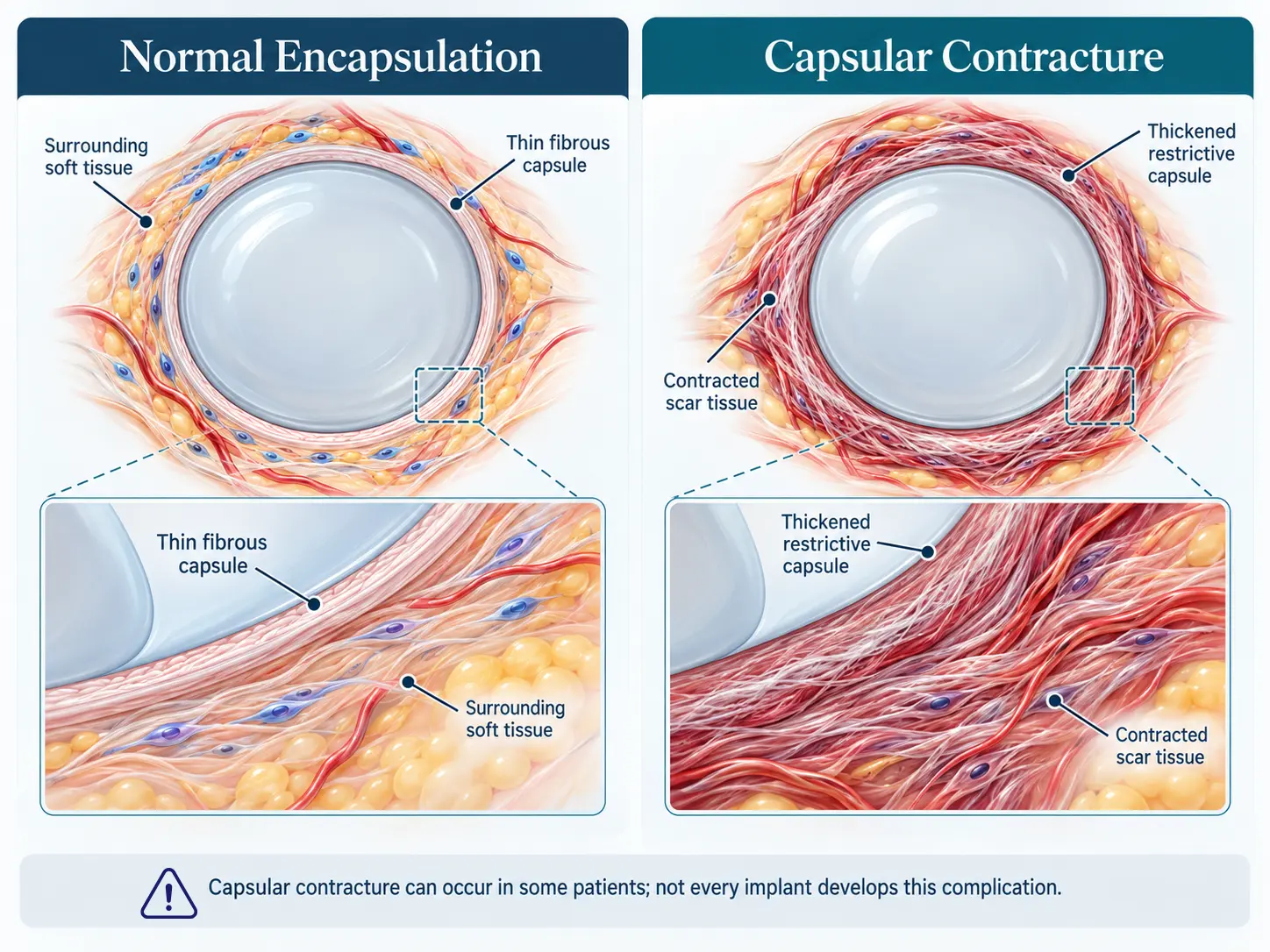
Whenever any foreign material is surgically implanted, the body responds by producing scar tissue around it.
This process is called encapsulation.
The body forms a layer of collagen-rich tissue, known as a fibrous capsule, around the implanted material.
This response is not unique to penile implants. A similar process occurs around breast implants and other medical devices.
In many situations, the capsule remains relatively thin and does not cause significant symptoms.
However, scar tissue does not always heal or behave the same way in every patient.
In some cases, the capsule becomes thicker, firmer, or more restrictive.
When the surrounding scar tissue tightens enough to interfere with the implant or nearby structures, the process is called capsular contracture.
How Can Capsular Contracture Affect the Penis?
Unlike the breast, the penile shaft must repeatedly expand and change shape as a part of its natural function.
Scar tissue triggered by a prosthetic that becomes tight or attaches to surrounding structures may restrict this natural movement.
In patients presenting to Rejuvall for post-implant complications, we have encountered problems consistent with restrictive penile scarring, including:
- Loss of visible penile length
- Tightness or pulling during erections
- Penile curvature
- Peyronie’s Disease
- Changes in penile shape or contour
- Reduced mobility of penile skin
- Discomfort or pain
- Difficulty with sexual activity
The severity of these problems depends on the location and extent of the scarring and whether surrounding structures are involved.
Capsular contracture is one possible explanation for these symptoms, but not the only one. A clinical examination is necessary to determine the actual cause.
What Happens to the Scar Capsule After Implant Removal?
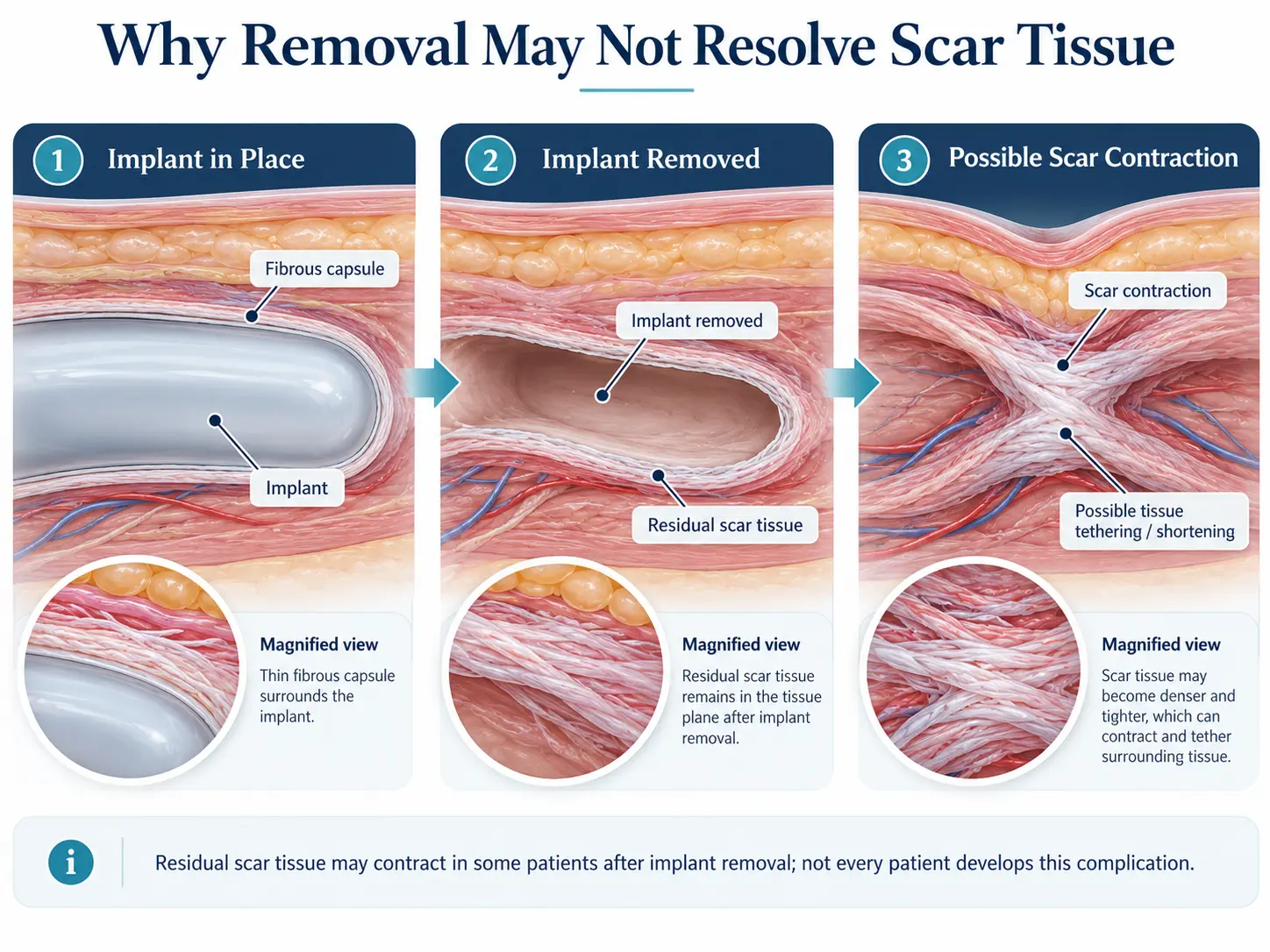
One of the most important things patients should understand is that removing the silicone implant does not remove the scar tissue that formed around it.
During some implant removal procedures, portions of the surrounding capsule often remain.
Depending on the patient’s anatomy and surgical circumstances, removing all surrounding scar tissue may not be appropriate or possible without risking injury to nearby structures.
In certain patients, residual scar tissue may continue to contract as healing progresses.
This can restrict the penile shaft, alter its shape, or contribute to shortening and curvature.
Published medical research has documented cases of penile tethering and shortening associated with capsular contraction after cosmetic penile implant removal.
The need for additional scar revision depends on the extent of the problem and its effects on penile function.
3 Types of Penile Implant Damage We Evaluate
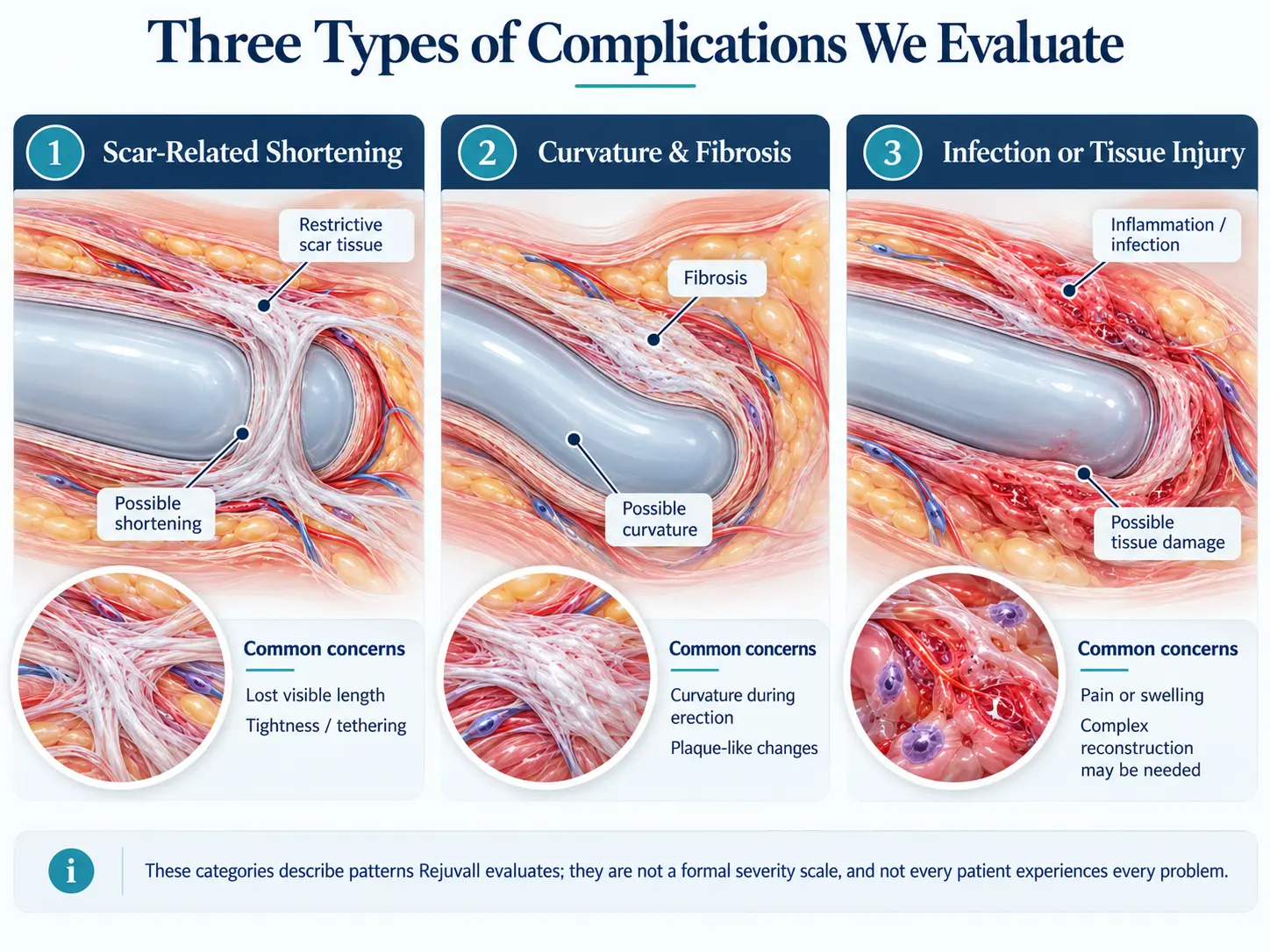
Based on our experience treating patients seeking penile enlargement repair, we have encountered several patterns of implant-related complications.
For educational purposes, these can be organized into three categories, ranging from localized scar tissue to more extensive structural damage.
These are descriptive categories based on our clinical experience, not a formally validated medical staging system.
1. Excessive Scar Tissue and Lost Penile Length
One pattern we have encountered involves internal scar tissue that restricts the penile shaft.
Some patients develop significant scarring near the penile base, while others have scar tissue extending along the shaft.
As this tissue contracts or becomes attached to nearby structures, it may restrict the penis from extending normally.
This can result in visible penile shortening, sometimes after an implant has already been removed.
For men who originally underwent penile enlargement to gain size, this can be particularly distressing.
Can Lost Penile Length Be Restored?
In selected patients, releasing or removing restrictive scar tissue may improve penile mobility and recover some of the lost visible length.
However, not every case of shortening has the same cause.
The possibility of improvement depends on the amount and location of scar tissue, previous surgical procedures, the condition of the penile tissues, and the patient’s overall healing response.
Some patients may require reconstructive surgery, while others may be candidates for different approaches.
Complete restoration of pre-implant penile length cannot be guaranteed.
Related Reading: Loss of Penile Length After Enlargement Surgery
2. Penile Curvature, Fibrosis, and Peyronie’s-Like Changes
Another pattern involves scar tissue that causes abnormal penile curvature or interferes with normal erections.
In some patients, the scar tissue remaining after implant removal contracts unevenly, pulling the penis into an abnormal position.
This may be especially noticeable during erections, when the affected tissues are placed under tension.
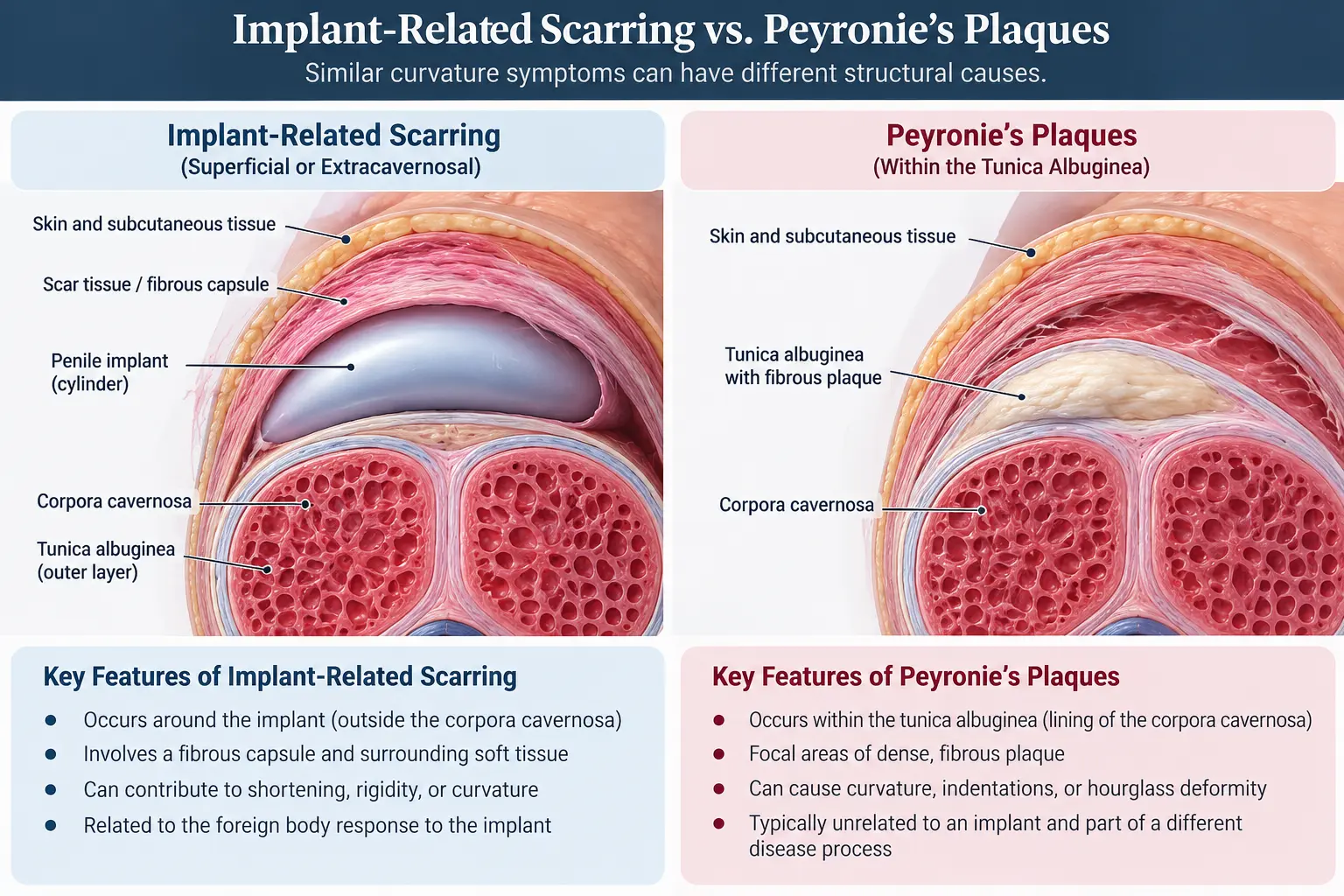
Some men also develop fibrous plaques or other structural changes that produce symptoms resembling Peyronie’s disease.
However, not every case of curvature following implant removal is Peyronie’s disease.
Peyronie’s disease typically involves plaques in the tunica albuginea, the protective tissue surrounding the erectile bodies.
Implant-related scar contracture may involve tissues outside those structures.
Although both conditions can cause curvature, shortening, and discomfort, their treatment may differ.
Why Proper Diagnosis Matters
At Rejuvall, Dr. Carney evaluates the source and extent of the deformity before determining whether corrective treatment is appropriate.
Depending on the findings, evaluation may include a physical examination and penile duplex Doppler ultrasound to assess penile anatomy and blood flow.
Some patients may require surgical release of scar tissue.
Others may have associated conditions that need separate treatment.
A penis pump or traction device may be appropriate during certain rehabilitation programs, but these devices cannot reliably remove dense scar tissue or correct severe structural deformities.
Patients should avoid aggressive stretching or unsupervised vacuum therapy when the cause of their symptoms is unknown.
Related Reading: Learn About Peyronie’s Disease Treatment at Rejuvall
3. Infection, Severe Tissue Damage, and Complex Reconstruction
A third, less common but potentially serious pattern involves infection and significant damage to penile tissues.
Infection is a recognized complication of surgically implanted medical devices.
Depending on the severity and location of an infection, implanted material may need to be removed.
In certain circumstances, repeated surgical procedures or infection involving already compromised tissue may contribute to additional scarring and difficulty healing.
At Rejuvall, we have encountered complex cases involving men who underwent multiple penile implant procedures and subsequently required extensive reconstructive care.
One particularly severe case in our clinical experience involved repeated implantation following infections and ultimately substantial penile shaft tissue damage.
In rare situations, severe tissue injury may progress to necrosis, meaning tissue has lost its blood supply and is no longer viable.
These cases may require extensive surgical reconstruction, potentially involving tissue grafts or flaps from another area of the patient’s body.
The specific reconstruction depends on the location of the damage, the amount of healthy tissue remaining, and the patient’s overall medical condition.
These severe presentations should not be considered typical outcomes of cosmetic penile implantation. They illustrate the importance of promptly addressing infection and other serious complications.
If you suspect an infection involving a penile implant, seek immediate medical evaluation rather than waiting for a cosmetic repair consultation.
What Are the Warning Signs of a Cosmetic Penile Implant Complication?
Complications may become noticeable while an implant is still in place or after it has been removed.
Symptoms that warrant medical evaluation include:
- Increasing penile firmness or tightness
- New or worsening penile curvature
- Loss of visible or functional penile length
- Pain during erections
- Hard lumps, ridges, or thickened areas
- Changes in penile sensation
- Implant movement, protrusion, or prominent edges
- Persistent swelling
- Changes in erectile function
- Skin thinning or irritation near the implant
Not every symptom indicates a serious complication or the need for surgery. However, persistent or worsening changes deserve evaluation by a qualified urologist.
Seek urgent medical attention for fever, worsening redness or swelling, pus or foul-smelling drainage, rapidly increasing pain, darkening penile skin, or exposed implant material. These symptoms may indicate infection or tissue injury requiring prompt treatment.
Why Implant Removal Alone May Not Restore Penile Size or Function
Many men understandably hope that removing an unwanted implant will return their penis to its original condition.
However, implantation and removal both involve surgery and tissue healing.
Even after the device is gone, scar tissue may remain around structures that control penile movement, sensation, and blood flow.
The residual scar capsule may contract or become attached to nearby tissues.
In some patients, this can contribute to ongoing shortening, curvature, discomfort, or erectile dysfunction.
Published surgical research has described significant scarring near penile neurovascular structures in selected patients undergoing reconstructive procedures after implant removal.
Because these structures are essential to normal penile function, their preservation is an important consideration during scar revision.
The goal of reconstruction is not simply to remove as much scar tissue as possible. It is to identify and address harmful restrictions while protecting healthy penile anatomy.
What Does Medical Research Say About Complications After Implant Removal?
Although research on long-term outcomes following cosmetic silicone penile implant removal remains limited, published studies provide useful information about complications that may occur in selected patients.
A 2025 study published in The Journal of Sexual Medicine examined 16 patients who underwent removal of a Penuma implant or presented for treatment of complications following removal.
Among these patients, researchers documented:
- Penile curvature
- Loss of penile length
- Changes in sensation
- Erectile dysfunction
- Localized infection
The investigators reported that capsular contraction contributed to penile tethering and shortening in some patients.
Ten patients underwent scar revision surgery for significant curvature. The researchers reported improvement in curvature and functional erections following revision, although none of these patients reported fully returning to their pre-implant condition.
It is important to understand the limitations of these findings.
The study involved a small, selected group of men seeking treatment for implant-related problems. It did not establish how frequently these complications occur among all cosmetic penile implant recipients.
The research also involved earlier Penuma implantation experiences and cannot independently establish complication rates for newer implant designs.
Nevertheless, the findings help explain why some patients may require additional reconstructive treatment even after the original device has been removed.
Reference: Complications of the Penuma penile implant for genital enhancement. The Journal of Sexual Medicine. 2025;22(5):975–977.
How Rejuvall Evaluates and Treats Cosmetic Penile Implant Complications
There is no single procedure that can correct every implant-related complication.
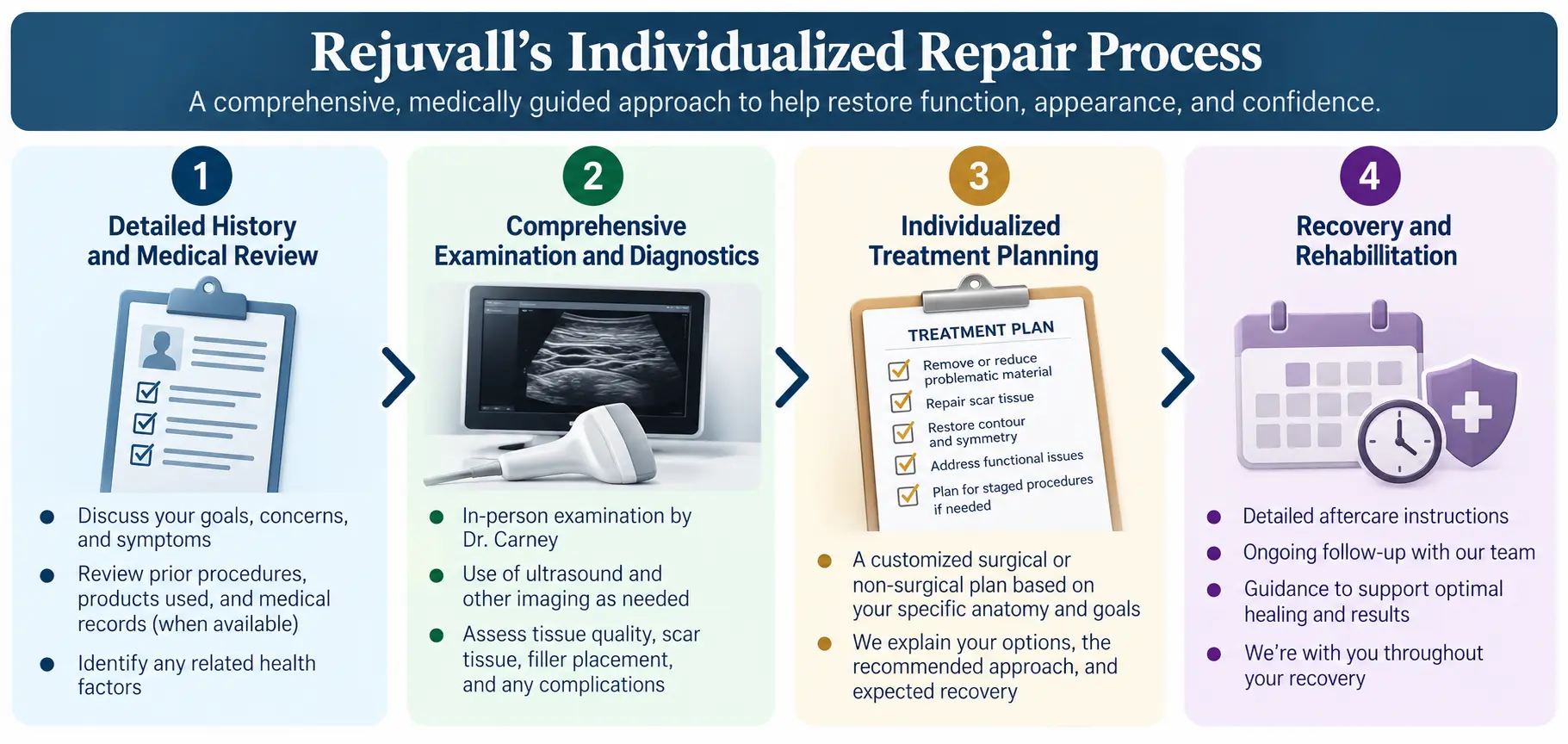
At Morganstern Rejuvall Health Centers, treatment begins with understanding the patient’s surgical history, current symptoms, and the condition of the remaining penile tissues.
Step 1: Review Your History and Symptoms
We begin by reviewing the original procedure, any subsequent surgeries, and the symptoms that developed.
Important information includes whether the implant remains in place, whether it has been removed, previous infections, and changes in penile length, curvature, sensation, or erectile function.
Prior surgical records, photographs, and imaging may help clarify the history.
Step 2: Identify the Underlying Problem
Dr. Carney evaluates whether the symptoms appear related to capsular contracture, superficial scarring, deeper fibrosis, tissue damage, or another condition.
Additional diagnostic testing may be recommended when needed.
Identifying the source of the problem is essential because conditions that look similar may require different treatments.
Step 3: Develop an Individualized Repair Plan
Depending on the clinical findings, treatment may involve:
- Surgical release or removal of restrictive scar tissue
- Correction of scar-related penile deformities
- Treatment of associated curvature or erectile dysfunction
- Reconstruction of damaged penile skin or soft tissues
- Management of implant-related complications
- Staged surgical repair when appropriate
For patients whose implant remains in place, the surgeon must also determine how management or removal of the device fits into the overall treatment plan.
Not every patient is a candidate for surgery, and not every complication can be fully corrected.
Step 4: Recovery and Rehabilitation
Appropriate postoperative care is important following any reconstructive procedure.
Depending on the treatment performed, an individualized rehabilitation program may help support healing and maintain improvements.
Some patients may benefit from medically supervised traction or other therapies when appropriate.
Patients should follow their surgeon’s specific instructions rather than attempting aggressive stretching or vacuum therapy without guidance.
Final outcomes depend on the severity of the original damage, healing, and adherence to postoperative recommendations.
Can Penile Length and Function Be Restored After Implant Removal?
This is one of the most common concerns among men seeking implant-related repair.
In some patients, improvements in penile length, curvature, appearance, or sexual function may be possible after reconstructive treatment.
However, the potential for improvement varies considerably.
Patients with localized, restrictive scar tissue may have different treatment options than those with extensive fibrosis, repeated surgeries, infection, or significant tissue loss.
Dr. Carney evaluates the anatomy and underlying cause before discussing what may realistically be achieved.
While our goal is to restore as much natural penile size and function as medically possible, no procedure can guarantee a return to the patient’s original pre-implant condition.
Why Choose Dr. Kenneth J. Carney for Penile Implant Complication Repair?
Treating complications after cosmetic penile surgery requires a detailed understanding of penile anatomy and reconstructive techniques.
Repeated operations and extensive scarring can make these cases particularly challenging.
At Morganstern Rejuvall Health Centers, reconstructive surgical care is led by co-founder Dr. Kenneth J. Carney, MD, PharmD, FACS.
Dr. Carney’s background includes:
- Board certification in urology and surgery
- A Doctor of Pharmacy degree
- More than two decades serving as Chief of Urology at Grady Memorial Hospital in Atlanta
- An academic appointment at Emory University School of Medicine
- Founding and continued leadership of a Genitourinary Reconstructive Surgery (GURS) fellowship
- Extensive experience treating complex male genitourinary conditions
Grady Memorial Hospital is a major Level I trauma center, where physicians regularly manage serious injuries and complex surgical conditions.
Dr. Carney’s training and experience in reconstructive urology are particularly relevant when complications involve scar tissue near delicate penile nerves, blood vessels, and erectile structures.
At Rejuvall, the priority is understanding the original injury, preserving healthy tissue, and identifying appropriate options for restoring function and appearance.
Frequently Asked Questions About Cosmetic Silicone Penile Implant Repair
Yes. Cosmetic silicone penile implants can be surgically removed. However, removal does not always resolve complications involving scar tissue, curvature, or penile shortening. Some patients require additional treatment.
Yes. The body may form a fibrous capsule around an implanted device. Some of this scar tissue can remain after removal and, in certain patients, may contract or restrict nearby tissues.
Several factors may contribute, including restrictive scar tissue, capsular contraction, previous surgical injury, or complications involving surrounding tissues. A clinical evaluation is needed to determine the cause.
In selected patients, surgical release or revision of restrictive scar tissue may improve penile mobility and recover some lost length. The amount of improvement varies, and complete restoration cannot be guaranteed.
Some men develop penile curvature or fibrosis following implantation or removal. These changes may resemble Peyronie’s disease, but the underlying causes can differ. A qualified urologist can determine whether curvature involves implant-related scarring, Peyronie’s plaques, or another condition.
Vacuum devices and traction may have a role in certain rehabilitation plans, but they cannot reliably remove dense scar tissue or correct significant structural deformities. Patients should seek medical guidance before using these devices following implant complications.
No. Morganstern Rejuvall Health Centers does not offer cosmetic silicone sleeve implants for penile enlargement. Our practice evaluates and treats selected complications following silicone penile implant enhancement procedures performed elsewhere.
Yes. Our practice does evaluate men experiencing complications following penile enhancement procedures performed by other providers. The appropriate treatment depends on the patient’s medical history and examination findings.
Repair costs depend on the extent of the complication, required diagnostic testing, and whether treatment involves one or more procedures. An individualized clinical evaluation is necessary to determine appropriate treatment options and pricing.
Get Help for Silicone Penile Implant Complications
If you have experienced penile shortening, curvature, excessive scar tissue, or other complications following a cosmetic penile implant procedure, understanding the underlying cause is the first step toward determining your options.
At Morganstern Rejuvall Health Centers, we evaluate men who have undergone enlargement procedures elsewhere and are now seeking specialized reconstructive care.
Our approach focuses on identifying the source of the complication, protecting healthy penile anatomy, and exploring appropriate treatment options to improve length, appearance, or function where possible.
Start with our confidential Cosmetic Urology Assessment.
After completing the assessment, you can schedule a free, private phone case consultation with our Patient Education Director to discuss your concerns and learn about the next steps toward a clinical evaluation.
Complete Your Confidential Cosmetic Urology Assessment
If the Cosmetic Urology Assessment form doesn’t appear above, click here to open it in a new window.
Trademark Notice: Penuma® and Himplant® are third-party trademarks used on this page solely to identify the products discussed for patient education. Morganstern Rejuvall Health Centers is an independent medical practice and is not affiliated with, sponsored by, or endorsed by the applicable manufacturers or trademark owners.
Medical Disclaimer: This information is provided for educational purposes and does not replace an individualized medical evaluation. Clinical observations discussed here reflect patients presenting to Rejuvall for reconstructive evaluation and should not be interpreted as complication rates for all implant recipients. Treatment availability and outcomes depend on each patient’s condition.
