
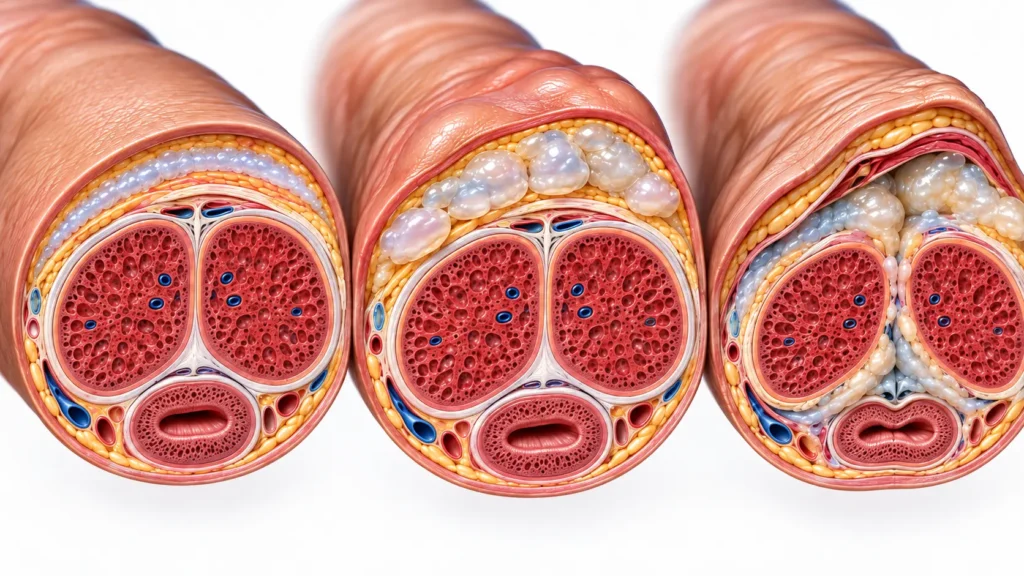
Penile Filler Repair: HA & PMMA Complications From Overuse or Improper Placement
Quick Answer: Penile filler complications can occur when too much product is injected, filler is distributed unevenly, or HA or PMMA is placed in the wrong tissue plane. These problems may cause lumps, nodules, excessive firmness, asymmetry, pain, inflammation, or, in more serious cases, problems involving deeper penile structures.
HA can often be dissolved with hyaluronidase. PMMA is permanent and cannot be dissolved, so repair may be more complex.
At Morganstern Rejuvall Health Centers, Dr. Kenneth J. Carney, MD, PharmD, FACS evaluates the filler material, volume, location, tissue response, and affected anatomy before recommending a repair approach.
When Penile Filler Goes Wrong
Penile filler requires more than simply adding volume beneath the skin.
The penis contains thin, mobile tissues surrounding important blood vessels, nerves, lymphatic pathways, erectile structures, and the urethra. There is limited room for injectable material, and placement matters.
Problems can develop when:
- Too much filler is used (in a single session, or overall)
- Filler is placed unevenly
- Too much material is crowded into superficial tissue
- Filler is placed too deeply
- Additional filler is used to cover an existing problem instead of correcting it
- Permanent filler is added before the patient’s tissue and immune response and desired size are fully understood
These complications may affect appearance, comfort, sensation, erections, or urinary function depending on their severity.
Too Much Penile Filler
There is no single number of syringes or milliliters that defines “too much” for every patient.
Penile anatomy, skin mobility, shaft circumference, previous procedures, scar tissue, and tissue and immune response all vary from patient to patient.
Overuse occurs when more filler is placed than the patient’s tissues can safely and predictably accommodate.
Possible problems include:
- Excessive firmness
- Bulky or unnatural contour
- Lumps or ridges
- Asymmetry
- Chronic swelling or inflammation
- Nodules or granulomas
- Fibrosis
- Pain, including pain during erection
Adding more filler is not the solution. If excessive volume is already contributing to the problem, additional injections make correction more difficult.
Improper Placement: Too Superficial or Too Deep
Filler placement can create different problems depending on the tissue plane.
Too superficial
Filler may become more visible or palpable and can contribute to rippling, nodules, uneven contour, firmness, or an overfilled appearance.
Too deep
Placing filler deeper does not automatically make treatment safer.
Deeper penile structures contain critical nerves, blood vessels, erectile tissue, and the urethra.
Permanent or excessive material placed too close to these structures can create more serious complications.
There is no large, empty space within the penis (even after stretching or pumping) where filler can be placed without anatomical consequences.
HA vs. PMMA: Why Repair Is Different
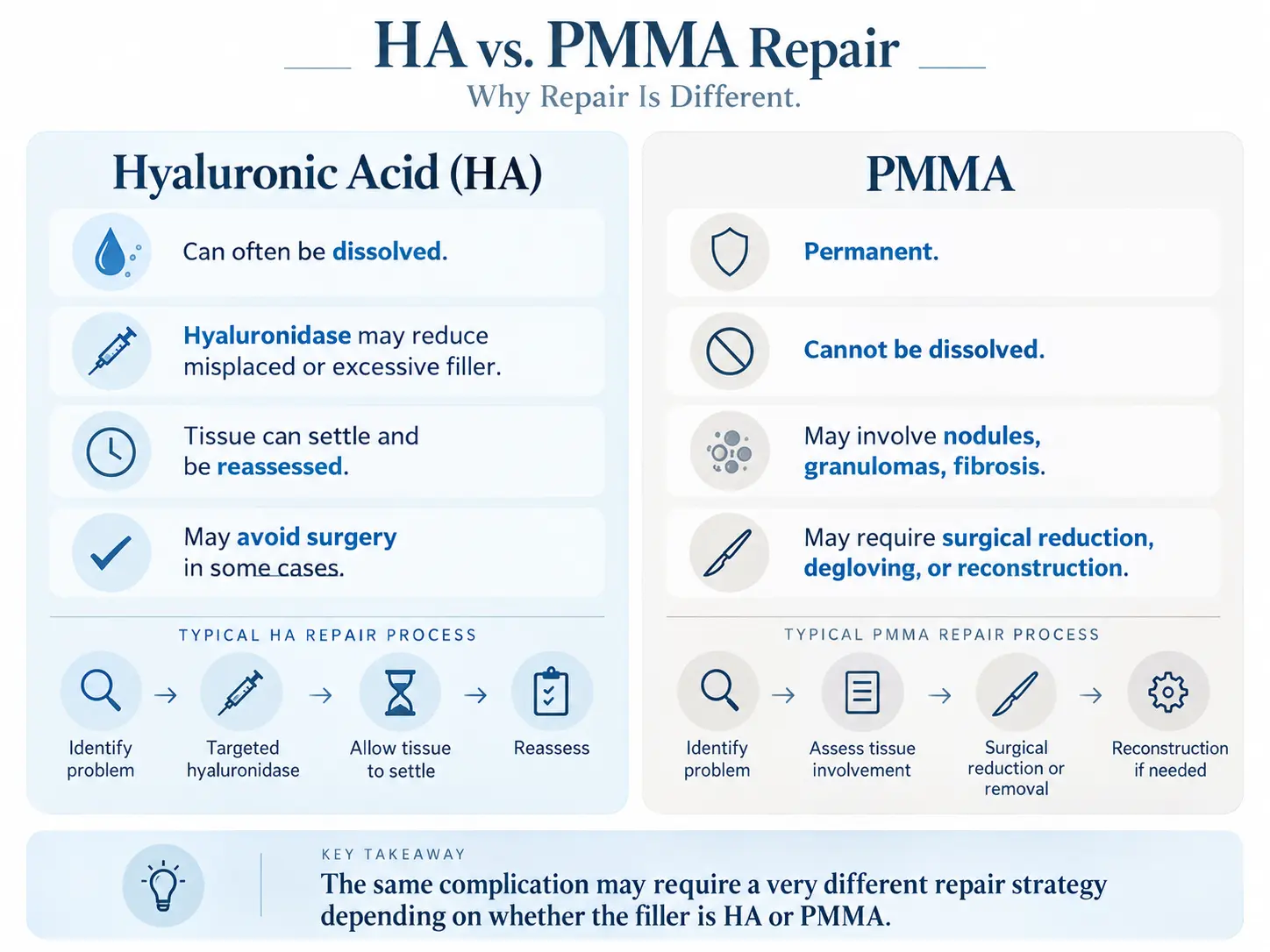
Both HA and PMMA can cause complications when volume or placement is inappropriate, but the repair options are different.
Hyaluronic Acid (HA)
HA can often be reduced or removed with hyaluronidase. This may allow a physician to correct excessive volume or irregular placement without surgery in some cases.
However, HA being reversible does not make poor technique harmless. Improperly placed HA can still cause pain, inflammation, contour problems, and other complications.
PMMA
PMMA is permanent and cannot be dissolved.
Once PMMA becomes incorporated into surrounding tissue and collagen, correction becomes more difficult. Significant problems involve nodules, granulomas, fibrosis, excessive permanent volume, or material positioned near deeper anatomy.
Some PMMA complications may require surgical reduction, removal of affected tissue, or reconstruction.
Common Problems We Evaluate
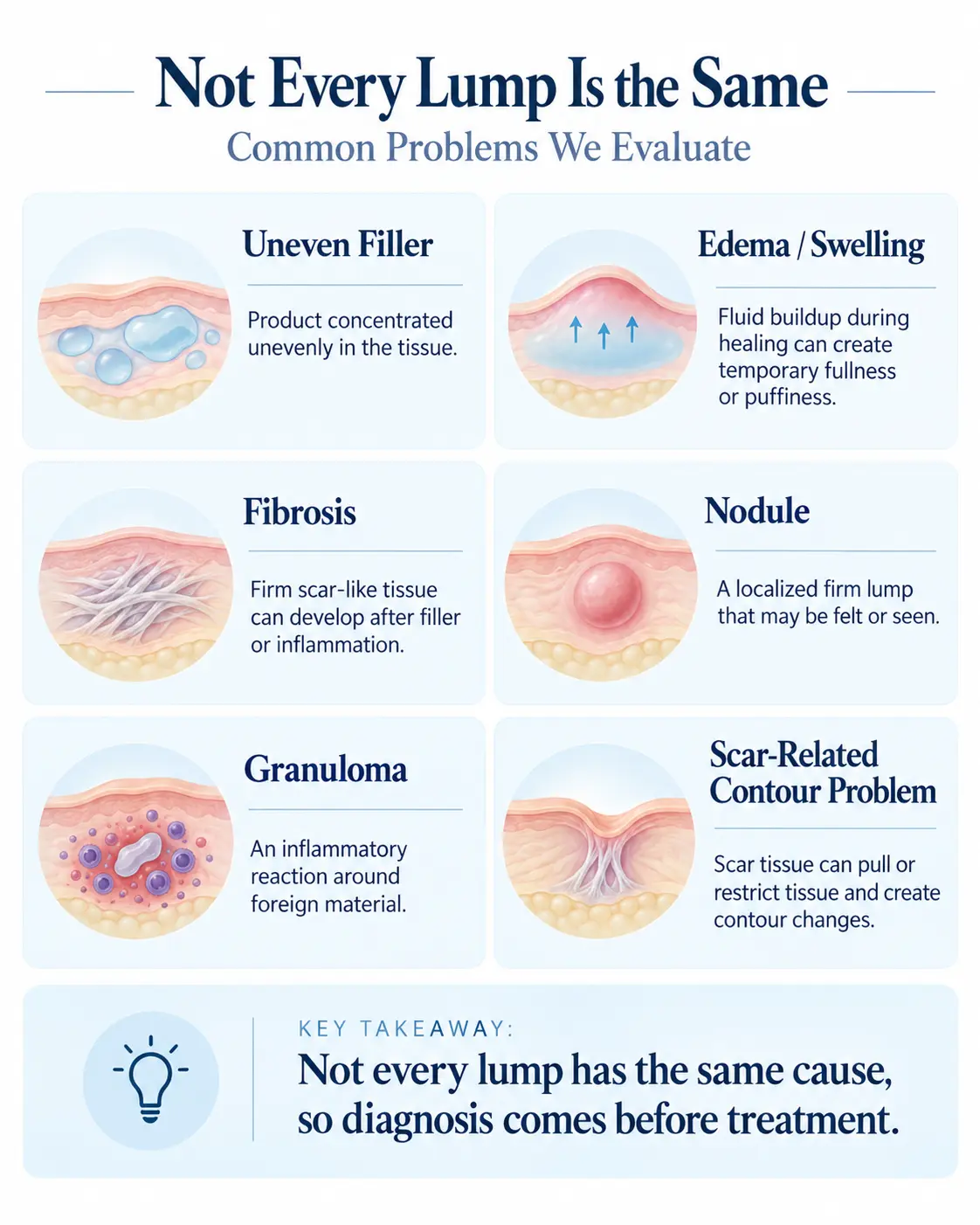
Patients may seek repair after penile filler because of:
- Lumps or nodules
- Uneven girth
- Ridges or irregular contour
- Excessive firmness
- Too much overall volume
- Chronic swelling
- Persistent inflammation
- Pain or tenderness
- Pain during erection
- Abnormal scar tissue
- Changes in sensation
- Urinary symptoms
- Previous unsuccessful attempts to dissolve or correct filler
Not every lump has the same cause. It may represent uneven filler, edema, fibrosis, a granuloma, scar tissue, or another problem.
That is why diagnosis always comes before treatment.
How Dr. Carney Evaluates Penile Filler Repair
Repair planning begins by determining what actually happened beneath the skin.
Dr. Carney evaluates factors including:
- What product was injected
- How much was used
- Number and timing of treatment sessions
- Whether the filler appears superficial or deep
- Areas of firmness, fibrosis, or inflammation
- Nodules or granulomas
- Skin and tissue mobility
- Penile contour
- Sensation
- Erectile symptoms
- Urinary symptoms
- Previous repair attempts
Medical records from the original injector can also be helpful, especially when the exact product or amount used is uncertain.
Are You Sure You Were Actually Injected With PMMA?
One important part of evaluating a penile filler complication is confirming what material was actually injected.
Rejuvall has seen a sharp increase in patients who were told they received PMMA but were later found to have liquid silicone or another permanent injectable material in their penile tissues. In some cases, the patient had no reason to question what they had originally been told.
This matters because PMMA and silicone behave very differently inside the body and require very different repair strategies.
Liquid silicone tends to migrate through tissue, interfere with lymphatic drainage, trigger chronic inflammation, form hardened areas, and create complications many years after the original injections.
For this reason, Dr. Carney does not base a repair plan solely on the name of the product a patient remembers being told they received. Whenever possible, Rejuvall asks patients to obtain records showing the exact product, amount used, treatment dates, and lot information. Sadly, a few clinics do give false information during that medical disclosure.
If the material appears inconsistent with PMMA or the patient’s symptoms suggest another injectable may be present, further evaluation may be necessary before deciding how to approach the repair.
Learn more about silicone girth enhancement complications and repair →
How Penile Filler Complications May Be Repaired
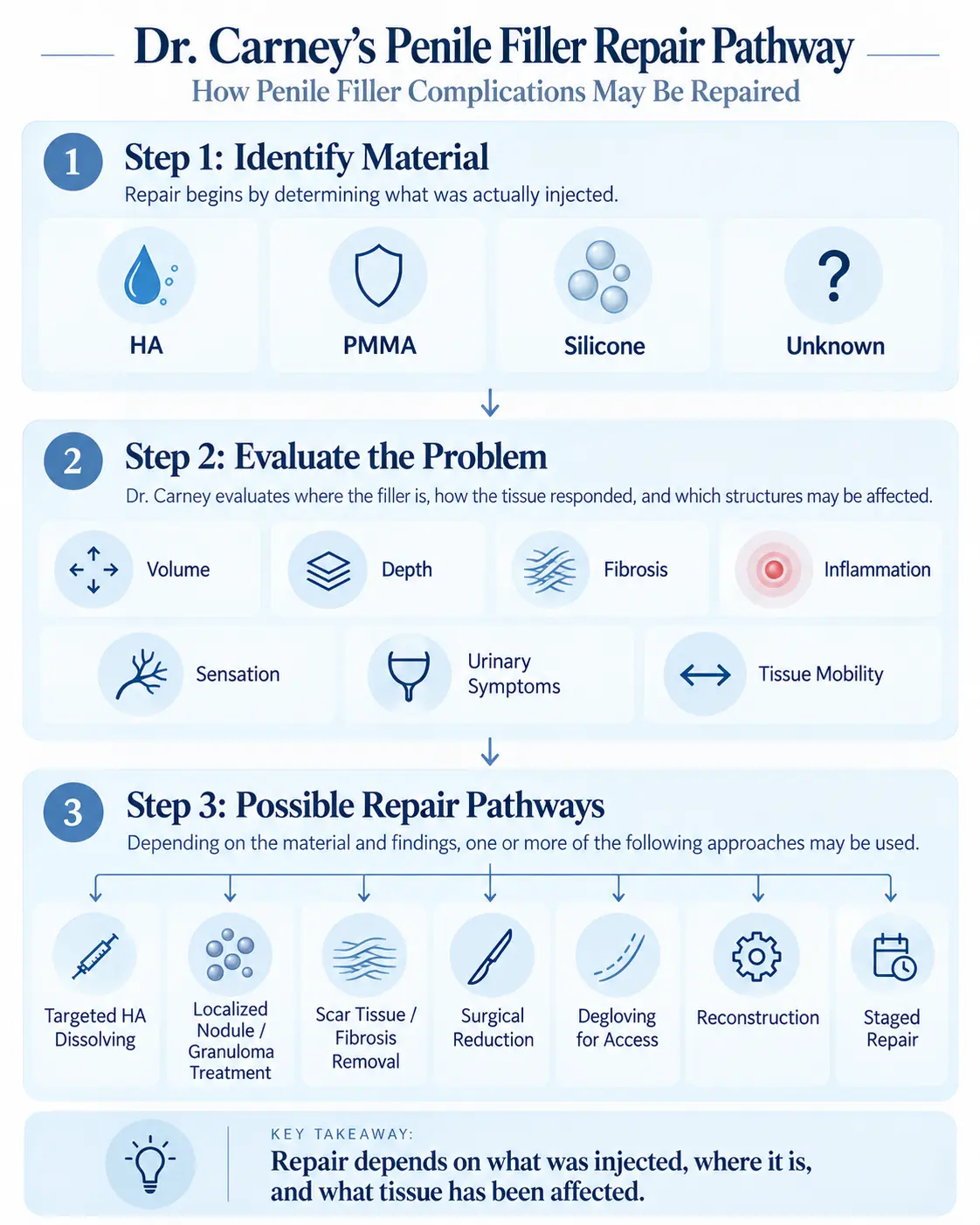
There is no single procedure for repairing a penile filler complication. Dr. Carney tailors the repair to the material involved, where it was placed, how much tissue has been affected, and whether the problem is primarily cosmetic, inflammatory, functional, or a combination of these.
For HA complications, treatment may include carefully dissolving excessive or misplaced filler with hyaluronidase. In some cases, the goal is not necessarily to dissolve every bit of HA.
Dr. Carney may instead target the areas creating excessive bulk, pressure, asymmetry, nodules, or abnormal contour and then allow the tissues to settle before deciding whether anything further is needed.
When PMMA or significant scar tissue is involved, repair can be more complex because PMMA cannot be dissolved. Depending on the individual case, Dr. Carney may be able to:
- Remove or reduce localized nodules or granulomas
- Excise problematic scar tissue or fibrosis
- Surgically reduce areas containing excessive permanent filler
- Release tissue that has become restricted or distorted by scarring
- Correct irregular contour caused by previous filler placement
- Remove damaged or chronically inflamed tissue when medically necessary
- Reconstruct affected penile tissues when a complication has caused more significant anatomical damage
- Perform repair in stages when trying to correct everything at once would place too much stress on the remaining healthy tissue
In complex cases, the objective is not simply to “take the filler out.” Permanent material may be incorporated into the patient’s own tissue, and attempting to remove every trace could unnecessarily damage healthy anatomy.
Instead, Dr. Carney’s goal is to identify which tissue is actually causing the problem, remove or correct what can safely be addressed, preserve healthy penile structures, and restore the best possible combination of comfort, function, and appearance.
Some patients need only a relatively focused correction. Others who have experienced excessive permanent filler, extensive fibrosis, repeated injections, previous failed repairs, or injury to deeper structures may require a more involved reconstructive approach.
Why Reconstructive Urology Experience Matters
Once a filler complication affects more than appearance, it is no longer simply a cosmetic issue.
Pain during erection, loss of tissue mobility, abnormal sensation, fibrosis, problems involving blood flow, or urinary symptoms all require an understanding of penile anatomy that extends beyond injectable filler technique.
Dr. Jeff Carney, MD, PharmD, FACS is a board-certified urologist and surgeon with decades of extensive experience in penile surgery, reconstructive urology, cosmetic urology, and repair of complications from previous male enhancement procedures.
This allows him to evaluate not only where the filler is, but also what it may be doing to the surrounding anatomy and what can safely be corrected without creating another problem.
When Symptoms Need Prompt Medical Attention

Some temporary swelling and tenderness can occur after filler treatment.
However, seek prompt medical evaluation for symptoms such as:
- Increasing or severe pain
- Difficulty urinating
- Blood from the urethra
- Major loss of sensation
- Significant penile or glans color change
- Cold or darkening tissue
- Open wounds
- Fever
- Pus or foul-smelling drainage
- Rapidly worsening inflammation
These symptoms represent more than a cosmetic filler problem.
Why PMMA Repair May Require Degloving the Penis
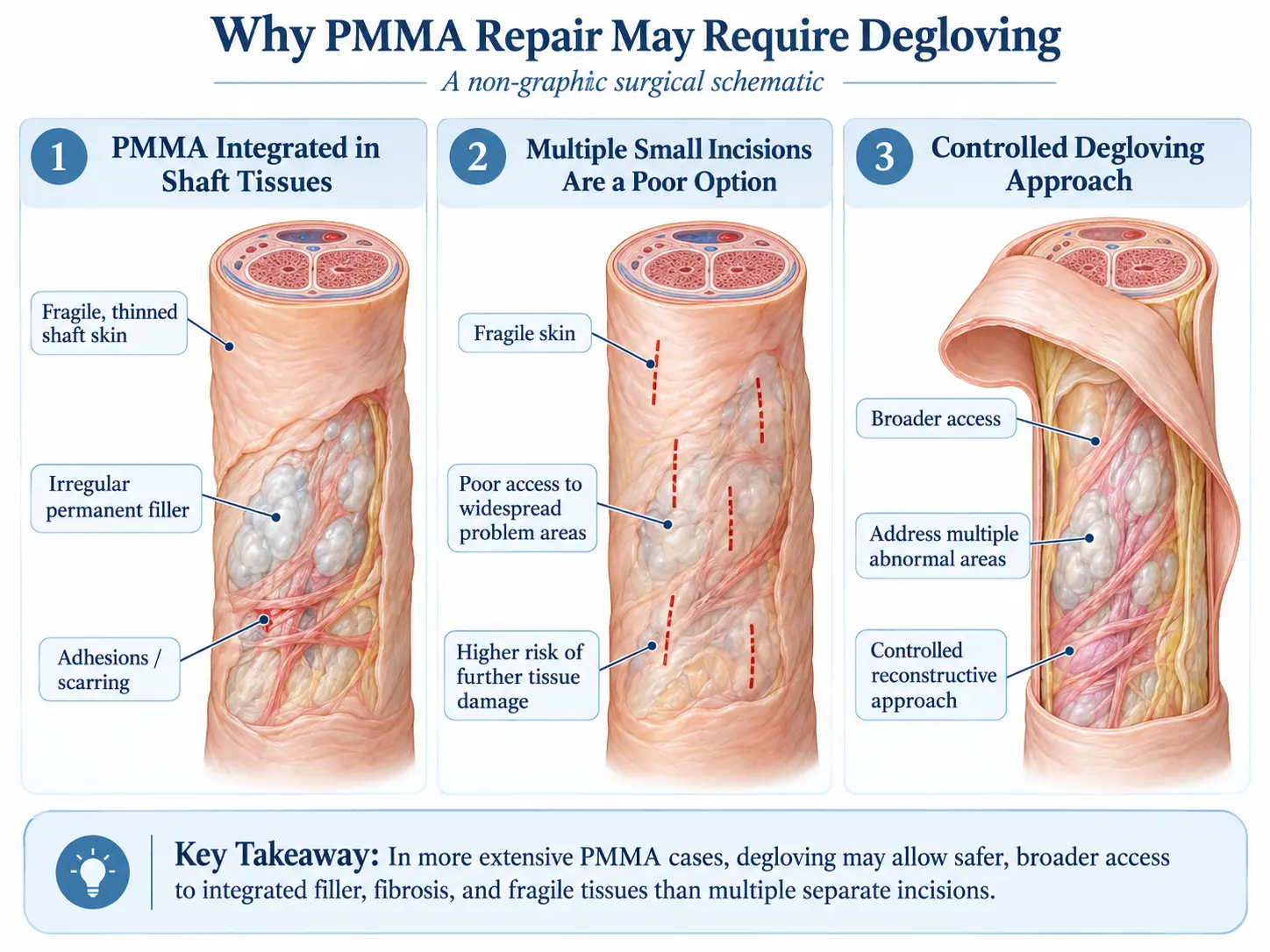
PMMA repair is usually very different from removing a single isolated lump.
Once PMMA has been in the penis long enough to integrate with the surrounding collagen and soft tissue, the shaft skin and underlying tissues become extremely thin, fragile, scarred, or tightly adherent to the filler beneath them.
In these cases, Dr. Carney will need to deglove the penis (carefully lifting the shaft skin away from the deeper tissues) to safely access and correct the affected areas.
Trying to make multiple small incisions directly over individual nodules, granulomas, or areas of uneven filler is not appropriate when the skin has become fragile.
In some longstanding PMMA cases, Dr. Carney describes the tissue as behaving almost like tissue paper: creating several separate openings can further compromise already-weakened skin and make wound healing more difficult.
Degloving provides broader surgical access to the affected tissue while allowing Dr. Carney to address multiple areas through a controlled approach rather than repeatedly cutting fragile shaft skin.
Depending on the case, this will allow him to:
- Remove or reduce problematic PMMA-containing tissue
- Excise nodules or granulomas
- Remove fibrosis or dense scar tissue
- Release areas that have become tethered or restricted
- Improve contour irregularities
- Preserve healthier surrounding tissue
- Reconstruct areas damaged by previous filler or previous repair attempts
Not every PMMA complication requires degloving, but more extensive or longstanding cases will require this type of reconstructive approach.
Why Adding More PMMA Does Not Fix an Uneven PMMA Result
An uneven PMMA result may sometimes appear temporarily improved when additional filler is injected into lower areas.
That does not necessarily correct the underlying problem.
If the original irregularity is caused by uneven PMMA distribution, fibrosis, granuloma formation, abnormal collagen response, or tissue restriction, adding more permanent material simply adds another layer of filler around an existing structural problem.
The penis may look more even for a period of time, but as the tissue continues to heal, remodel, and react to the permanent material, irregularities become visible or palpable again.
For this reason, Dr. Carney does not view repeatedly adding PMMA as a reliable way to repair an already-complicated PMMA result.
The goal of repair is to identify and correct the tissue causing the unevenness, not simply cover it with more permanent filler.
PMMA Cannot Be Dissolved or Injected Away
Unlike hyaluronic acid filler, PMMA cannot be dissolved.
There is also no injectable medication that simply removes integrated PMMA, scar tissue, or a true PMMA granuloma.
Some providers may inject corticosteroids such as Kenalog® (triamcinolone) into firm or inflamed areas. Steroids can sometimes reduce inflammation and make scarred or inflammatory tissue feel softer.
However, this does not remove the PMMA itself, and it does not eliminate the underlying nodule, granuloma, fibrosis, or uneven distribution of permanent filler.
A softer lump is not always a corrected lump.
If the physical problem is permanent material embedded within abnormal or scarred tissue, definitive correction may still require surgical treatment.
Can Penile Filler Complications Be Repaired?
Many penile filler complications can be improved, but the repair depends on what actually caused the problem and what material is present.
For some HA complications, treatment may be relatively limited. Targeted hyaluronidase can sometimes reduce excessive or misplaced filler and allow the tissues to settle before they are reassessed.
PMMA complications are different because PMMA is permanent and cannot be dissolved.
Localized problems may sometimes be treated with focused removal of a nodule, granuloma, scar tissue, or a limited area of problematic material. However, more extensive PMMA complications require a much broader reconstructive approach.
When PMMA has integrated throughout the shaft tissues, the overlying skin becomes thin, fragile, scarred, or tightly adherent. In these cases, making multiple small incisions to chase individual lumps or irregularities will only serve to further damage already-compromised tissue.
Dr. Carney may instead need to deglove the penis to gain controlled access to the affected tissue, remove or reduce problematic PMMA-containing tissue, address fibrosis or granulomas, release restricted areas, and reconstruct the shaft while preserving as much healthy anatomy as possible.
Simply adding more PMMA is not a true repair for an uneven permanent-filler result. It may temporarily camouflage low areas, but it does not correct the underlying uneven distribution, fibrosis, granuloma formation, or tissue distortion and may add even more permanent material to an already-complicated problem.
Likewise, steroid injections such as Kenalog may sometimes reduce inflammation or soften firm tissue, but they do not dissolve PMMA or physically remove permanent filler, fibrosis, or a granuloma.
For patients with extensive PMMA complications, treatment may therefore require:
- Surgical removal or reduction of problematic tissue
- Nodule or granuloma excision
- Fibrosis and scar-tissue removal
- Release of restricted or tethered tissue
- Degloving for broader surgical access
- Reconstruction of damaged shaft tissue
- Staged repair when correcting everything at once would place too much stress on remaining healthy tissue
The goal is not simply to remove every trace of PMMA or make the penis look smoother temporarily. The goal is to address the tissue actually causing the complication while preserving healthy anatomy and improving comfort, function, penile health, and appearance.
Concerned About Penile Filler Performed Elsewhere?
If you are experiencing persistent lumps, pain, inflammation, excessive firmness, abnormal contour, urinary symptoms, or another problem after HA or PMMA penile filler, Rejuvall can evaluate the underlying cause and determine whether repair may be appropriate.
If possible, obtain records from your original injector showing the product used, amount injected, treatment dates, and number of sessions. This information can help Dr. Carney better understand what may be present before planning a repair.
To take the next step, complete and submit the Cosmetic Urology Assessment below. Once your assessment has been reviewed, our team can help you schedule your case consultation.
Complete the Cosmetic Urology Assessment Below
If the Cosmetic Urology Assessment form doesn’t appear above, click here to open it in a new window.
