
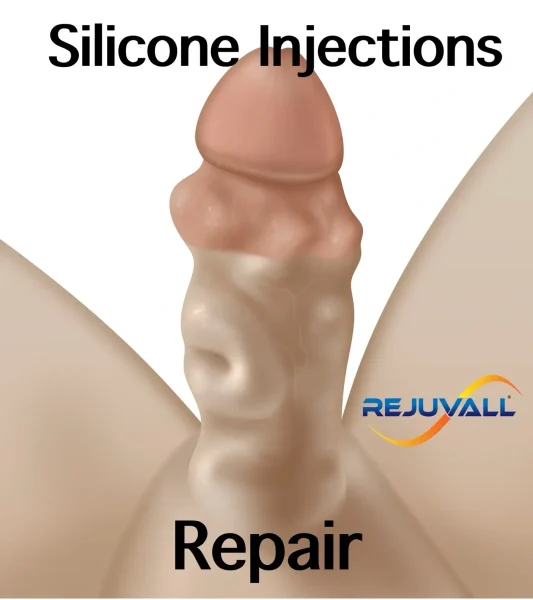
Complications of Silicone Penile Injections
Liquid silicone penile injections complications occur because silicone oil does not stay localized. Over time, it can migrate into penile tissue, the scrotum, abdomen, and lymphatic system, causing granulomas, chronic inflammation, tissue necrosis, deformity, pain, and impaired lymphatic drainage.
RED FLAG WARNING:
Many clinics promote penile injections using terms such as “pharmaceutical grade silicone,” “collagen-inducing filler,” “CMC injections,” or “minimally invasive permanent penile thickening.” These phrases are marketing language, not medical classifications.

There is no FDA-approved form of silicone oil for penile injection.
Silicone injected into penile or scrotal tissue is:
- non-biodegradable
- non-absorbable
- prone to migration
- capable of triggering chronic immune and inflammatory reactions
While physicians may disagree about the risks and benefits of certain cosmetic procedures, there is broad medical consensus that injecting liquid silicone into the penis or groin is dangerous and medically inappropriate.
Unfortunately, we continue to see its use increase—often under deceptive branding—resulting in severe, life-altering complications for patients.
How Silicone Is Marketed as “Permanent” or “Collagen-Inducing”

Silicone injections are often falsely marketed as “permanent,” “collagen-inducing,” or “all-natural” penile enlargement. These claims are medically inaccurate. In practice, these procedures involve injecting liquid silicone oil, which does not stimulate meaningful collagen growth and carries significant long-term health risks.
Many men who present to our clinic believed they received a safe, non-silicone filler.
Instead, they were told they underwent a:
- “minimally invasive permanent penile thickening”
- “collagen activation” or “collagen layering” procedure
- “all-natural, non-surgical penile enlargement”
- “CMC-based injectable filler”
- “pharmaceutical grade silicone”
Patients commonly report being told that:
“The injected material dissolves in a few weeks, and that’s when your body starts producing permanent collagen.”
This explanation is medically false.
In cases where we have surgically removed and laboratory-tested the injected material, it was found to be predominantly liquid silicone oil, often comprising 90–95% of the injected volume, with only trace amounts of thickening agents.
There was no evidence of meaningful collagen formation inside the penile shaft.
What Is Actually Being Injected
So-called “minimally invasive permanent penile thickening” is not a recognized medical procedure. Surgical findings show these injections typically consist of liquid silicone oil mixed with small amounts of thickening agents such as carboxymethylcellulose (CMC) and anesthetic—rather than FDA-approved dermal fillers.
Based on surgical findings, imaging, and extracted material analysis, these injections typically contain:
- Dimethicone (silicone oil):
A low-viscosity silicone fluid that is not approved for penile injection and is known to migrate extensively through human tissue. - Carboxymethylcellulose (CMC):
A thickening agent sometimes added in small amounts to increase the viscosity of silicone oil so it can be injected more easily. CMC itself does not create collagen or permanent tissue structure. - Lidocaine:
A local anesthetic included to reduce pain and swelling during injection. Its presence is often used to make the mixture appear more “medical,” but it has no relevance to long-term outcomes.
In other words, these procedures are silicone oil injections disguised through terminology, not regenerative or collagen-based therapies.
Silicone oil is inexpensive, easy to obtain, and highly profitable—factors that help explain its continued misuse despite well-documented risks.
Why Silicone Injection Complications Often Appear Years Later
Silicone injection complications are frequently delayed because silicone oil does not biodegrade or remain stable in tissue. Patients may develop granulomas, immune reactions, migration, or lymphatic obstruction many years after injection—even when early symptoms were absent.
One of the most dangerous aspects of silicone penile injections is how long complications can take to appear.
If a patient does not experience:
- acute infection,
- immediate allergic reaction, or
- early tissue necrosis,
they are often falsely reassured that the procedure was “successful.”
In reality, silicone-related complications are frequently delayed.
We routinely see men present 5, 10, or even 15 years after injection with new symptoms they never connected to a prior enlargement procedure.
These delayed complications occur because silicone oil:
- does not break down,
- does not stay where it was injected,
- and continuously interacts with the immune and lymphatic systems.
Silicone Migration: Why It Never Stays in Place
Silicone oil has extremely low viscosity and behaves like free fluid rather than tissue. Once injected, it can migrate through tissue planes and lymphatic channels into the scrotum, lower abdomen, pelvis, and lymph nodes, making complete removal medically impossible.
Liquid silicone has an extremely low viscosity. Once injected, it behaves like oil rather than tissue.
Over time, silicone droplets:
- move between tissue planes,
- enter lymphatic channels,
- migrate into the scrotum, lower abdomen, pelvis, and lymph nodes.
This migration happens slowly and silently.
Patients may notice:
- gradual asymmetry,
- firm or hardened skin,
- unexplained swelling,
- or nodules forming far from the original injection site.
Imaging studies—including duplex Doppler ultrasound—frequently reveal widespread silicone dispersion, even in patients who were told silicone was not used.
Once migration occurs, complete removal becomes medically impossible.
The Lymphatic System: Why Silicone Causes Long-Term Harm
The lymphatic system removes waste, toxins, and excess fluid from tissue. When silicone oil enters lymphatic channels, it can obstruct drainage, leading to chronic inflammation, immune dysfunction, lymphedema, infection risk, and progressive tissue damage.
The groin and genital region contain some of the most critical lymphatic drainage pathways in the human body.
The lymphatic system:
- removes waste products,
- filters toxins,
- regulates immune response,
- and prevents chronic swelling and infection.
When silicone oil enters these channels, it obstructs lymphatic flow.
This leads to:
- chronic inflammation,
- immune dysregulation,
- progressive swelling (lymphedema),
- and increased susceptibility to infection and tissue breakdown.
Unlike temporary fillers, silicone remains permanently embedded within these pathways.
Granulomas and Chronic Immune Reactions

Silicone is recognized by the body as a foreign substance. The immune system responds by forming penile filler granulomas, foreign-body giant cell reactions, and fibrotic nodules that often worsen over time and do not resolve with massage or dissolving enzymes.
Silicone is recognized by the body as a foreign substance.
In response, the immune system attempts to isolate it by forming:
- granulomas,
- foreign body giant cell reactions,
- fibrotic nodules.
These immune reactions:
- may appear months or years after injection,
- often worsen over time,
- and can become painful, disfiguring, or functionally impairing.
Importantly, granulomas caused by silicone do not resolve with massage or dissolving enzymes.
Additional injections—especially of more silicone—make the immune reaction worse, not better.
We have treated multiple patients who were told their unevenness was “collagen growth” and encouraged to undergo additional injections, only to experience rapid worsening of symptoms.
Silicone Migration Into the Scrotum and Pelvis

Silicone migration into the scrotum and pelvis is especially dangerous due to disruption of lymphatic drainage. This can lead to scrotal lymphedema, chronic infection, massive swelling, pain, urinary dysfunction, and severe long-term disability.
When silicone reaches the scrotum, the consequences become more severe.
The scrotal skin is:
- thin,
- highly vascular,
- and essential to lymphatic drainage from the groin.
Silicone infiltration in this region can cause:
- scrotal lymphedema,
- skin thickening and fibrosis,
- recurrent infections,
- massive enlargement of the scrotum (“giant scrotal lymphedema”).
In advanced cases, patients experience:
- difficulty walking,
- urinary obstruction,
- chronic pain,
- severe emotional distress.
These conditions are not cosmetic problems—they are serious urologic and systemic medical disorders.
Why Silicone Is Especially Dangerous Compared to Other Fillers
Unlike PMMA filler penile enhancement
or hyaluronic acid penile filler, silicone oil is not regulated, biodegradable, or stable, and it poses significantly higher long-term medical risks. Once injected, silicone can cause permanent inflammation, migration, granulomas, tissue necrosis, and systemic health risks.
Injectable dermal fillers regulated by the FDA are:
- temporary,
- biodegradable,
- and eventually absorbed by the body.
Silicone is none of these things.
The FDA has repeatedly warned that:
- injectable silicone is not approved for cosmetic use,
- it is not classified as a dermal filler,
- and it has been linked to chronic pain, scarring, embolism, autoimmune reactions, and death.
Once injected, silicone cannot be fully removed.
Surgery can reduce the burden of silicone and repair damaged tissue, but it can never restore the body to its pre-injection state.
Silicone Penile Injection Removal & Repair: What Can — and Cannot — Be Fixed

Silicone oil cannot be fully removed once injected. Surgical penile girth enhancement repair focuses on reducing silicone burden, removing damaged tissue, restoring function where possible, and preventing progression of immune or lymphatic disease—not reversing exposure.
Once silicone oil has been injected into penile or scrotal tissue, there is no way to reverse the exposure.
What can be done is damage control:
- reducing the total silicone burden,
- repairing compromised tissue,
- restoring function where possible,
- and preventing further progression of disease.
Understanding these limits is essential for patient safety and informed decision-making.
Why Silicone Cannot Be Fully Removed
Silicone disperses as microscopic droplets that integrate into tissue and migrate through lymphatic and vascular systems. Even advanced surgery cannot fully remove all silicone once it has spread.
Unlike solid implants or temporary fillers, silicone oil:
- disperses as microscopic droplets,
- integrates into tissue planes,
- migrates through lymphatic and vascular systems.
Even with advanced surgery, complete removal is medically impossible.
Surgical goals are therefore focused on:
- excising accessible silicone-laden tissue,
- relieving pressure and obstruction,
- removing necrotic or fibrotic skin,
- and restoring anatomy to the safest functional state achievable.
Any provider claiming they can “fully remove” injected silicone is misleading patients.
When Surgical Removal Is Necessary
Surgical intervention is typically required when silicone injections cause progressive swelling, infection, painful granulomas, skin breakdown, lymphatic obstruction, or urinary or sexual dysfunction. Delaying treatment increases the risk of irreversible damage.
Surgery is typically recommended when patients experience:
- progressive swelling or lymphedema,
- recurrent infections,
- painful or enlarging granulomas,
- skin breakdown or necrosis,
- urinary or sexual dysfunction,
- or systemic symptoms linked to immune or lymphatic compromise.
Delaying treatment in these cases increases the risk of irreversible damage.
Penile Silicone Removal Surgery: What It Involves

Penile silicone removal surgery may involve excision of silicone-infiltrated tissue, removal of necrotic or fibrotic skin, debulking granulomas, and reconstruction of penile anatomy. Procedures are individualized due to unpredictable silicone spread.
Surgical repair may include one or more of the following, depending on severity:
- Excision of silicone-infiltrated tissue
- Removal of fibrotic or necrotic skin
- Debulking of granulomatous masses
- Reconstruction of penile shaft skin
- Correction of deformities caused by migration
Each case is unique. There is no standardized “silicone removal procedure” because no two patients present with the same pattern of damage.
This is why board-certified urologic expertise is critical.
Scrotal Silicone Complications Require Specialized Care
Scrotal silicone complications, especially scrotal lymphedema are among the most complex cases due to lymphatic obstruction and tissue fragility. Treatment often requires staged surgical excision, reconstruction, and prolonged recovery under specialized urologic care.
Scrotal silicone complications are among the most difficult cases we treat.
When silicone obstructs lymphatic drainage in the scrotum, patients may develop:
- chronic edema,
- massive scrotal enlargement,
- skin thickening and infection,
- loss of normal tissue elasticity.
Repair often requires:
- extensive surgical excision,
- staged reconstruction,
- prolonged recovery,
- and close postoperative monitoring.
Without intervention, these conditions can become medically disabling or life-threatening.
What Surgery Can Realistically Achieve
Surgery can reduce pain, inflammation, infection risk, and functional impairment, but it cannot eliminate all silicone or restore tissue to its pre-injection state. Honest expectations are essential for patient safety.
It is essential to be honest about outcomes.
Surgery can:
- reduce pain and inflammation,
- improve hygiene and mobility,
- restore urinary and sexual function in many cases,
- prevent worsening lymphatic disease,
- significantly improve quality of life.
Surgery cannot:
- eliminate all silicone from the body,
- reverse all immune damage,
- restore tissue to a completely untouched state,
- or guarantee cosmetic perfection.
Any responsible surgeon will clearly explain these limits before proceeding.
Why Early Intervention Matters
Early evaluation and treatment before extensive migration or lymphatic damage results in simpler surgery, better functional outcomes, and lower long-term health risk.
Patients who seek treatment early—before extensive migration and lymphatic obstruction—tend to have:
- simpler surgical options,
- fewer stages of reconstruction,
- better functional outcomes,
- and lower long-term health risks.
Waiting until symptoms become severe often means:
- more extensive surgery,
- longer recovery,
- and permanent loss of tissue function.