
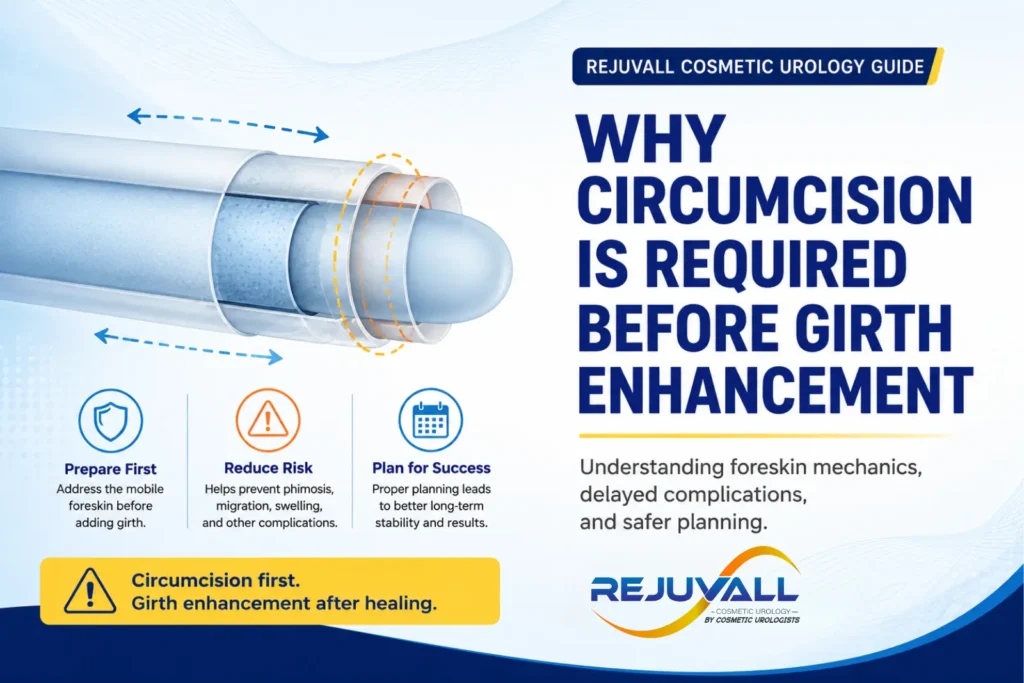
Medical editorial illustration explaining why circumcision is required before penile girth enhancement at Rejuvall

Why Circumcision Is Required Before Penile Girth Enhancement

Quick Answer: Why does Rejuvall require circumcision before girth enhancement?

Rejuvall requires circumcision before penile girth enhancement because adding a bulking agent under shaft skin commonly changes how the foreskin moves, retracts, stretches, swells, and heals.

In uncircumcised men, increased penile shaft thickness derived through volume from hyaluronic acid filler, PMMA/Bellafill®, or fat transfer can interfere with natural foreskin movement and retraction, thus increasing the risk of filler migration, phimosis, swelling, infection, hygiene problems, uneven contour near the glans, and delayed revision needs.

For this reason, Rejuvall only performs penile girth enhancement on circumcised men. When needed, Rejuvall offers GirthCirc™, a girth-optimizing circumcision planned with future enhancement in mind.

Important Warning for Uncircumcised Men Considering Girth Enhancement

Rejuvall does not perform penile girth enhancement on uncircumcised men because adding girth under foreskin creates a predictable pathway to complications.

Every man’s penis starts out uncircumcised. While the vast majority of men in the United States get circumcised shortly after birth, many guys prefer to stay uncircumcised throughout maturity and beyond.

Uncircumcised men are more likely to develop UTIs (or pass on such illnesses to a partner), phimosis, and paraphimosis. Nonetheless, many men prefer to remain uncircumcised, with some claiming it improves sensation during intercourse.

Cosmetic urological procedures that thicken the penis using man-made medical techniques disrupt the penile foreskin’s natural retraction from the glans during an erection or prevent the foreskin from returning to its normal position before arousal.

At Rejuvall, we’ve repeatedly observed cases in our repair clinic where uncircumcised men added thickness and the first results appeared healthy and smooth, but difficulties arose months or years later as the new, artificially thicker shaft encountered friction during intercourse and masturbation.

Here is the simplest way to understand the problem:

Imagine putting a thick sock on your foot, then trying to slide that same tight shoe back on. At first, you might be able to force it. It may even look okay for a little while.

But the shoe was not made for the larger size underneath. Over time, it starts to pinch, rub, trap moisture, create pressure, distort the shape, and cause pain.

That is what can happen when girth is added to an uncircumcised penis.
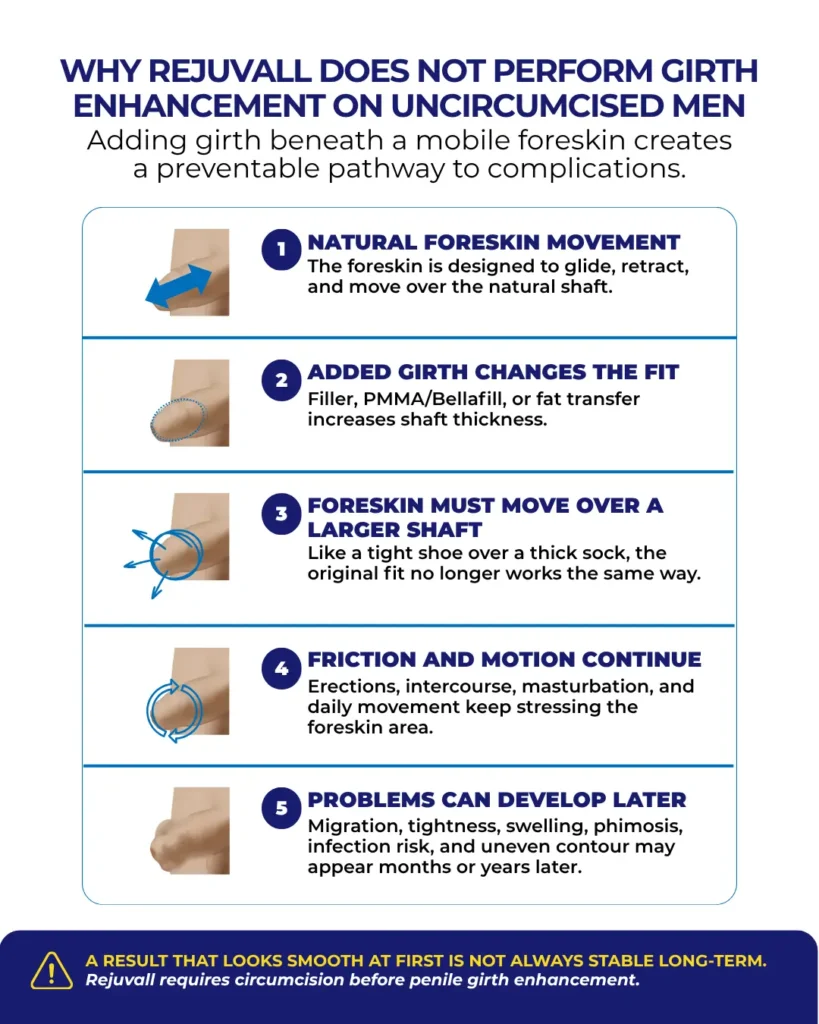
The foreskin was designed to glide over the natural shaft. Once filler, PMMA/Bellafill®, or transferred fat is added beneath the shaft skin, the shaft is no longer the same size.

The foreskin is now being forced to stretch, retract, and move over a larger structure. Even if the result looks smooth at first, that mismatch can become a serious problem over time.

In Rejuvall’s experience, uncircumcised girth enhancement commonly leads to a delayed complication pattern: filler or swelling collects near the foreskin, the foreskin becomes tighter, retraction becomes harder, hygiene becomes more difficult, and the area near the glans can become swollen, bulky, uneven, infected, or painful. In some cases, men develop phimosis, contour distortion, chronic swelling, sensory changes, or sexual function problems.

This is why short-term before-and-after photos are not enough. A penis can look fantastic right after treatment and still develop foreskin-related complications months or years later. The penis is not sitting still after enhancement. It moves during erections, intercourse, masturbation, and daily activity.

That repeated movement can gradually push filler, swelling, scar tissue, or collagen response toward the most mobile and vulnerable area: the foreskin.

Some providers claim they can avoid these problems by injecting deeper or using a special placement technique.

Rejuvall strongly disagrees. Deeper placement does not change the basic mechanical problem: a larger shaft is still being forced to move inside a mobile foreskin sleeve.

Once foreskin tissue becomes stretched, swollen, scarred, tight, or distorted, repair can be difficult even for experienced urologic surgeons. The glans, foreskin, and surrounding penile tissues are highly sensitive and important to sexual function.

A girth enhancement that looks good for a few months is not a success if it creates preventable foreskin complications later.

That is why circumcision before girth enhancement is not optional at Rejuvall.

It is not a cosmetic preference.
It is not a bias against uncircumcised anatomy.
It is not something Rejuvall negotiates case by case.

It is a clinical safety standard.

Infographic showing why uncircumcised penile girth enhancement can increase the risk of foreskin complications

Why Circumcision Comes First in Girth Enhancement Planning

Circumcision is one of the most important safety and planning steps for men considering penile girth enhancement.

At Rejuvall, circumcision is required before girth procedures, including hyaluronic acid filler, PMMA-based enhancement with Bellafill®, and surgical fat transfer procedures such as PERM®.

An uncircumcised penis is not the problem. Adding artificial or transferred girth beneath a mobile foreskin is the problem.

Once the shaft is enlarged, the foreskin must move over a larger structure, tolerate new tension, and adapt to new swelling and friction patterns.

That altered relationship creates a predictable complication pathway. This is why short-term before-and-after photos and early satisfaction are not enough. An uncircumcised enhancement may look smooth at first, but the foreskin can become tighter, harder to retract, swollen, distorted, or more vulnerable to infection over time.

Rejuvall requires circumcision first because these risks are preventable. For men who are not yet circumcised, this usually means staging treatment: circumcision first, healing time, then girth enhancement once the shaft skin has settled.

For some men who were circumcised earlier in life but have a tight scar line, prominent circumcision ring, or “pinched” area behind the glans, circumcision revision may also be recommended before adding girth.

Why Foreskin Becomes a Problem After Girth Enhancement

The foreskin is designed to move. In an uncircumcised penis, it glides over the glans, retracts during erection or sexual activity, and shifts with normal changes in penile size. That movement is normal anatomy.

The problem begins when artificial or transferred volume is added beneath the shaft skin.

Penile girth enhancement increases the circumference of the shaft. Whether the added volume comes from hyaluronic acid filler, PMMA/Bellafill®, or fat transfer, the skin envelope must now accommodate a larger structure than it did before.

In a circumcised penis, the shaft skin can usually settle more evenly around the added girth. In an uncircumcised penis, the foreskin creates an additional moving layer of tissue near the glans, exactly where contour, tightness, swelling, and retraction problems are most likely to appear.

A simple way to understand this is to imagine pulling the same fitted sleeve over an arm after padding has been added underneath. The sleeve may still move at first, but it no longer fits the same way. Over time, it can become tight, stretched, bunched, or distorted.

The foreskin can behave the same way after girth enhancement. It may still retract during early healing, but as swelling resolves and the tissues settle, the foreskin may become tighter, less mobile, or more likely to collect swelling and filler-related volume near the head of the penis.

This is why Rejuvall treats circumcision as a structural planning requirement before girth enhancement.

Removing the foreskin before adding girth creates a more stable shaft environment and allows the enhancement to be planned around the shaft itself rather than around a mobile layer of tissue that can become distorted over time.

The Biggest Risk: Phimosis After Girth Enhancement

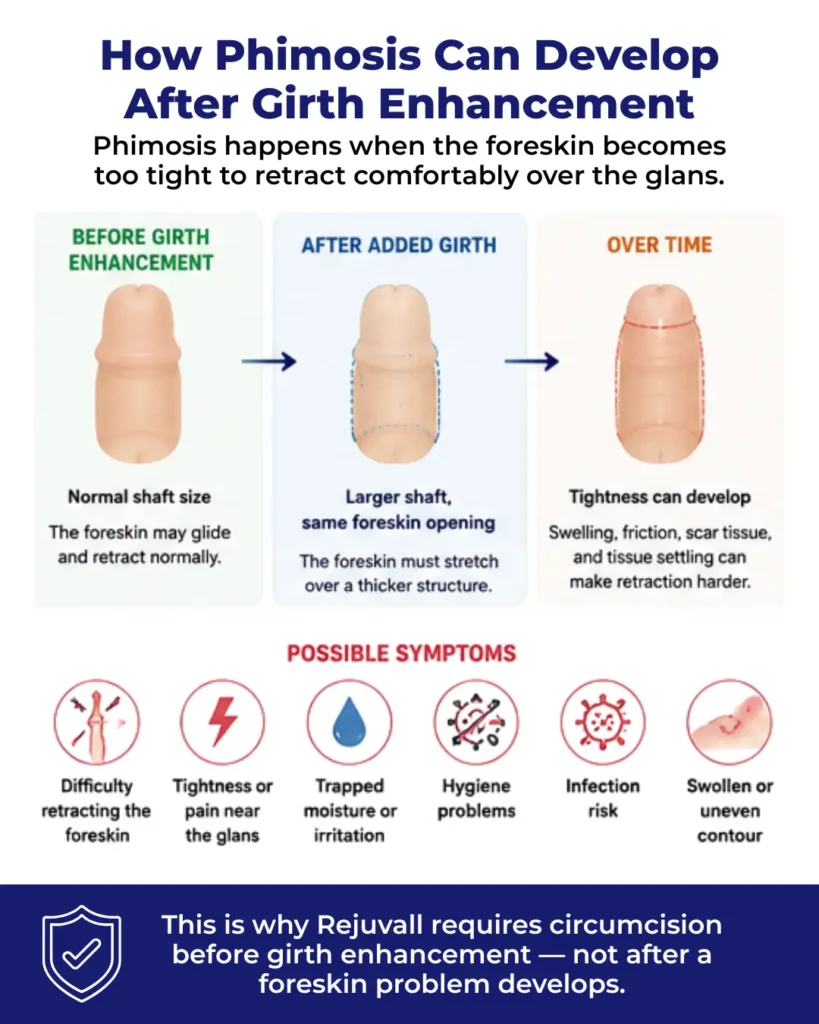
One of the most serious foreskin-related complications after penile girth enhancement is phimosis, a condition where the foreskin becomes too tight to retract comfortably over the glans.

Before treatment, the foreskin may retract normally because it is moving over the patient’s natural shaft size. After filler, PMMA/Bellafill®, or fat tissue is added, the shaft is larger, but the foreskin opening has not necessarily expanded in the same way. What once moved freely can become tight, resistant, or trapped behind the added girth.

A simple analogy is a turtleneck collar. If the neck underneath becomes larger but the collar does not stretch enough to match it, the collar becomes tight and difficult to move. In the penis, that tightening can become phimosis.

When phimosis develops after girth enhancement, it can create multiple problems at once. The foreskin may become painful or difficult to retract. Hygiene becomes harder. Moisture, bacteria, and irritation can become trapped beneath the foreskin, increasing the risk of inflammation or infection.

Sexual activity may become uncomfortable, and the distal shaft may develop a swollen, constricted, or uneven appearance near the glans.

Phimosis also makes correction more complicated. Once filler, collagen response, scar tissue, swelling, or transferred fat has interacted with a tight foreskin over time, the problem is often not as simple as removing the foreskin later. Revision treatment may need to address both the foreskin problem and the contour irregularity caused by the prior enhancement.

This is why Rejuvall requires circumcision before girth enhancement rather than waiting to see whether a foreskin problem develops.

Diagram explaining how phimosis can develop after penile girth enhancement in uncircumcised men

Why Some Uncircumcised Girth Enhancements Look Fine at First — Then Develop Problems Later

One of the most misleading things about uncircumcised girth enhancement is that it can look great, at first.

A result may look smooth, even, and natural shortly after treatment, especially while the tissues are still swollen and the added volume appears well distributed. The foreskin may still retract during early healing. The patient may feel reassured that everything worked.

But early appearance does not prove long-term safety.

The penis is a dynamic organ. It expands during erection, contracts when flaccid, moves during sex and masturbation, and undergoes repeated cycles of friction, compression, swelling, and tissue remodeling. When girth has been added beneath the shaft skin, those forces gradually change how filler, fat, collagen, scar tissue, swelling, and foreskin interact over time.

This is why complications can appear months or even years after the original procedure.

In an uncircumcised patient, the foreskin creates a mobile sleeve of tissue near the glans. As the enhanced shaft continues to move and settle, added volume can gradually shift toward the distal shaft or foreskin area. The foreskin can begin to feel tighter, retract less easily, or collect swelling in a way that was not obvious early on.

This delayed pattern makes it dangerous for patients to judge risk based only on short-term before-and-after photos, early reviews, or immediate post-treatment results.

A penis can look great in the first few weeks or months and still develop long-term foreskin complications later.

Some providers suggest that certain injection techniques or deeper placement planes prevent foreskin-related problems in uncircumcised men. Rejuvall disagrees with that claim.

Technique matters, but placement depth does not eliminate the mechanical relationship between added girth and a mobile foreskin.
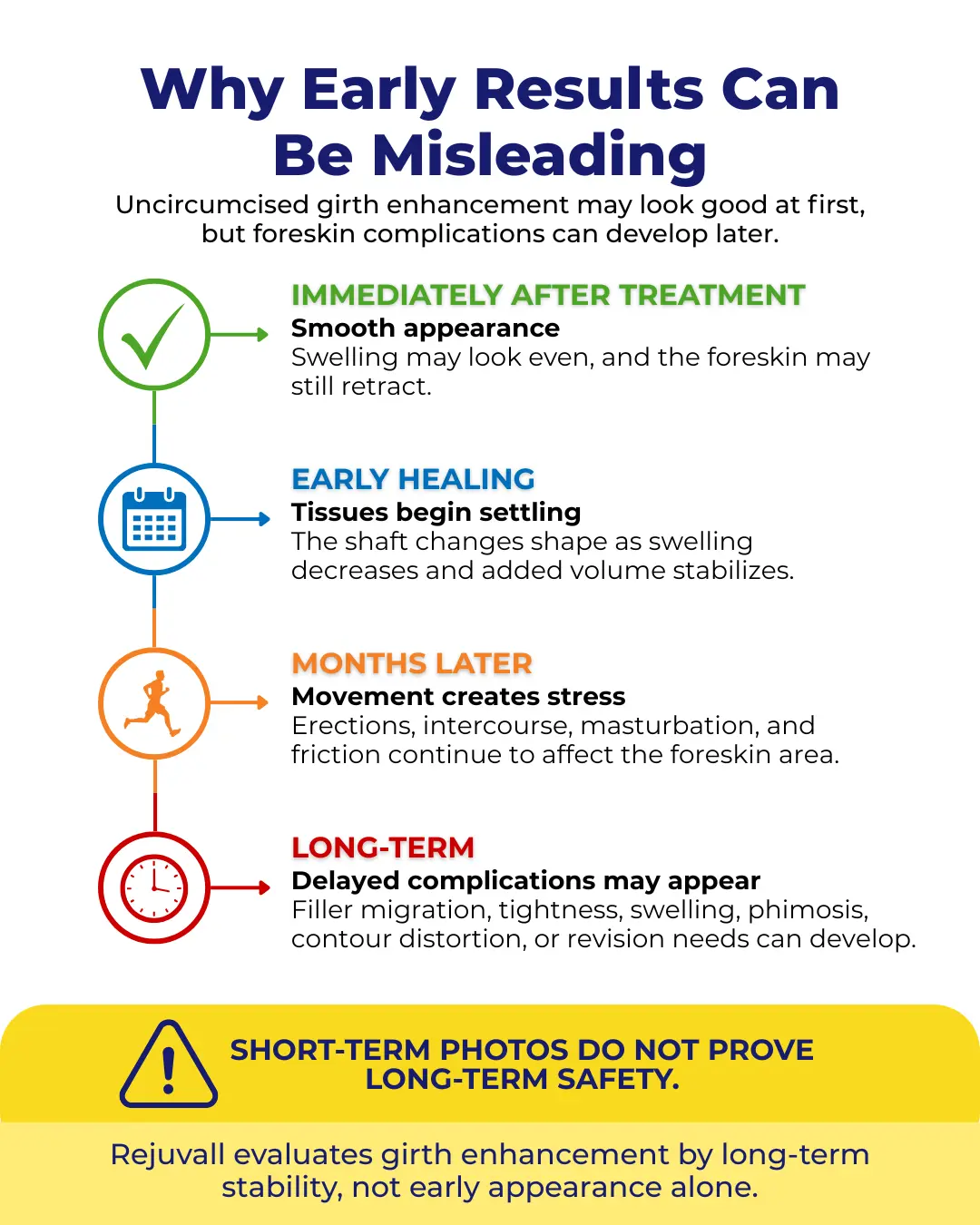
Timeline showing how foreskin-related complications can develop months or years after penile filler or PMMA girth enhancement

Why Fillers and Fat Transfer Migrate Toward the Foreskin

Penile girth enhancement adds volume beneath the shaft skin. That volume may come from hyaluronic acid filler, PMMA/Bellafill®, or transferred fat, but the basic mechanical issue is the same: the added material must settle within a part of the body that is constantly changing size, shape, and tension.

In a circumcised penis, the shaft skin is more stable. Once girth is added, the tissues can heal and settle around the enlarged shaft without the added complication of a mobile foreskin. In an uncircumcised penis, the foreskin creates a moving sleeve of skin near the glans. That movement affects where swelling, filler, collagen response, or transferred fat accumulates over time.

The foreskin area is especially vulnerable because it sits at the distal end of the shaft, where skin movement, friction, and retraction forces are concentrated. Over time, those forces encourage added volume to move toward the path of least resistance, especially near the glans and foreskin opening.

When filler or added tissue volume migrates toward the foreskin, the result is both functional and cosmetic. Some men notice a thickened or swollen-looking area near the glans. Others develop an uneven transition between the shaft and head of the penis, a bulky “collar” effect, or a tighter foreskin that becomes harder to retract.

Migration is also harder to correct after it has affected the foreskin area. Once the distal shaft becomes swollen, tight, or uneven, treatment often requires more than simply removing foreskin later. The underlying filler, collagen, fat, scar tissue, or lymphatic swelling may also need to be addressed.

This can make revision much more complicated than proper planning would have been at the start.
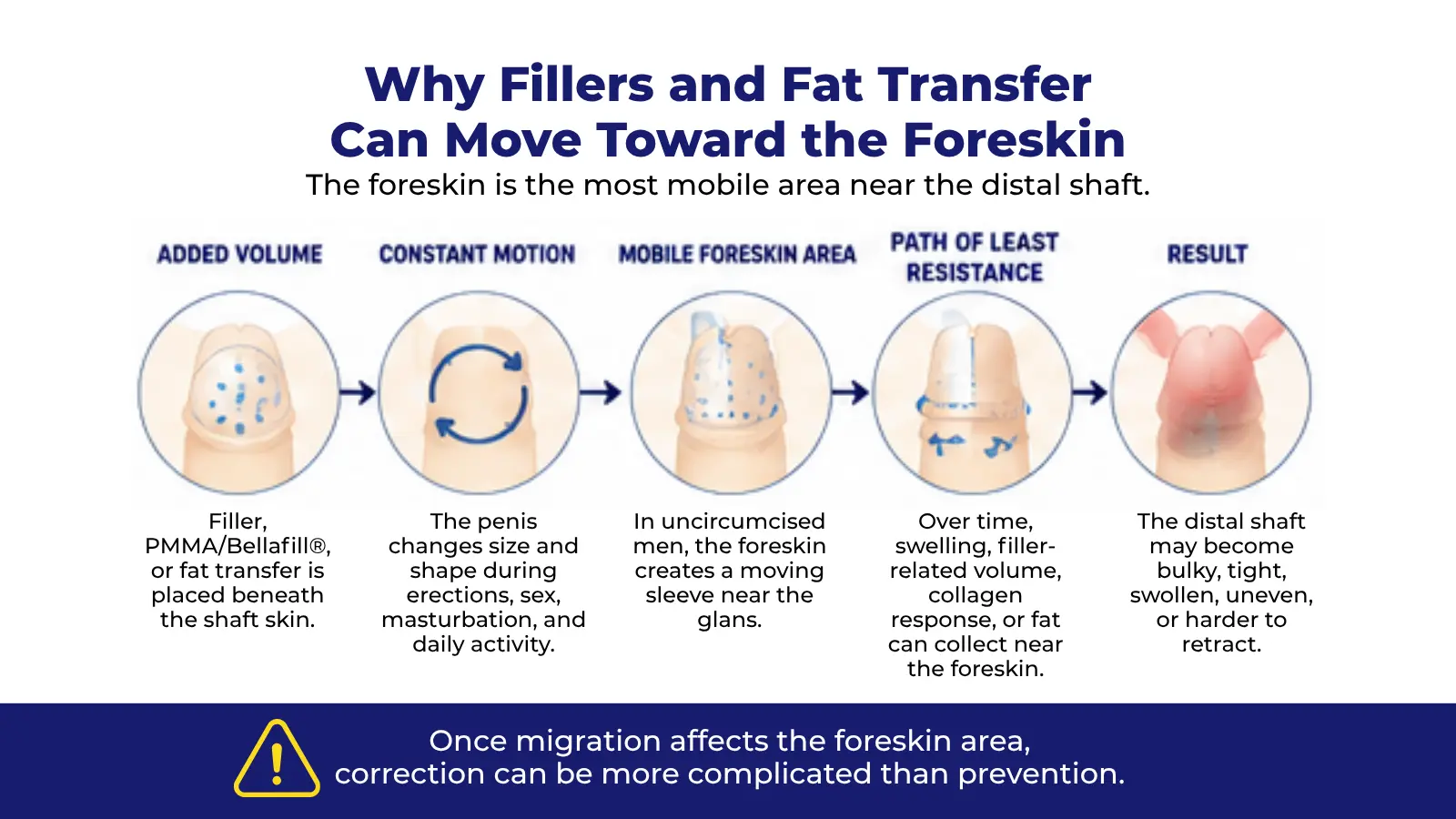
Medical infographic explaining how penile filler or fat transfer volume can migrate toward the foreskin after girth enhancement

Circumcision Improves Long-Term Cosmetic Predictability

Circumcision before girth enhancement is not only about preventing complications. It also creates a more predictable cosmetic result.

When the foreskin is present, the added girth must settle beneath shaft skin that continues to glide, fold, retract, and shift near the glans. That movement makes the final contour less predictable, especially as swelling decreases and the tissues remodel over time.

A circumcised shaft provides a more stable foundation for enhancement. Without a mobile foreskin layer, the added volume can be shaped more evenly along the shaft, and the transition near the glans is easier to monitor during healing.

Aftercare is also simpler because the patient and clinical team can better assess swelling, contour, skin tension, and any areas that need attention.

For Rejuvall, the goal is not simply to add size.

The goal is to create a result that looks natural, heals safely, and remains smooth and predictable over time. Circumcision removes a variable that can interfere with that outcome.

What Is a “Girth-Optimizing Circumcision”?

A girth-optimizing circumcision is an adult circumcision planned specifically for men who may want penile girth enhancement in the future. At Rejuvall, this approach is called GirthCirc™.

A standard adult circumcision focuses on removing the foreskin and creating a clean, comfortable, functional result. A girth-optimizing circumcision does that too, but it also takes future shaft enlargement into account.

The best way to understand GirthCirc™ is to think of it as tailoring before construction.

If more volume will be added later, the skin needs to be planned for that future size. If too much skin is removed, the shaft may feel tight after enhancement. If too much redundant skin is left behind, the patient may still have movement, bunching, or contour issues near the glans.

If the circumcision scar line heals as a tight or “pinched” ring, it can interfere with swelling patterns and make the transition near the head of the penis look less natural after enhancement.

GirthCirc™ is designed to reduce those problems by planning the circumcision with the patient’s future girth goals in mind. For men pursuing hyaluronic acid filler, PMMA/Bellafill®, or PERM®, this helps the shaft skin settle more naturally once additional circumference is added.

This does not mean circumcision and girth enhancement should be performed at the same time. The circumcision still needs time to heal before girth is added.

At Rejuvall, patients generally need to wait at least 90 days after circumcision before undergoing penile girth enhancement.
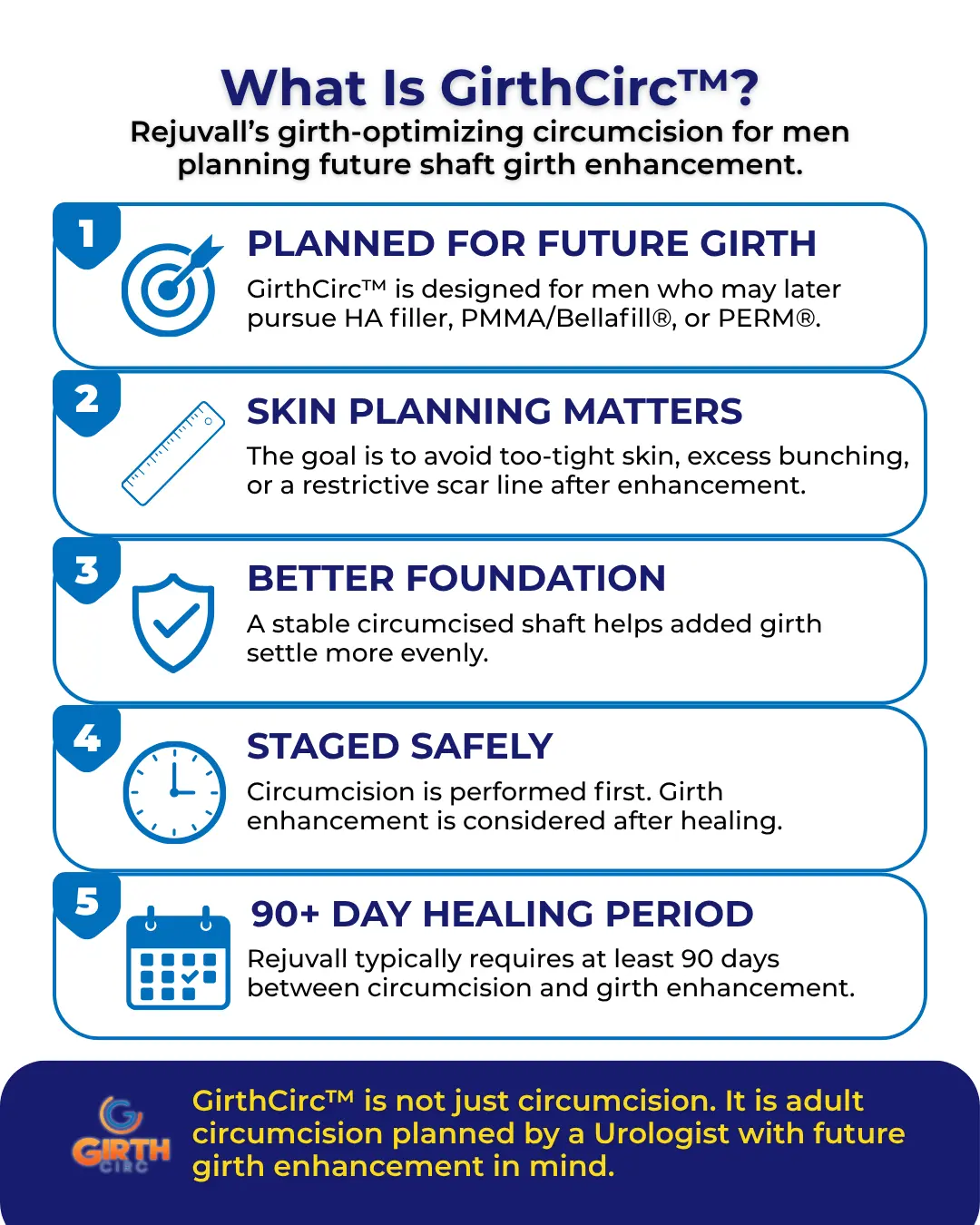
Infographic explaining GirthCirc, Rejuvall’s girth-optimizing adult circumcision before penile girth enhancement

Why Circumcision and Girth Enhancement Cannot Be Done at the Same Time

Circumcision and girth enhancement should not be performed at the same time because the two procedures create competing healing demands.

Circumcision requires an incision around the penile shaft skin. That incision needs time to close, strengthen, and settle without excessive tension. Girth enhancement immediately adds volume beneath the shaft skin.

Doing both at the same time would be like stretching a garment while the seam is still freshly stitched. The seam needs time to heal and strengthen before pressure is placed on it.

If girth is added before the circumcision incision has healed, the new circumference places pressure on the fresh closure line and increases the risk of swelling, wound separation, scar problems, and an uneven cosmetic result.

For this reason, Rejuvall stages treatment. Circumcision is performed first, the tissue is allowed to heal, and girth enhancement is considered after the shaft skin has settled. In most cases, Rejuvall requires at least 90 days between circumcision and penile girth enhancement.

What If I’m Already Circumcised?

Being circumcised is an important first step, but Rejuvall still evaluates the quality and position of the circumcision before girth enhancement.

Not all circumcisions heal or settle the same way, and some men who were circumcised as infants have scar patterns that can affect cosmetic outcomes later in life.

One common issue is a tight or prominent circumcision scar line behind the glans. If that scar line acts like a restrictive ring, it can interfere with normal swelling and lymphatic drainage after girth is added.

In simple terms, it can behave like a tight band around the shaft. Fluid and swelling do not move as smoothly past that point, which can contribute to persistent fullness, a “pinched” appearance, or a thicker-looking area near the head of the penis while the tissues are healing and settling.

Other concerns include uneven skin distribution, excess shaft skin in one area, too little shaft skin in another, adhesions, scarring, or a transition line that becomes more noticeable after enhancement. These issues may be subtle before girth is added but become more visible once the shaft circumference increases.

For most circumcised men, no additional circumcision procedure is needed before girth enhancement. However, in some cases, Rejuvall recommends circumcision revision before adding girth.

The goal is to improve the baseline anatomy, reduce avoidable contour problems, and give the enhancement the best possible foundation.

Is Circumcision Required for Every Penis Enlargement Procedure?

Circumcision is required before penile girth enhancement at Rejuvall, but it is not automatically required before every type of penis enlargement procedure.

The main concern is added circumference. Procedures that increase shaft girth, including hyaluronic acid filler, Bellafill® PMMA-based enhancement, and PERM®, place additional volume beneath the shaft skin.

If the foreskin is still present, that added girth interferes with normal foreskin movement and significantly increases the risk of tightness, phimosis, migration, swelling, hygiene issues, and uneven contour near the glans.

Length enhancement is different. Because lengthening procedures involve a different anatomy and healing process, circumcision planning depends on the patient’s goals, baseline anatomy, and treatment sequence.

In some cases, an uncircumcised patient who wants both length and girth may be advised to address length first, then circumcision, then girth enhancement after the tissue has healed.

For men who are uncircumcised and interested in girth enhancement, the general pathway is circumcision first, healing time, then girth enhancement once the shaft skin has settled.

For men pursuing multiple procedures, Rejuvall’s team will explain the safest order based on anatomy, goals, and long-term cosmetic predictability.

Frequently Asked Questions About Circumcision Before Girth Enhancement

Yes. Rejuvall requires circumcision before penile girth enhancement. This applies to shaft girth procedures using hyaluronic acid filler, PMMA/Bellafill®, and surgical fat transfer (PERM®).

The foreskin is a mobile sleeve of tissue that normally glides, retracts, and shifts over the glans and distal shaft. After girth is added, the shaft becomes larger, but the foreskin must now move over a changed structure, increasing the risk of tightness, swelling, filler movement, contour changes, and difficulty retracting the foreskin.

Yes. In uncircumcised men, filler or filler-related volume can gradually shift toward the foreskin area, sometimes months or years after treatment. This can create swelling, tightness, uneven contour, or a bulky appearance near the glans.

Yes. PMMA can create serious foreskin-related problems if it is placed in an uncircumcised penis. Because PMMA is designed to create a long-lasting collagen response, migration, swelling, contour irregularity, or tightening near the foreskin can be more difficult to correct later.

Yes. Any procedure that adds shaft circumference can change how the foreskin moves and retracts. This includes surgical fat transfer procedures such as PERM®.

Phimosis is a condition where the foreskin becomes too tight to retract comfortably over the glans. After girth enhancement, this can happen when the shaft becomes larger but the foreskin opening does not accommodate the new circumference.

Yes. Phimosis and other foreskin-related complications can develop months or years after penile girth enhancement, even if the early result looked perfect.

No. Rejuvall does not perform circumcision and girth enhancement at the same time because the fresh circumcision incision needs time to heal before additional shaft volume is added.

Rejuvall typically requires at least 90 days between circumcision and penile girth enhancement. This allows the incision, swelling, and shaft skin to settle before added volume is placed.

GirthCirc™ is Rejuvall’s girth-optimizing adult circumcision for men who plan to pursue penile girth enhancement later. It is planned with future shaft enlargement in mind.

Most men circumcised as infants do not need another circumcision before girth enhancement. However, Rejuvall evaluates the scar line, skin distribution, and transition behind the glans before adding girth.

Not at Rejuvall. Rejuvall does not perform penile girth enhancement on uncircumcised men. If you are uncircumcised and want girth enhancement, the treatment plan must be staged safely: circumcision first, healing time, then girth enhancement if appropriate.

Circumcision is not automatically required before every penile lengthening procedure. The requirement specifically applies to girth enhancement because adding circumference changes the relationship between the shaft skin and foreskin.

Considering Girth Enhancement? Start With the Right Plan.

Penile girth enhancement is not just about adding size. The best outcomes depend on careful planning, safe anatomy, proper sequencing, and long-term cosmetic predictability.

If you are uncircumcised and interested in shaft girth enhancement, Rejuvall will not recommend simply adding filler, PMMA/Bellafill®, or fat and “seeing what happens.” That is how preventable foreskin complications develop.

Rejuvall can help you understand why circumcision is required, how the procedure should be timed, and whether GirthCirc™ is appropriate for your goals.

If you are already circumcised, Rejuvall can evaluate whether your existing scar line and shaft skin provide a strong foundation for filler, PMMA/Bellafill®, or surgical fat transfer.

The first step is a free phone consultation with Rejuvall’s Patient Education Manager.

During this call, you can discuss your goals, learn which procedures may be appropriate, and understand the safest order of treatment before scheduling a medical consultation.

Submit the Cosmetic Urology Assessment today to find out whether you are a candidate for penile girth enhancement and what planning steps may be needed before treatment.

Leave a Comment

Your email address will not be published. Required fields are marked *

Scroll to Top