
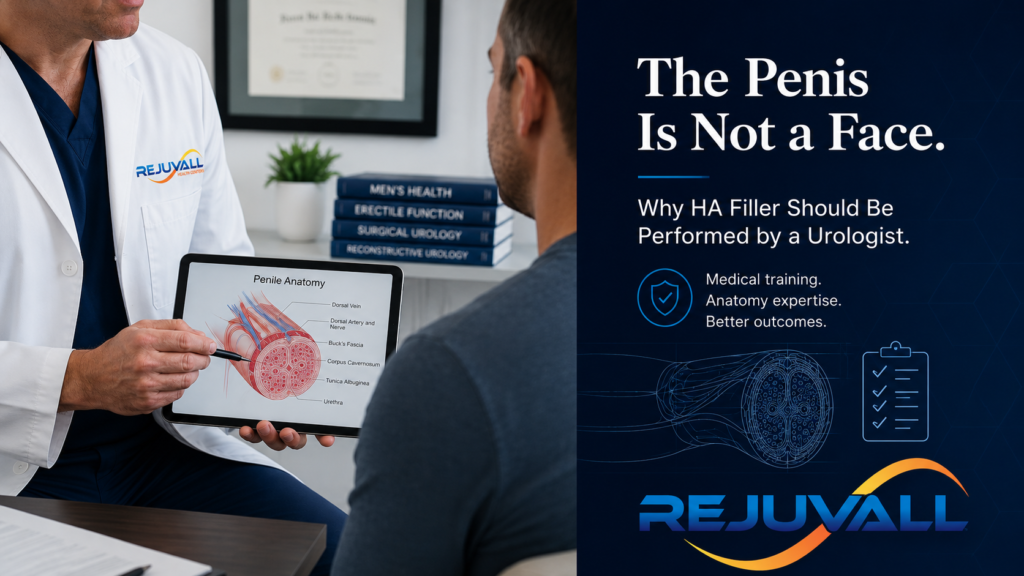
Quick Answer: Hyaluronic acid (HA) can be one of the safest and most flexible options for non-surgical penile girth enhancement—but only when it is performed by a provider with extensive, penis-specific medical and surgical training.
The problem is that many non-urologists now offer penile HA injections after only a brief course in generic filler technique—sometimes just a few hours of training designed for facial aesthetics. A urologist, by contrast, spends years training in the anatomy, blood supply, nerve pathways, erectile function, disease processes, surgery, and reconstruction of the penis.
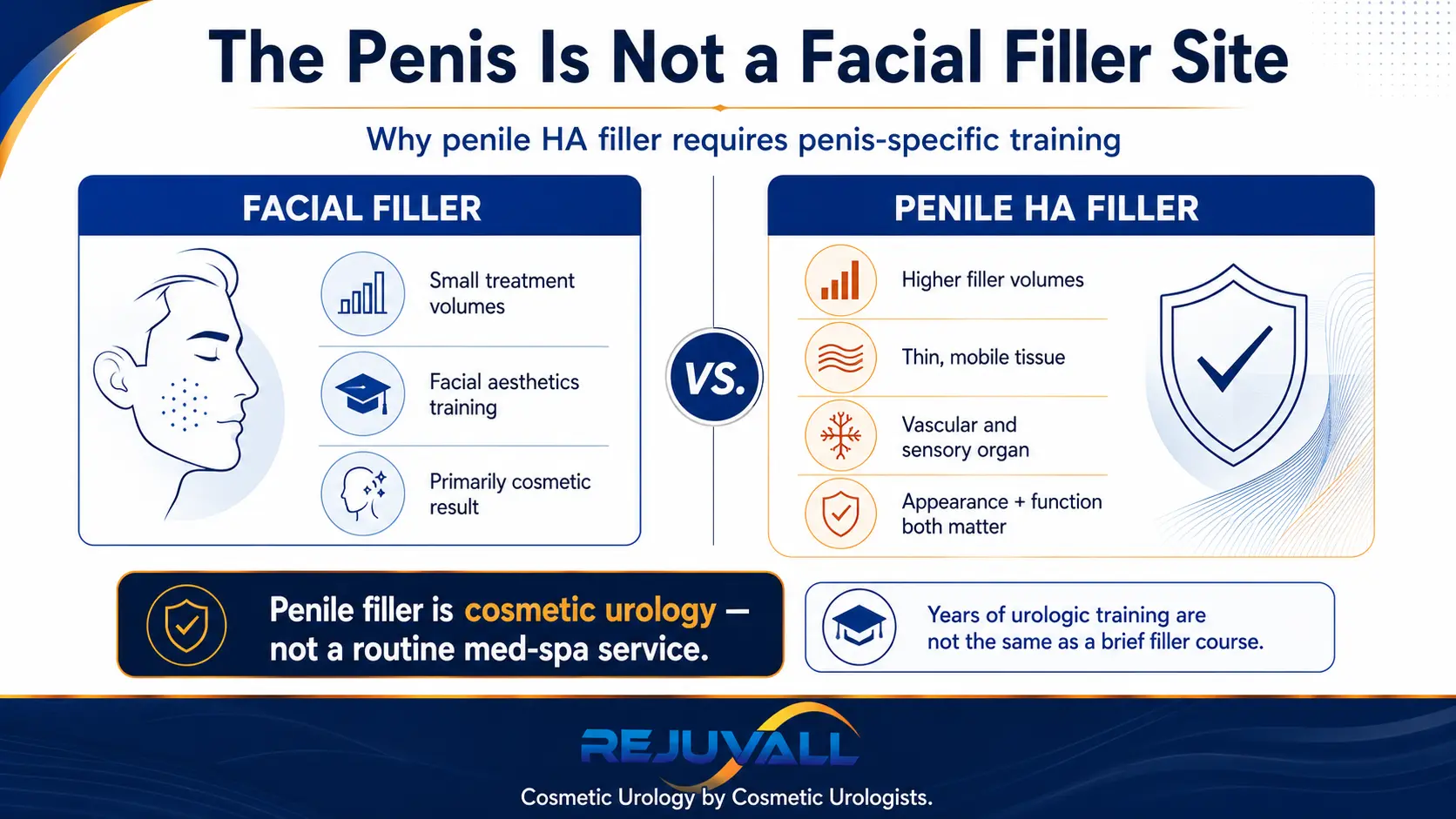
That distinction matters. The penis is not a face, and penile filler is not a routine med-spa procedure. It requires an understanding of how to place high volumes of filler safely in a thin, mobile tissue layer over a vascular, sensory organ—and how to recognize and manage complications when they occur.
At Rejuvall, we believe cosmetic urology should be performed by cosmetic urologists.
Hyaluronic acid (HA) is one of the safest and most adaptable options for non-surgical penile girth enhancement.
However, HA’s safety and success are not only dependent on the versatility of FDA-approved hyaluronic acid.
The credentials and penile-specific medical and surgical training of the individual performing the injections are equally, if not more, important to achieving safe and excellent results.
No one seems to remember that a man’s penis is a complex vascular organ.
You decide you want a bigger penis. Based on what you’ve learned, HA injections seem like the best way to begin.
So what’s next? For many men, the next step is looking for the best deal or the clinic closest to home.
That might be a reasonable approach if men had as many penises as fingers on each hand, because if something “goes wrong,” the consequences would not be life-changing.
Unfortunately, that is not the case.
Men have only one penis to work with, and many are unaware that the penis is a complicated vascular human organ.
Many non-urologists now provide penile HA injections after a brief course in generic filler technique, sometimes after as little as a few hours of facial aesthetics instruction.
In contrast, a urologist receives 6–8 years of training in anatomy, blood supply, nerve pathways, erectile function, disease processes, surgery, and penile reconstruction.
Add another year or two of specialized training in cosmetic and reconstructive plastic urology, and it can take nearly ten years for a board-certified cosmetic urologic specialist to be qualified to deliver the care you require and deserve.
There is a significant difference between nearly ten years of professional medical training and a ten-hour weekend class on “how to inject HA into the penis.”
The Penis Is Not a Facial Filler Site
It appears that nearly anyone with a medical credential can now offer hyaluronic acid injections for penile girth enhancement.
Some providers primarily inject lips, cheeks, and facial lines. Others attend a brief training course, sometimes only a few hours focused on general filler technique, then begin marketing themselves as penis enlargement specialists.
A polished website, a few before-and-after photos, and the ability to purchase HA filler do not make someone a cosmetic urologist.
Hyaluronic acid itself can be an excellent material for penile girth enhancement. In the hands of a cosmetic urologist, it is one of the safest and most flexible fillers available because it is long-lasting, adjustable, and can often be dissolved with hyaluronidase if medically necessary.
But getting a good result from HA injections in the penis requires far more than knowing how to inject facial filler.
The penile shaft has much thinner, more delicate skin than the lips, cheeks, or jawline (think eyelid skin).
It is also a highly complex vascular, highly innervated organ with an extensive network of blood vessels and nerves directly involved in sensation and erectile function. Unlike a typical facial treatment, penile girth enhancement usually also requires many times more filler volume to create an appropriate result.
That means placement matters differently. Volume matters differently. Anatomy matters differently.
A poor facial filler result may be upsetting. A poorly performed penile filler procedure can create unevenness, nodules, inflammation, migration, loss of volume, an unnatural appearance, or a more severe problem that requires medical correction.
The former can ruin someone’s day; the latter can ruin someone’s life.
This is why penile HA injections should not be treated as a side service for a med spa, facial injector, or provider whose only penile training came from a weekend course.
The penis is not a face. Penile filler is cosmetic urology.
Why Penile Filler Requires Urologic Expertise
Rejuvall is not a med spa that added penile filler to a menu of cosmetic injectables.
We are a urology-based men’s sexual health and cosmetic urology practice that opened our doors over 45 years ago.
That means we see the penis not only as a cosmetic structure, but as a vascular, sensory, functional organ with complexity akin to the heart that can be affected by disease, trauma, surgery, scar tissue, erectile dysfunction, prior enhancement procedures, and poor injection technique.
Dr. Kenneth J. Carney, MD, PharmD, FACS is a board-certified urologist and surgeon with extensive reconstructive experience involving penile tissue.
He has performed more than 1,000 penile degloving procedures and more than 1,000 Peyronie’s surgeries—procedures that require direct visual access to the layers, blood supply, and structural anatomy of the penis.
That experience changes how Rejuvall evaluates penile filler.
We do not just look at whether a penis appears larger immediately after injection. We look at tissue quality, circulation, skin mobility, prior procedures, scar tissue, glans-to-shaft proportion, erectile function, and whether the material was placed in a way that can remain stable over time.
It also means that when men come to us after filler performed elsewhere, we can recognize patterns that a provider without urologic and reconstructive training may miss.
Some patients arrive with unevenness, nodules, inflammation, loss of volume, migration, or concerns about what was actually injected.
Others were told that a problem was normal, that it would “settle eventually,” or that no one could help them because the filler was supposedly permanent.
Many of these cases are not emergencies. But they can be distressing, difficult to correct, and entirely preventable, nonetheless.
That is why Rejuvall sees these problems: not because HA itself is inherently unsafe, but because more providers are treating penile girth enhancement like a routine facial filler service without the years of penis-specific training required to understand what can go wrong, and how to fix it when it does.
The 8 Most Common Problems We See
Hyaluronic acid is often described as the “safe” penile filler because it is temporary and can usually be dissolved with hyaluronidase.
That is true; when it is actually HA, placed appropriately, and performed by someone who understands penile anatomy.
But reversibility does not erase poor technique.
It does not make unknown products safe.
And it does not mean every bad result is simple to correct.
These are the problems Rejuvall sees most often in men who received penile HA injections elsewhere:
1. Uneven HA Placement and Contour Problems
The most common issue we see is uneven filler placement.
A penis is not a smooth, fixed cylinder. The skin moves. The tissue changes between flaccid and erect states. The shaft narrows and widens in different areas throughout the day.
If HA is deposited inconsistently, the result may look acceptable immediately after treatment but become uneven as swelling resolves.
Patients may develop ridges, lumps, asymmetry, thin areas next to thick areas, or a result that looks different depending on whether the penis is flaccid or erect.
This is especially common when an injector relies on a blunt-tip cannula as though it automatically guarantees safety or precision.
A cannula may help an inexperienced injector avoid certain structures, but it can also make it harder to control exactly where the product is being placed along the shaft.
The goal is not just to get filler into the penis. The goal is to place it evenly enough that it remains smooth, balanced, and proportionate after healing.
2. Too Much HA in the Superficial Tissue
Another common problem is placing too much HA too close to the surface.
The superficial penile tissue is thin and mobile, much like eyelid skin. It cannot always tolerate a full treatment volume without becoming irregular, inflamed, or visibly uneven.
When too much filler is crowded into this layer, patients may develop nodules, rippling, firmness, visible contour changes, or a “stuffed” appearance that does not look natural.
This is one reason penile filler should not be approached like facial filler.
A facial injector may be highly accustomed to using superficial placement in certain areas of the face. That does not mean the same approach translates safely or predictably to the penis.
The tissue of the penis is different, the surface area is different, the volume is different, and the consequences of poor placement are different.
When we evaluate these cases, the problem is often not that HA was used. The problem is that too much was forced into tissue that was never meant to hold that amount of product at one time.
3. Too Much HA Placed Too Deeply
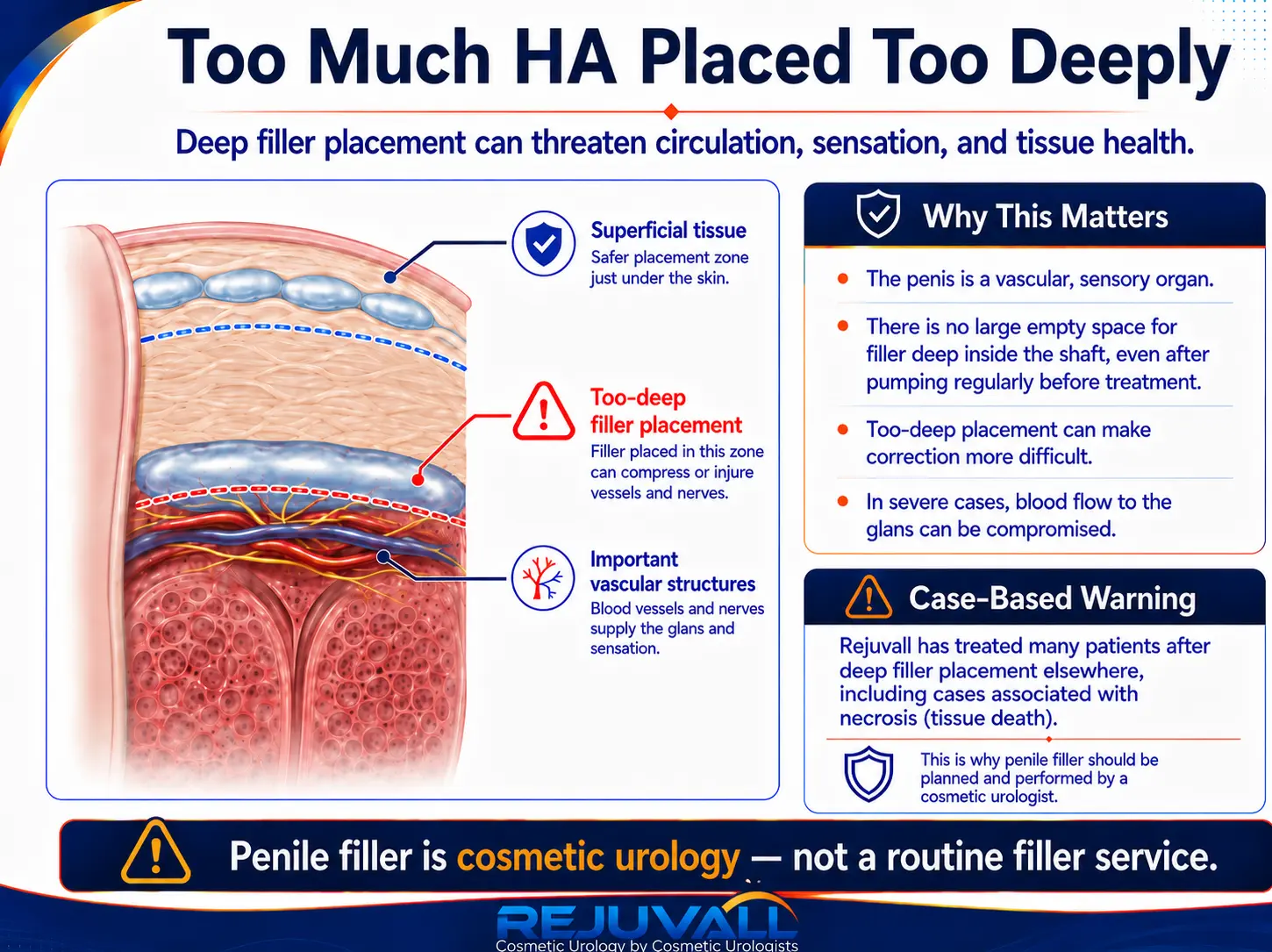
The opposite problem is placing filler too deeply.
Some injectors understand that superficial placement can create visible lumps, so they overcorrect and try to place HA closer to the deeper structures of the penis, claiming this “deeper technique” eliminates the risk of any complications.
That is not a safer solution.
The penis contains a complex network of blood vessels, nerves, erectile tissue, and connective layers. There is not a large, forgiving “empty space” deep inside the shaft where filler can simply be deposited without consequence, even if you pump for months before your procedure.
Too-deep placement creates a result that is difficult to assess, difficult to correct, and potentially more concerning because of its proximity to structures involved in circulation, sensation, and erectile function.
This is where penis-specific anatomy matters most.
Someone who has spent years treating penile disease, performing reconstructive procedures, and operating directly on penile tissue understands that these layers are not theoretical. They are structures we protect every day.
4. Injecting Uncircumcised Patients
At Rejuvall, we require circumcision before any girth enhancement procedure.
That policy exists because the foreskin changes how filler behaves around the distal shaft. It can create an area where filler migrates, bunches, or settles unevenly.
It can also produce an unnatural transition between the shaft and foreskin, particularly when the penis is flaccid.
Some providers inject uncircumcised men because they do not want to lose the sale or delay treatment.
Others may simply not understand why the foreskin changes the long-term predictability of the result.
But this is not a minor technical detail.
A patient may be satisfied immediately after treatment, then later develop uneven contour, filler movement, swelling around the foreskin, or a result that looks less natural as the tissue settles. Correcting those issues can be more complicated than avoiding them in the first place.
Circumcision is not required at Rejuvall to create an extra procedure. It is required because we are trying to create the safest and most stable foundation possible before adding volume to the shaft.
5. The “It Disappeared Immediately” Cases
Over the last year, we have evaluated several patients who received large amounts of what they were told was HA filler elsewhere (one received more than 35 mL over multiple sessions) and yet seemed to retain almost none of the added size.
Not gradually. Almost immediately.
In these cases, the patient reported that the result disappeared far faster than it should have. Then, after receiving appropriately planned treatment at Rejuvall, the same patient’s penis responded normally to HA.
We are honest with patients about this: we do not always know exactly why that happened.
It may be product quality. It may be placement. It may be dilution. It may be that the material was not what the patient was told it was. It may be a combination of those factors.
But when we see the same pattern repeatedly, we cannot dismiss it as normal metabolism or tell the patient that everybody simply “burns through filler quickly.”
A patient deserves to know what was injected, how much was injected, and why a treatment failed.
6. Provider Overconfidence and False Precision
One of the most concerning patterns we see is false confidence from the provider.
Some providers speak as though they can reliably place filler into highly specific microscopic tissue planes through a blind injection technique.
They may use technical language to sound precise, but the penis is not a static diagram. Even with direct surgical exposure, identifying and working around penile layers requires skill, experience, and respect for how complex the anatomy actually is.
Dr. Carney has performed more than 1,000 penile degloving procedures and more than 1,000 Peyronie’s surgeries—operations that allow direct visual access to penile structures.
Even with the anatomy visible, penile tissue is complex. That is why it is so concerning when a provider with little or no urologic surgical experience presents blind filler injection as though it is exact, predictable, and free of meaningful risk.
The providers who get into the most trouble are often not the ones who admit the limits of what they know. They are the ones who do not recognize those limits at all.
7. Mixing HA With Other Products or “Proprietary Formulas”
Patients should never have to guess what was injected into their penis.
We have evaluated men who were told they received HA, only to later learn (or strongly suspect) that another material may have been mixed in.
We have also seen providers combine HA with longer-lasting fillers, biostimulatory products, or vague “proprietary formulas” without giving the patient a clear explanation of what each material does or how it can be corrected.
That matters because HA can be dissolved. Other products may not be.
Once materials are mixed, future correction becomes more complicated.
A patient who believes he received a reversible filler may discover that only part of the result can be dissolved. He may also have no reliable medical record showing what product was used.
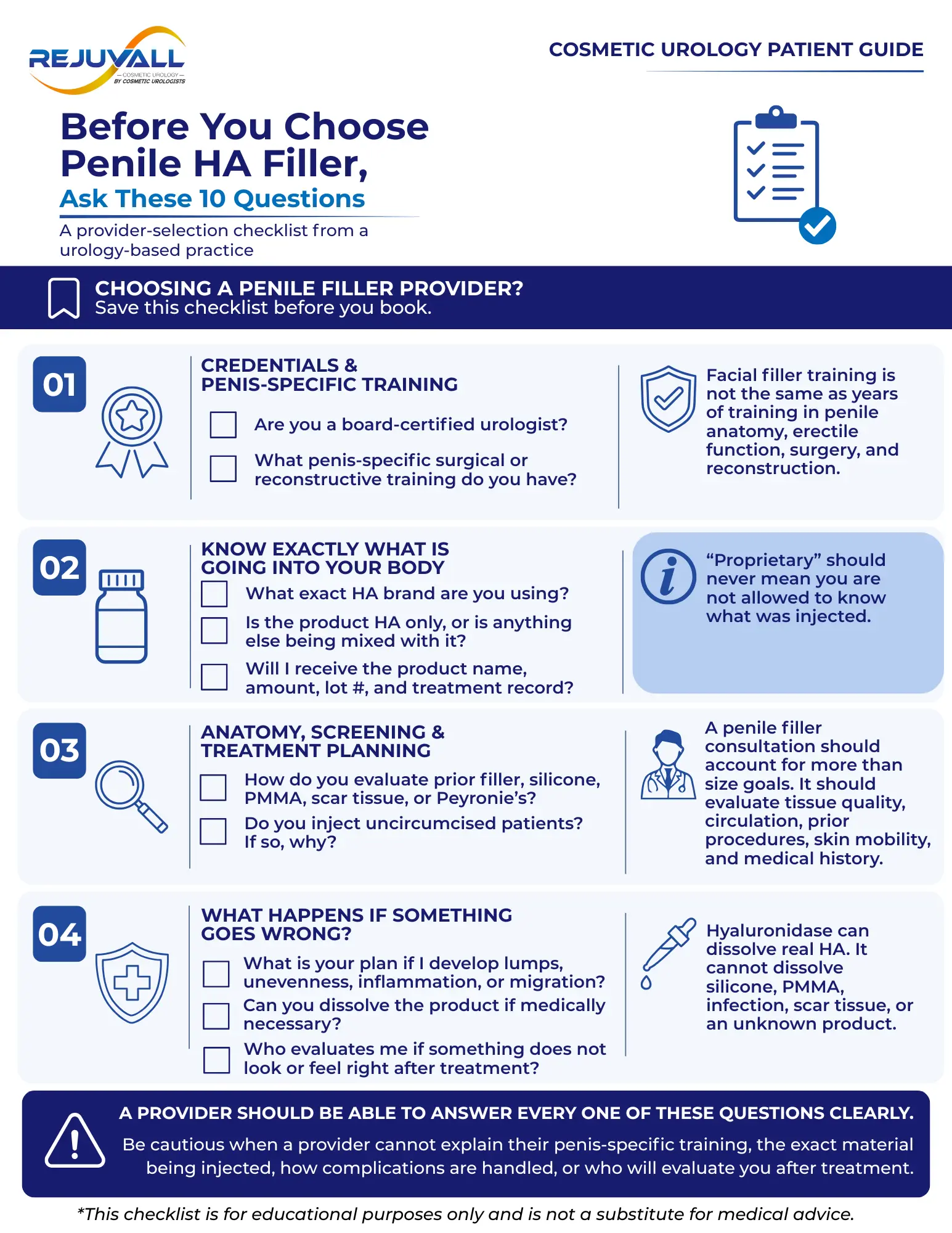
Avoid any provider who cannot clearly answer these questions:
- What exactly are you injecting?
- Is it HA only?
- Is it reversible?
- What is the brand name?
- How much are you using?
- Will I receive documentation of the product and lot number?
“Proprietary” should never mean “you are not allowed to know what is in your body.”
8. DIY Penile Filler
There is no safe version of do-it-yourself penile filler.
Buying injectable HA online, ordering “penis filler kits,” sharing products, injecting at home, or having a friend perform the injection is not cost-saving.
It is gambling with a highly vascular, highly sensitive organ.
We have seen patients influenced by online forums and social media posts that make DIY injection sound simple because HA can supposedly be dissolved later. That is dangerously misleading.
Hyaluronidase is not a magic eraser for every problem. It does not prevent infection. It does not undo tissue trauma. It does not tell us what was actually injected. And it does not replace the ability to assess blood flow, tissue response, swelling, pain, or a developing complication.
A DIY injector cannot reliably manage an emergency, recognize a vascular problem, diagnose an infection, or determine whether a lump is filler, scar tissue, inflammation, or another material entirely.
The penis is not the place to experiment with online medical advice.
HA can be a very good option for penile girth enhancement. But only when it is treated like cosmetic urology, not a DIY project, not a med-spa add-on, and not a weekend-course procedure.
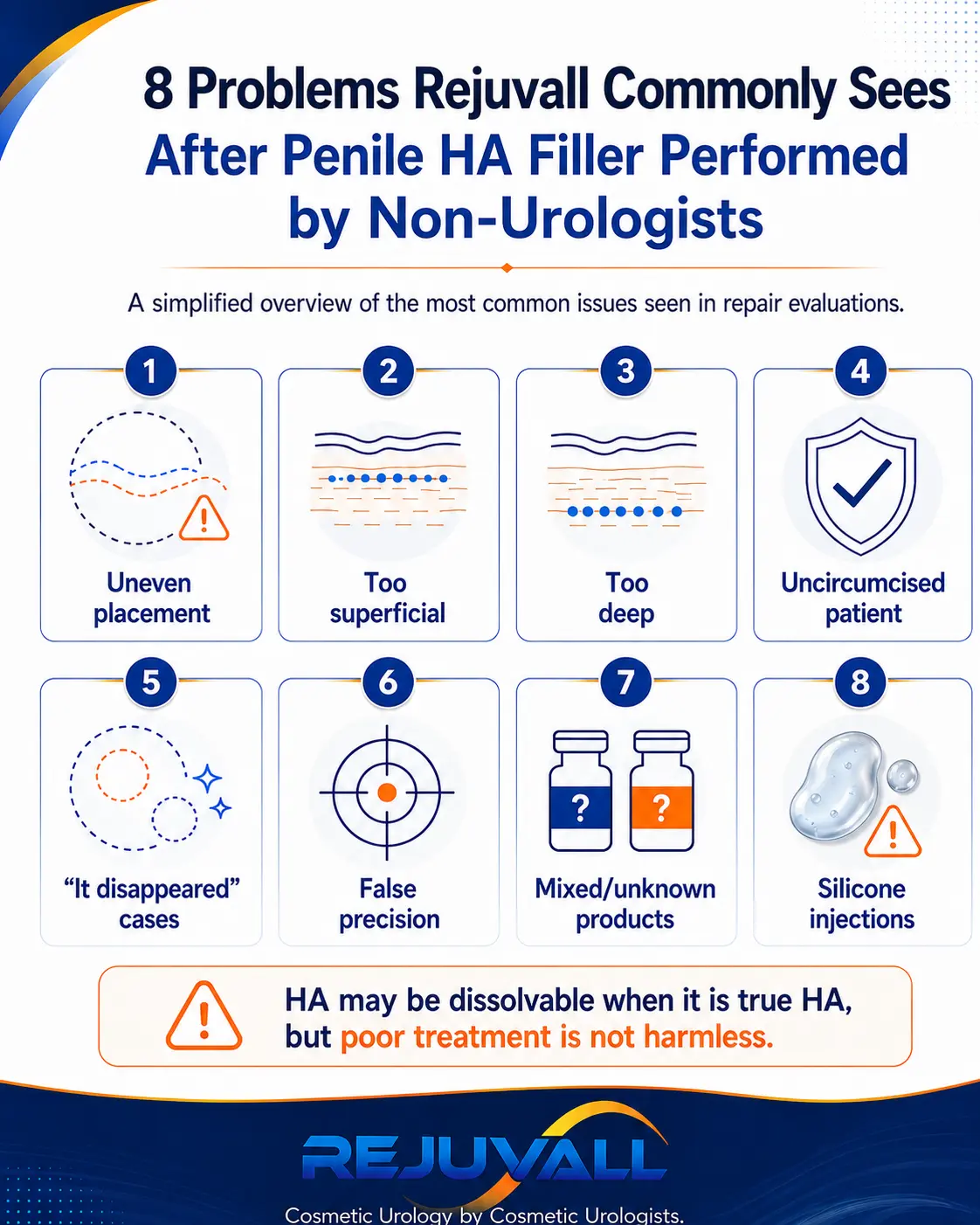
HA Is Reversible, But That Does Not Make Poor Treatment Harmless
One of HA’s biggest advantages is that it can usually be dissolved with hyaluronidase when medically necessary.
That makes HA far more forgiving than permanent fillers. But it does not mean a poorly performed treatment is harmless, or that every problem can be fixed with one quick injection.
Hyaluronidase only works on actual hyaluronic acid. It cannot dissolve silicone, PMMA, scar tissue, infection, inflammation, or an unknown material mixed into the product.
In some cases, it may take more than one treatment to adequately dissolve a significant amount of HA or correct a contour issue.
More importantly, dissolving filler does not undo the stress, swelling, tissue irritation, or anxiety caused by a poor result.
That is why “it can be dissolved later” is not an excuse for aggressive injection, unknown products, poor placement, or inadequate training.
The goal should always be to get the treatment right the first time, not to rely on hyaluronidase to rescue a bad one.
The Bottom Line: Cosmetic Urology by Cosmetic Urologists
Hyaluronic acid can be an excellent option for men who want non-surgical penile girth enhancement. It is flexible, long-lasting, and, when true HA has been used appropriately, can usually be dissolved if a medical reason to do so arises.
But the material alone does not make the procedure safe.
A good penile filler result depends on understanding penile anatomy, respecting tissue limits, selecting the right patients, using the correct product, placing it appropriately, recognizing when something is not normal, and knowing how to manage a problem when one occurs.
That is not the same as injecting lips, cheeks, jawlines, or facial folds.
Penile filler is not a side service for a provider whose primary experience is facial aesthetics. It is not something that should be learned in a brief course and then offered as another item on a cosmetic menu.
It is cosmetic urology.
At Rejuvall, we see men who are happy with properly performed HA enhancement. We also see men who come to us after treatment elsewhere because they are dealing with unevenness, lumps, inflammation, migration, unexplained loss of volume, or uncertainty about what was injected.
Those cases are why our position is simple:
Cosmetic Urology by Cosmetic Urologists.
Because when a procedure involves the appearance, blood flow, sensation, and function of the penis, the provider should have years of specialized training in the penis, not just a few hours of general filler instruction.
Frequently Asked Questions About HA Penis Filler
Hyaluronic acid can be one of the safest options for non-surgical penile girth enhancement when it is performed by a qualified cosmetic urologist using a known HA product and an anatomy-based treatment plan.
But HA itself is not what makes a procedure safe. Safety depends on the provider’s understanding of penile anatomy, the amount and placement of filler, proper patient selection, aftercare, and the ability to recognize and manage a problem if one occurs.
The penis is a highly complicated vascular, sensory organ with complex tissue layers, blood supply, nerves, erectile structures, and functional considerations that do not apply to routine facial filler.
A urologist has years of medical and surgical training focused on the penis, urinary tract, male sexual function, penile disease, reconstruction, and complications.
That is very different from a provider whose training is primarily in lips, cheeks, facial folds, or general aesthetic injections.
Usually, yes. When actual hyaluronic acid has been injected, hyaluronidase can often be used to break it down if there is a medical reason to dissolve it.
However, hyaluronidase cannot dissolve PMMA, silicone, scar tissue, infection, inflammation, or an unknown product. It is also not a guarantee that every poor result can be corrected immediately or with a single treatment.
Do not inject more filler to “cover it up” before you know what is causing the problem.
A lump may be HA, swelling, scar tissue, inflammation, a different filler material, or a combination of issues. Start by gathering your treatment records, including the exact product name, amount injected, dates of treatment, and any product or lot documentation you were given.
A urology-based evaluation can help determine whether the issue may settle with time, needs monitoring, may respond to hyaluronidase, or requires a different repair approach.
No. Rejuvall requires circumcision before any girth enhancement procedure.
The foreskin makes filler placement and long-term contour less predictable, increasing the risk of migration, bunching, unevenness, and an unnatural transition near the distal shaft.
Circumcision helps create a more stable foundation for a smoother, safer result.
HA is not permanent.
At Rejuvall, patients are generally counseled that HA girth enhancement may last approximately 12 to 48 months, depending on the product used, treatment plan, anatomy, metabolism, activity level, and how the individual body responds over time.
No. DIY penile filler is dangerous.
Online products may be counterfeit, diluted, improperly stored, contaminated, or something other than what the seller claims. More importantly, self-injection cannot account for penile anatomy, sterile technique, tissue planes, blood flow, infection risk, or complications.
The fact that HA may be dissolvable does not make at-home penile injection safe.
It should never be casually mixed into a vague “custom blend” or added without the patient understanding exactly what is being injected.
At Rejuvall, HA and permanent PMMA are treated as separate treatment paths.
A patient considering permanent girth enhancement should first have a stable, smooth, medically appropriate HA foundation and a separate evaluation of whether PMMA is suitable for his anatomy and goals.
Considering HA Girth Enhancement? Start With a Cosmetic Urology Evaluation.
Penile filler is too important to choose based on the lowest price, the most syringes offered, or a provider’s social-media and/or before-and-after photos.
Before any treatment, Rejuvall evaluates your anatomy, circumcision status, tissue quality, prior procedures, medical history, goals, and whether HA is actually the right option for you.
Our approach is built around one standard:
Cosmetic Urology by Cosmetic Urologists.
Start Your Cosmetic Urology Assessment
If the Cosmetic Urology Assessment form doesn’t appear above, click here to open it in a new window.
A confidential first step for men considering penile girth enhancement, revision, or repair after treatment elsewhere.
Already had filler somewhere else? Learn more about evaluating lumps, unevenness, migration, or unknown injectable products.

