
Quick Answer: Penis enlargement surgery in the U.S. typically costs $3,000 to $40,000+, depending on the procedure type (girth vs. visible length vs. both), whether anesthesia and an accredited facility are required, and the surgeon’s training and complication-support capabilities. The biggest price drivers are procedure time, facility/anesthesia fees, materials (fillers/grafts/implants), surgeon credentials, and aftercare. The lowest advertised price can become the most expensive path if the procedure is poorly planned or poorly supported—because revisions, ER visits, imaging, infection treatment, and repair surgery can add thousands (or tens of thousands) of dollars. The safest way to control cost is choosing a plan with clear documentation, realistic outcomes, and a defined complication pathway.
Penis Enlargement Surgery Cost in the United States
The cost of penis enlargement surgery in the United States varies from $3,000 to $40,000, contingent upon the specific procedure necessary to attain the desired outcomes. The primary factors that influence variations in penis enlargement costs include the time required for the exact procedure, facility costs, anesthesia, materials, credentials, malpractice, guarantees, local operating costs, patient health and age, procedure reversibility, and any degree of requested patient catering services.
What are penis enlargement procedures and why do men get them?
Any medical procedure that is performed by a licensed medical provider and intended to produce a larger penis is considered a “penile enlargement procedure.”
Certain options are designed to last a lifetime, whereas others are more temporary, allowing the patient to first “test drive” a bigger size. Some are surgical; others are non-surgical. Some people opt for man-made injectable fillers or synthetic implants, while others prefer all-natural versions. Some procedures are designed to increase length, while others increase thickness, and a few increase both.
PENIS ENLARGEMENT SURGERY COSTS
Important Reminders About Penis Enlargement Costs
Price matters, but outcomes and safety matter more. The true “cost” of any penile enhancement procedure includes not only the procedure fee, but also downtime, aftercare requirements, the likelihood of needing follow-up treatment, and what happens if a complication occurs.
Before choosing a provider, make sure you clearly understand:
- What outcome is realistic for your anatomy (length, girth, or both)
- Exactly what materials/products will be used (and whether documentation is provided)
- What aftercare is required and what it will cost (visits, medications, devices, time off work)
- What the revision pathway is if you don’t like the result or a complication occurs
If you use online forums for research, look for detailed timelines and balanced posts that cover both pros and cons—not just marketing claims.
What cost factors most affect the total price of penile enlargement surgery?
There are several variables that drive price differences between clinics and procedures. The most common cost drivers include procedure time, facility fees, anesthesia, materials/products, provider training and credentials, malpractice coverage, guarantees, geographic overhead, patient health complexity, revision risk, and optional support services.
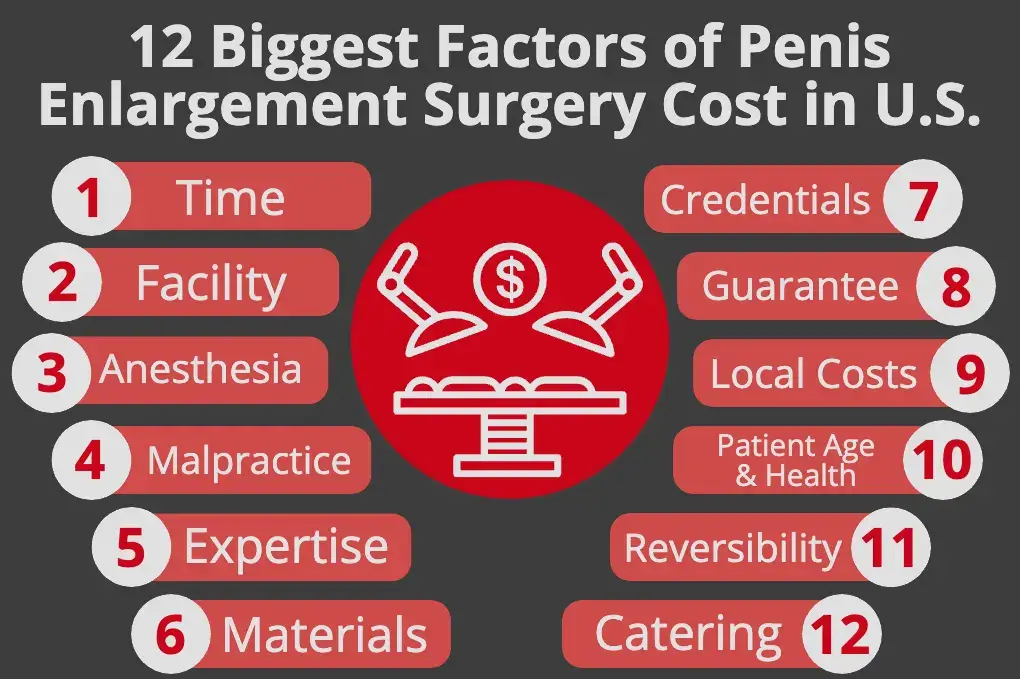
1. Time: The amount of time required to perform your procedure
The expected duration to perform your procedure is usually the biggest single cost determinant, as it directly affects the costs of your surgeon, anesthesiologist, facility use expenses, supporting surgical personnel, and related costs.
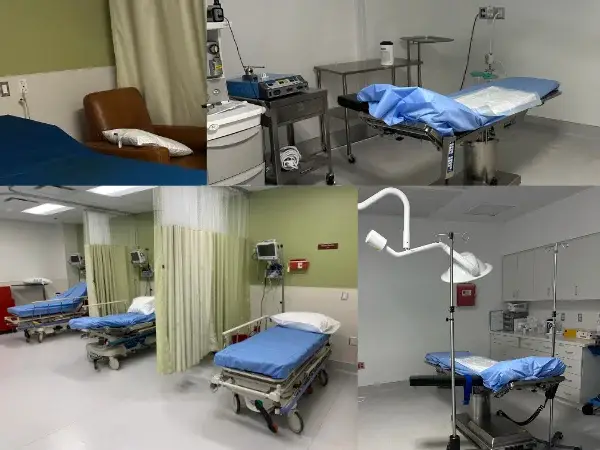
2. Procedure Facility
A professional facility obviously entails greater financial costs compared to the conversion of an old clinical examination room into a makeshift penile enlargement procedure space.
A quality procedure space will include everything from emergency backup power in the event of an unexpected power outage to room air that changes twelve times every hour to help ensure a germ-free environment, to ensure patient safety. Clinics that own their own procedure facilities are generally more affordable than those contracting with outpatient surgical facilities, although not always. Clinic-owned facilities also tend to rank higher for men concerned about privacy issues, particularly with celebrity patients.
Enlargement operations that require a hospital setting are the most expensive in terms of facility fees.
3. Anesthesia
The inclusion of anesthesia in your procedure will result in an increase in expenses. This often adds between $2,000-$5,000 to your procedure depending upon the time required to perform the procedure and the exact type of anesthesia used.
A patient’s personal health and history with anesthesia can have a significant impact on these costs.
4. Malpractice Insurance
Most patients probably assume every doctor carries malpractice insurance. However, there are enlargement clinics currently in operation in states like Florida where healthcare providers are not legally required to uphold malpractice insurance.
The aforementioned situation poses a clear risk to patients and has implications for financial expenditures.
5. Expertise Required
The degree of expertise required to perform a particular procedure has an impact on costs. Obviously, a minor medical procedure that can be performed by a physician’s assistant (PA) or a family practitioner (GP) will be cheaper compared to an alternative that requires the skills of a board-certified surgeon.
It is imperative to exercise caution regarding “self-described” surgeons who employ marketing jargon to inflate their level of expertise. A growing proportion of the penile enlargement repair procedures we perform are being performed on patients who erroneously believed that the provider they were appointing was a surgeon when, in fact, they were seeing an esthetician, general practitioner, or another less qualified professional.
The most prevalent indicator of these operators is their self-identification as “cosmetic surgeons,” given that the state medical boards do not recognize this particular licensed designation. The nomenclature originated among estheticians who were engaged in injectable cosmetic procedures. Many individuals in the general public often mistake the term “cosmetic surgeon” for a “plastic surgeon.” It’s because of this confusion that such individuals employ this moniker.
While this skimping on “expertise” might save you some money in the short term it can cost you dearly over the long haul.
6. Materials
With non-surgical dermal injectable procedures, the cost of FDA-approved dermal fillers can increase costs substantially. Any man-made item that’s swallowed, injected, or implanted into the human body requires FDA-approval or clearance. If any of these items are necessary for your enhancement procedure it will add to costs.
Some clinics advertise “permanent” injections using non-standard or poorly documented materials. Unapproved or undisclosed injected substances can increase the risk of long-term complications and make repair more complex and expensive. If a provider won’t clearly document what they’re using (product name, source/manufacturer, and traceability), that’s a significant red flag.
7. Credentials of Surgeon Performing your Procedure
A certain level of proficiency is necessary for all penile enhancement procedures. It is evident that a medical procedure that may be performed by a physician’s assistant (PA) or a family practitioner (GP) will be lower priced compared to an alternative that requires the expertise of a board-certified surgeon. Specialty fellowship-trained surgeons usually cost the most.
8. Guarantee
In general, clinics that offer a guarantee with penile enlargement treatment outcomes tend to impose greater fees compared to those that do not provide such assurances.
9. Local Operating Costs
Operating costs for clinics and surgical facilities can vary greatly by state and municipality. The variations in rental expenses, labor costs, supply expenditures, and medical laws across different states and cities significantly impact the cost to deliver healthcare services.
10. Patient Personal Health History and Age
The age and personal health history of a patient are factors that can influence their eligibility for a safe and affordable outpatient ambulatory operation, hence potentially affecting associated expenses.
Performing procedures that are mandatory in a hospital significantly increases expenses.
11. Reversibility: Risks, Costs
Patients should develop a thorough understanding of the risks associated with achieving a reversible state, as well as the understanding surrounding the financial implications involved in the process of reversing a problematic procedure.
We strongly recommended that those considering a penile enlargement operation visit the “Consumer Reports of Penis Enlargements,” AKA “The Phalloboards”, to get real world insights about any potential problems and issues with reversibility for any procedure you are considering.
12. Patient Catering & Care
The incorporation of post-operative nursing care and transportation after an enlargement procedure will increase the total costs for a procedure.
Some clinics offer such services ala carte, but most are rather expensive. Patients are encouraged to bring a loved one or friend to help with post-procedure care and lower costs.
Does health insurance cover the cost of penis enlargement surgery in the US?
Penile enlargements are not covered by health insurance
In general, cosmetic penile enhancement is not covered by insurance. However, certain procedures that address function (for example, severe buried penis with hygiene or urination problems) may have coverage components depending on diagnosis, documentation, and plan rules. If coverage may apply, your care team can advise what documentation is typically required.
Financing is available to cover the cost of penis enlargement surgery
Financing is available for penile enhancement procedures, however, the available amounts and terms are dependent upon your credit history and rating.
To get the cost of most procedures fully covered by financing, a patient must usually have a credit score of above 720 and not be maxed out on credit utilization.
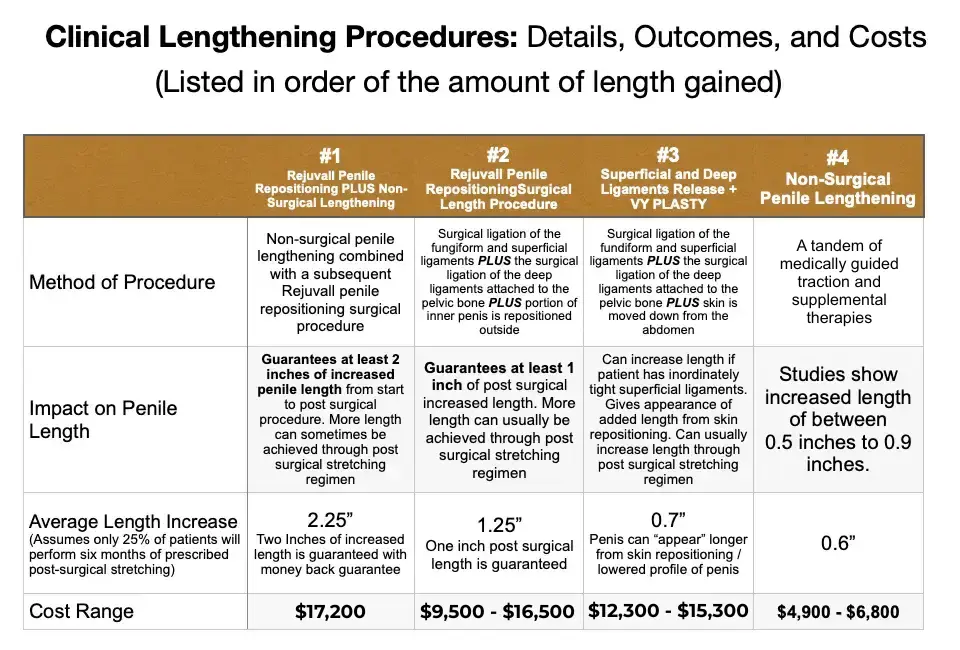
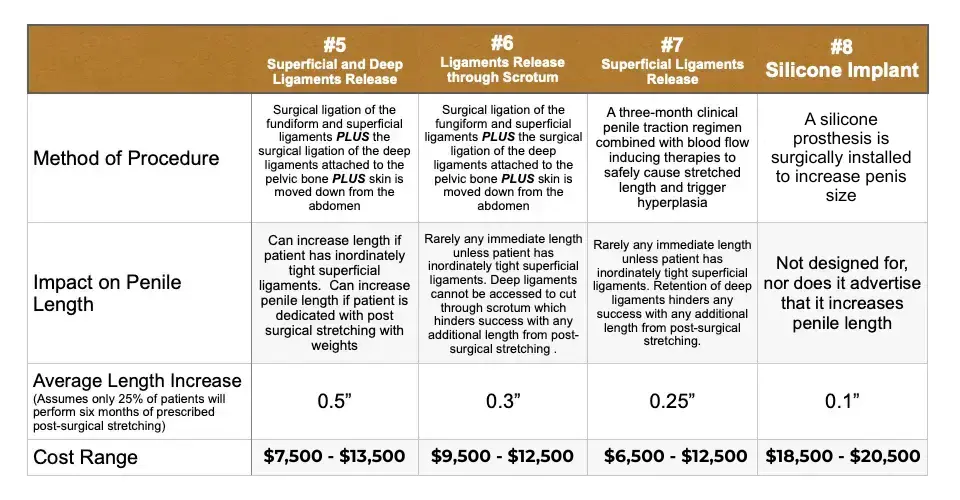
LENGTH: Penile enlargement procedures comparison chart
AFFORDABILITY
What are the most affordable medical penis enlargement procedures?
Non-surgical enlargements are almost always the most affordable enlargements, at least at the onset. They eliminate the costs for anesthesia and reduce surgeon, staffing, and facility costs.
They are often a great way to start your experience with male enhancement. However, because of the lower cost to provide such services they’re also a haven for some horrid scams in penile enlargement. As discussed previously, we strongly recommend each patient do some research reading at the Consumer Reports of Penis Enlargement: The Phalloboards.
Advantages and Disadvantages of a Non-Surgical Penis Enlargement Procedure
Advantages
For men who prefer minimal downtime or want a more reversible starting point, non-surgical options may be appropriate. In many cases, hyaluronic acid (HA) filler can provide a measurable girth increase with shorter recovery and without general anesthesia.
Some men also notice improved flaccid appearance after treatment, especially if they experience flaccid retraction related to temperature, stress, or blood-flow factors.
Disadvantages
The disadvantage of injectable filler is that it doesn’t increase penile length and it’s not well suited for some patients discussed previously. Rejuvall offers a non-surgical penile lengthening procedure, but that adds more cost and time to your journey. Non-surgical lengthening is not as simple and easy as non-surgical girth injections.
Additionally, while its entry cost is lower it can end up costing as much or more than penis enlargement surgical options.
Some men are not good candidates for non-surgical injections
As mentioned earlier, non-surgical penis enlargements almost always provide the most affordable entry point for penis enlargement. We say “almost” because some men will not receive a good or affordable outcome with this path, including:
- Men with an engorged suprapubic fat pad above the base of the penis: If your penis gets notably longer when you “press down” at the base of the penis, you might be suffering from GEFP. If you get an injectable penis filler starting from such a condition, your penile length often goes from “small” to tiny.
- Men with a Micropenis diagnosis. Men with a micropenis diagnosis (3″ or less when erect) almost always end up appearing even smaller if they start with injectable filler. They should start with lengthening.
- Men who are starting with an endowment of 7″ or more can get a non-surgical enlargement, but it’s usually rather expensive to receive a notable size improvement, because of their starting dimensions.
How much injectable filler will you need for a non-surgical enlargement?
Lots of men start their penis enlargement journey with injectable filler procedures just as women usually begin with facial fillers before scheduling any full plastic surgery.
Injection enhancements offer a path to first “test drive” a penis enlargement before investing in a full-blown surgical operation.
Most men who explore injectable non-surgical penile enlargement begin by wondering how much filler will be required to achieve the increase in size they seek.
Following is a link to tables that will educate you on the amount of filler you will need depending upon your existing endowment and increased size goals.
What steps can a patient take to reduce the cost of penis enlargement surgery?
If you’re wanting increased size down below but you’re packing a BMI over 35 and your available budget is $5,000, you’re not going to find viable solutions. However, you can find someone who will tell you what you want to hear and end up worse off than you were before. Your best option in such an instance is to invest some of your savings with a personal trainer or join a gym for more exercise and an improved diet that will eventually open up more affordable options.
If you want all-natural, life lasting penile thickness or increased length but are currently smoking two packs of cigarettes a day, now is a good time to quit smoking. FYI: you can keep smoking cigarettes with non-surgical, injectable dermal fillers for increased girth.
In other words, study up on procedures and find the one that’s going to deliver what you want and need. Then, take the steps now that will make the procedure results even better and more affordable for when you’re ready to pull the trigger.
Are you a good candidate for penis enlargement surgery?
One of our experienced case consultants will gladly assist you in obtaining the answers you require. He’ll answer all of your questions and affirm that you’re a good fit for whichever path you want to take.
Following that, we’ll schedule you for an online urologic examination with our surgeon. The vast majority of men complete this step by using the same secure HIPAA-compliant Telehealth platform that we use to treat urologic clinical patients.
PENIS ENLARGEMENT SURGERY COST WARNING
Not doing your homework can result in your penis enlargement costing a fortune
Remember when we earlier discussed how crucial it is to do your homework before scheduling any penile enlargement surgery?
If you’ll recall, we mentioned you should visit The Phallobaords, the web’s only patient-driven discussions about penis enlargement surgery and surgeons. Rejuvall® surgeon Kenneth J. Carney, MD. PHARM, FACS of is one of only a few reconstructive urologists who’s completed the specialized fellowships required to earn the title of “penile plastic trauma surgeon.” Thus, we see more cases of “penile enlargements gone bad” than most.
Following is a true case study of a patient who didn’t start by doing his homework.
A $100,000 Outcome From a “Low-Cost” Start (Case Example)
Stories like this can sound exaggerated — but cost escalation is a real pattern in elective penile enhancement when a procedure goes poorly and the original provider cannot (or will not) support a clear repair pathway.
To protect patient privacy, the details below are presented as a case example based on a real repair trajectory we commonly see: a lower-transparency initial procedure, followed by complications, revisions, imaging, and staged repair care. Exact totals vary by region, severity, travel needs, and insurance benefits — but the cost “stacking” is what matters.

How could someone end up spending over $100,000?
It often starts with a procedure that looks affordable up front, followed by common add-on costs that appear when things don’t heal as expected.
1) Initial procedure (elsewhere)
Procedure fee: $16,000
Travel + lodging: $1,000
Subtotal: $17,000
2) Early complication and urgent evaluation
(Examples: infection, severe swelling, pain, wound issues)
Emergency department visit: $5,500 (example split: $1,200 out-of-pocket + $4,300 insurance)
Running total: $22,500
3) First revision attempt with the original provider
Revision procedure: $3,000
Travel: $1,000
Subtotal: $4,000
Running total: $26,500
4) Removal / “reversal” step when symptoms persist
Removal/reversal fee: $2,000
Travel: $1,000
Subtotal: $3,000
Running total: $29,500
5) Reconstructive urology evaluation + imaging to identify the problem
(Examples: in-office exam + duplex Doppler ultrasound to assess plaque/fibrosis, scarring, and blood flow)
Office + ultrasound testing + travel: $2,400
Running total: $31,900
6) Treatment planning and staged repair care
Depending on findings, men may require a combination of:
- device-based treatment costs (out-of-pocket): $4,700
- device-based treatment costs (insurance example): $19,700
- intralesional medication injections (example totals): $18,500
- travel for follow-up visits / treatment weeks: $7,100
Example subtotal for this phase: $54,700
Running total: $86,600
7) Surgical scar-tissue removal / revision procedure
Procedure fee: $8,000
Travel: $1,000
Subtotal: $9,000
Running total: $95,600
8) Optional restoration step (when clinically appropriate)
Some men later pursue a separate procedure aimed at restoring lost visible length after healing and stabilization.
Example restorative length procedure: $9,800
Running total: $105,400
The takeaway
The point of this example isn’t that every complication becomes a six-figure event — it’s that the cheapest starting price can become the most expensive path when you add:
- emergency care,
- revision attempts,
- travel,
- imaging and diagnostics,
- staged repair treatment,
- and secondary surgeries.
If you’re comparing providers, don’t just ask “What’s the price?” Ask:
- What exactly is being done, with what materials?
- What documentation will I receive (product name, lot number, operative note if applicable)?
- What is the complication plan — and who manages it?
- What does revision care look like, and what does it cost?
Doing this homework up front is one of the most reliable ways to protect both your health — and your total spend.
FAQs About Penis Enlargement Surgery Cost
Most men will see price ranges from $3,000 to $40,000+ depending on the exact approach. Some “entry-level” options are lower-cost, while complex combined procedures and cases requiring anesthesia/facility time can be much higher.
Because “penis enlargement” isn’t one procedure. Total cost changes based on:
- Goal (girth, visible length, both)
- Setting (office vs. accredited surgical facility vs. hospital)
- Anesthesia type and duration
- Materials used (filler, fat processing, grafting, implants)
- Provider credentials and revision capability
- Aftercare plan and follow-up needs
Common add-ons that push real-world totals higher include:
- Anesthesia fee (often a major add-on when required)
- Facility fee (OR time, staffing, equipment)
- Medical clearance/testing (labs, EKG, pre-op evaluation)
- Medications (antibiotics, pain control)
- Follow-up visits and post-op care
- Travel/lodging for out-of-town patients
- Time off work and recovery logistics
Many advertised prices highlight only the surgeon/procedure fee. Your total cost may include separate line items for:
- facility/OR
- anesthesia provider
- supplies/materials
- pathology/labs (when applicable)
- post-op care
A transparent clinic will list what is included vs. billed separately.
Often, yes at the start because they typically avoid anesthesia and a surgical facility. But some non-surgical paths can cost more over time if they require maintenance sessions or if a patient ends up needing correction/repair due to poor technique or poor product documentation.
“Cheap” becomes expensive when the original approach creates problems like:
- infection or inflammation
- contour irregularity/lumps
- scarring/firmness
- pain or functional issues
- undocumented or misrepresented materials
Those issues can trigger a cascade of added costs (urgent care/ER, imaging, medications, revision surgery, travel, time off work).
Revision costs vary widely based on severity, but the big drivers are:
- surgeon time and complexity
- facility/anesthesia needs
- additional materials
- multiple stages (more than one procedure)
- travel and recovery time
Even “minor” fixes can add thousands; complex repair pathways can add much more.
Purely cosmetic enlargement is typically not covered. In some cases involving functional problems (for example, certain buried penis repairs), insurance may cover parts of care depending on diagnosis and documentation—but coverage is highly case-specific.
Many clinics offer financing, but approval and limits depend on the lender and your credit profile. It’s important to compare the true financed total (interest + fees), not just the monthly payment.
Price alone isn’t the best filter. Better value usually looks like:
- clear inclusion list (what your quote includes)
- documented product/material verification
- defined complication plan (what happens if something goes wrong)
- realistic outcome counseling
- provider training aligned with penile anatomy and downstream management
The safest cost-control strategies usually include:
- getting medically evaluated first (avoid the wrong procedure)
- optimizing health factors that increase complication risk (smoking, A1C, weight/BMI when relevant)
- choosing a staged plan when appropriate
- avoiding clinics that won’t document product/materials or aftercare
Ask for:
- an all-in estimate (surgeon + facility + anesthesia + materials)
- what’s included in follow-ups
- revision policy (what’s covered vs. new charges)
- product documentation (brand/lot/traceability when applicable)
- what happens if you have a complication while traveling home
SCHEDULE YOUR CASE CONSULTATION
Are you a good candidate for penis enlargement surgery?
Schedule your free case consultation and find out
One of our experienced case consultants will gladly assist you in obtaining the answers you require. He’ll answer all of your questions and affirm that you’re a good fit for whichever path you want to take.
Following that, we’ll schedule you for a urologic examination. Many men complete this step by using the same secure HIPAA-compliant Telehealth platform that we use to treat urologic clinical patients.
If the Cosmetic Urology Assessment form doesn’t appear above, click here to open it in a new window.
Do you lose feeling in your Penis after enlargement surgery
While loss of sensation can be a potential complication after surgical penile enhancement, we have never had one of our patients lose feeling after surgery.